(Bloomberg) — Yes the market got shanked Thursday, and yes Mark Zuckerberg just saw his personal wealth reduced by an amount roughly equal to Consolidated Edison. But none of it amounted to a repudiation of risk-taking at the peak of earnings season.
Quite the opposite.
For all the ink spilled as the former Facebook fell Thursday, moves in equity volatility indexes — proxies for investor nerves — were relatively contained, particularly compared with past blowups.
Gains in the price of bearish options on the biggest tech ETF were similarly muted — a sign that bulls kept their cool and had purchased hedges before the Meta Platforms Inc. massacre.
Amazon.com Inc., whose price hike for its Prime subscription service was cheered by investors, is poised to restore a rally that was disrupted by Meta’s debacle.
Amazon surged in extending trading after the online giant’s profit beat expectations, helped by the cloud-computing division. Shares of Invesco QQQ Trust Series 1 (ticker QQQ), the biggest ETF tracking the tech-heavy Nasdaq 100, jumped almost 2% in after-hours trading.
“Overall, the mega-tech companies did exceptionally well,” David Katz, president and chief investment officer of Matrix Asset Advisors, said by phone.
“They had sold off prior to their earnings and many of them have started to rally post-earnings. For companies like Microsoft and Google and Apple and Amazon, that will hold. We think their very strong earnings season sets a much better tone for them.”
While history will no doubt remember this earnings season for Meta’s 26% collapse, its plunge was an outlier among the biggest of big tech — in terms of direction, anyway.
The Faang block’s other main constituents all posted sizable post-result swings, and all of them were gains. Alphabet Inc. soared 7.5%, Apple Inc. climbed 7% and Microsoft Corp. saw an initial 10% drop morph into a 2.9% gain.
In each case, the amount of market value added numbered in the tens of billions of dollars.
Since Microsoft’s shares reversed their loss on the evening of Jan. 25, the Nasdaq 100 exchange-traded fund is up about 7%.
“FB is clearly not representative of what’s going on in the broad market, where earnings are still strongly beating expectations and forward forecasts for revenue growth still rising,” said Gina Martin Adams of Bloomberg Intelligence.
“It also confirms a breakup of the concept of Faang as a theme in general,” she added. “Clearly these are companies with very different business models and that shows in earnings results this season.”
Read: Goldman Touts Options Trade Netting 15% on Wild Earnings Days
The string of robust results from the Faangs is the latest evidence that while a hawkish Federal Reserve can still treat the market to anxiety-inducing quakes, the jury is still out as to whether central-bank policy alone will be enough to overwhelm the countervailing force of rising profits.
It’s a lesson worth heeding for many who are betting that the glory days are likely over for the pandemic-era safety trade in large-cap equities.
From long-only funds to professional speculators, tech shares are out of favor, with institutions having cut allocations to lows unseen since the financial crisis. Short sales are on the rise, and demand for puts have stayed elevated.
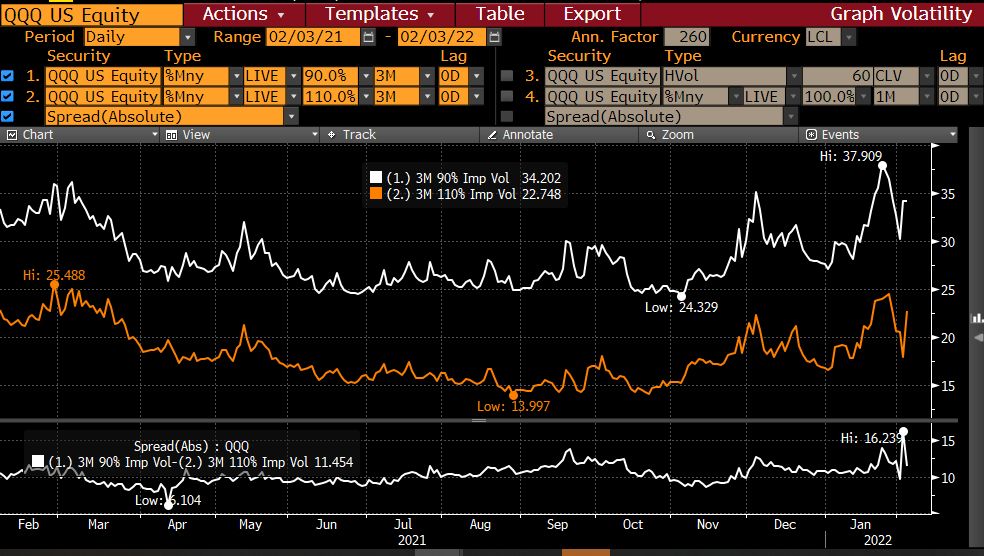
Such sentiment explains why the price of bearish options on the biggest tech ETF held relatively firm during Thursday’s regular-session bloodbath. The skew of three-month QQQ puts betting on a 10% decline fell relative to calls wagering on a comparable gain, with the spread narrowing by roughly 5 points to 11.5.
The CBOE NDX Volatility Index, a gauge of option costs tied to the Nasdaq 100, rose less than 2 points to 31.24, while the tech-heavy measure tumbled more than 4%. Historically, when the cash measure posted a drop of this size, the volatility index added almost 5 points, on average.
Before Facebook’s fallout, almost $1 trillion were added to the total value of Faang stocks as the group surged 10% over six days, buttressed by better-than-expected earnings.
“What drives companies is earnings and revenue growth,” said Chad Morganlander, senior portfolio manager at Washington Crossing Advisors.
“And the names that have held up rather well have shown this quarter to have sturdy and vibrant attributes.”
Last week, Microsoft’s forecast on its Azure cloud-computing business soothed investor concern about a slowdown and Apple demonstrated the company’s ability to navigate a difficult supply environment.
Google on Wednesday added to the latest evidence of Faang resilience, posting a surge in advertising revenue.
Many tech stocks “can’t keep up with the high multiples that people had already priced in.
At the first hint of weakness — bam! — investors headed for the exits and sold aggressively,” Adam Sarhan, chief executive of investment advisory service 50 Park Investments, said in an interview.
“The only reprieve to the bullish side of the equation is Apple, Microsoft and Amazon, which have helped hold up the market.”
Their strong showings reawakened fear of missing out.
“We’re seeing a little bit of FOMO,” Alon Rosin, Oppenheimer & Co.’s head of institutional equity derivatives, said by phone.
“All of a sudden, everyone’s seeing the numbers are good, ‘I’ve got to get my exposure back,’ and that’s what we’re seeing in the after-market moves.”
More stories like this are available on bloomberg.com
©2022 Bloomberg L.P.