(Bloomberg) — Russia faces further sanctions following its recognition of two breakaway regions in eastern Ukraine. President Vladimir Putin says he remains open to “diplomatic solutions” but insists Russia’s interests and security must be guaranteed.
The European Union applied sanctions to 23 high-ranking Russians while U.S.
President Joe Biden is targeting the builder of the Nord Stream 2 gas pipeline that runs from Russia to Germany.
Ukraine said banks and ministry websites suffered another cyberattack on Wednesday.
Kyiv is seeking to declare a nationwide state of emergency which could see officials impose restrictions on movement for at least 30 days.
Key Developments
- Biden’s First Round of Russian Sanctions Fail to Shock
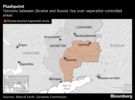
- A Visual Guide to the Tensions Around Russia and Ukraine
- Germany Says It Can Do Without Russian Gas.
That’s a Tall Order
- What’s at Stake for Global Economy as Russia Standoff Escalates
- Russian Markets Reeling, With Ruble Record Low in Sights
All times CET:
U.S.
Sanctions Russia-to-Germany Pipeline (7:59 p.m.)
Biden announced that the U.S. is sanctioning Nord Stream 2 AG, the company behind a key gas pipeline from Russia to Germany, as well as the company’s leadership.
The decision came after Germany announced it would halt certification of the pipeline.
“Through his actions, President Putin has provided the world with an overwhelming incentive to move away from Russian gas and to other forms of energy,” Biden said in a statement.
While the U.S.
has long opposed the Nord Stream 2 pipeline, sanctions targeting the project only appeared late in the Trump administration, after the conduit was largely complete. The U.S. for years argued that completion would make Europe more dependent on Russia energy, undermining the continent’s security objectives.
EU Sanctions Target Media, Banking, Government Figures (7:35 pm)
The EU sanctions made final Wednesday target 23 people including banking executives, military chiefs, media figures and a top Kremlin official over Russia’s actions in Ukraine.
The bloc included on its list state television presenter Vladimir Soloviev, Foreign Ministry spokeswoman Maria Zakharova and the head of Kremlin-backed media outlet RT, Margarita Simonyan, according to officials familiar with the names.
The sanctions against prominent Russian media figures come after the EU accused Moscow-linked outlets of spreading disinformation about Ukraine.
Kremlin Chief of Staff Anton Vaino and Defense Minister Sergei Shoigu were also penalized, the officials said, but those steps are more symbolic since they usually travel abroad only on state business using diplomatic passports.
Russia Standoff Poses New Challenge for Global Economy (7 p.m.)
The tensions with Russia pose new risks for the global economy as it recovers from Covid-19.
Limited sanctions unveiled by the U.S.
and Europe so far are unlikely to derail the recovery but soaring energy prices are adding to inflationary pressures already worrying central banks. Tighter sanctions or other supply disruptions could wreak havoc with global supply chains.
Europe stands to be hardest hit.
Russia is a commodities powerhouse and the main supplier of energy to Europe, and the crisis over Ukraine is already prompting economists to revise down their growth projections for this year.
U.S Plans More Russia Sanctions as Soon as Wednesday (6:11 p.m.)
The U.S.
sanctions are expected to hit Nord Stream 2 AG, the company that built the $11 billion natural gas pipeline connecting Russia and Germany, according to people familiar with the matter. That would follow Berlin’s move Tuesday to halt certification of the project and complicate any future effort to bring the pipeline online.
The new U.S.
penalties on additional members of Russia’s elite would expand the list of those within Putin’s inner circle facing restrictions on where they can do business and travel.
U.S. Says Latest Ukraine DDOS Attack Consistent With Russia (6 p.m.)
The attack was similar in nature to a distributed denial-of-service outage at Ukrainian banks last week that the U.S.
attributed to Russia, the White House said in a statement. It said it had been in touch with Kyiv to offer assistance, including to determine who was responsible.
European Stocks Close Lower (5:36 p.m.)
European stocks ended the day lower as U.S.
equities continued to extend losses amid rising tensions with Russia over the Ukraine standoff. The Stoxx Europe 600 fell 0.3% while the S&P 500 declined 0.7%, erasing earlier gains on positive sentiment that Western sanctions on Russia were initially limited.
“There was some optimism among investors we spoke to as the White House’s Russia sanctions were not as sweeping as originally expected, but our sense is that this saga is far from over and most of our contacts expect both additional sanctions in the days ahead as well as a targeted legislative package,” wrote BTIG’s Isaac Boltansky.
Fears the Ukraine tension could snarl commodity supplies bolstered everything from energy to wheat and nickel.
Oil resumed a rally with Brent crude reaching $98 a barrel. Gold climbed. Meanwhile, the CBOE Volatility index, or so-called fear gauge, climbed to the highest since late January.
EU to Hold Emergency Summit on Ukraine (4:25 p.m.)
Leaders will hold an emergency summit in Brussels Thursday to discuss the situation in Ukraine.
European Council President Charles Michel, who chairs the meetings, said they’ll discuss latest developments and how to hold Russia accountable for its actions.
The EU’s leaders will discuss trigger points for potential future sanctions against Russia, according to two officials familiar with the plans who asked not to be identified because the preparations are private.
The EU has a broader package of sanctions prepared in the event Moscow escalates further.
Link to EU announcement on sanctions
Stock Erase Gains on Cyberattack (4:20 p.m.)
U.S.
and European equities erased gains after Ukraine said several government and bank websites had been subject to a cyberattack.
The S&P 500 and Stoxx Europe 600 were little changed after each had gained more than 0.9% earlier in the session.
The yield on the benchmark 10-year Treasury note rose to nearly 2%. Meanwhile, oil extended gains with Brent crude reaching almost $99 a barrel.
Banks, Government Sites Hit by DDOS Attack (4:07 p.m.)
The government confirmed an Interfax report that its websites came under attack.
Several government websites as well as some banks faced a DDOS attack around 4 p.m.
local time, the Minister of Digital Transformation Mykhailo Fedorov said on social network Telegram.
Ukraine has faced two waves of cyberattacks since late January. The most recent, last week, hit the country’s largest banks, which restored operations in full within a few hours.
The Feb. 15 DDOS-attack was the largest in Ukraine’s history and the U.S and the U.K said Russia was behind it.
Cyberattack on Ukraine Government Sites Reported (3:50 p.m.)
Several Ukrainian government websites including those of the Cabinet of Ministers and the parliament suffered cyberattacks Wednesday, according to news agency Interfax.
It didn’t say anything about the source.
The web pages of ministries including the Foreign Ministry and the Defense Ministry are either temporarily out of order or are not operating smoothly.
The respective press offices acknowledged problems with the sites, but didn’t elaborate on the reason.
Russia’s Dollar Bonds Can’t Escape Blow of EU, U.S. Sanctions
EU Bans Trade, Investments in Breakaway Regions (3:20 p.m.)
The European Union will ban the import of goods coming from the Donetsk and Luhansk regions.
Member states will also prohibit investments in entities and the acquisition of real estate in the breakaway territories in eastern Ukraine, according to the draft text of the EU sanction package adopted on Wednesday and seen by Bloomberg.
In addition, the bloc will ban exports to these regions in sectors from transport and telecommunications to energy.
Tourists won’t be able to travel there from member states or by using EU planes or vessels.
Zelenskiy Calls for Stronger Sanctions on Russia (3:10 p.m.)
Ukrainian President Volodymyr Zelenskiy said he expects international sanctions on Russia to be strengthened and praised Germany’s decision to halt the Nord Stream 2 gas pipeline from Russia.
“It must become irreversible,” Zelenskiy told a press conference in Kyiv alongside his Polish and Lithuanian counterparts. “We expect further steps to increase sanctions pressure.”
Zelenskiy said he cannot predict what next steps Russia and Russia-backed separatists will take, but added that he relies on the Ukrainian army.
“We are ready for everything,” he said.
ECB Stress Tests Banks’ Exposure to Russia (2:45 p.m.)
The European Central Bank is telling lenders active in Russia to report on the risks they face from a range of diplomatic and military scenarios related to Moscow’s tensions with the West over Ukraine, according to people familiar with the matter.
The Frankfurt-based ECB is working with banks to assess risks to their liquidity, loan books, trading and currency positions as well as their ability to keep operations running, said the people, who asked to remain anonymous as the discussions are private.
The regulator, in touch on a daily basis in some cases, wants lenders to assess scenarios including severe economic sanctions as well as the real-world consequences of an invasion, they said.
ECB Stress-Tests Banks’ Russia Exposure as Putin Pushes Ukraine
Western Banks That Stayed in Russia Face a Test (2:15 p.m.)
Lenders who maintained operations in Russia after the 2014 annexation of Crimea – enticed by the profit even as many peers fled the scene – now face a test after Putin’s moves this week ratcheted up tension and drew fresh punitive measures.
Italian and Austrian lenders have actually increased business in Russia since 2015, according to data from the Bank for International Settlements compiled by Bloomberg Intelligence.
France’s Societe Generale SA, Italy’s UniCredit SpA and Austria’s Raiffeisen Bank International AG are the European banks with the biggest Russian operations.
EU to Ban Russian Bonds in Sanctions Package (12:20 p.m.)
The EU is set to ban the purchase of Russian government bonds as part of proposed sanctions on Moscow.
The measures will prohibit the purchase or sale of “transferable securities and money-market instruments issued” by Russia, its government, the Russian central bank or entities acting on the latter’s behalf, according to draft documents seen by Bloomberg.
The move is in line with measures unveiled earlier by the U.S., and it’s not clear how big of an impact it will have on Russia, which is benefiting from high energy prices and a high volume of foreign currency reserves.
More stories like this are available on bloomberg.com
©2022 Bloomberg L.P.