(Bloomberg) — Any policy signals on China’s battered property and tech sectors will be keenly watched by equity investors as they turn their focus to the nation’s top political meeting that starts Saturday.
Relief for the real estate sector, which has been dragged by slumping sales and an unprecedented cash squeeze, will be on the top of the agenda for traders.
They’ll also be on the lookout for any further fallout from the yearlong crackdown on the nation’s tech sector.
The timing of the National People’s Congress comes as China’s economic outlook is cloudy at best.
Stocks onshore are still reeling from a $1.2 trillion market rout following regulatory curbs and as financial risks from the property sector continue to mount. Meanwhile, surging global inflation, a divergent U.S.
monetary policy and the war in Ukraine are further complicating decision making in Beijing.
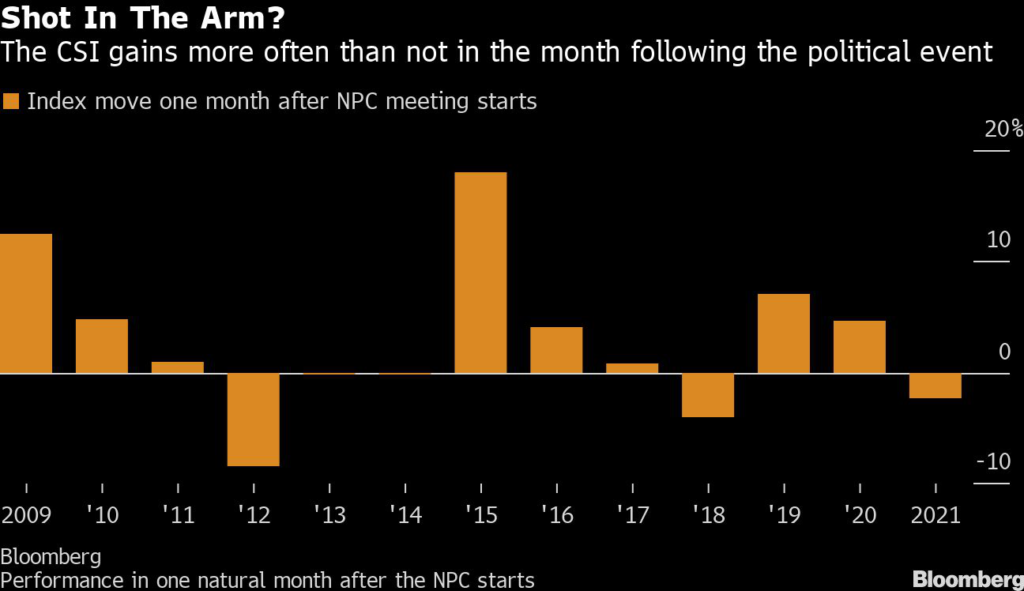
Still, many expect stability and even a bounce for equities, at least in the short term. China’s CSI 300 Index rose an average 2.6% in the month following the political gathering over the past 13 years, according to Bloomberg-compiled data.
Traders say that the event, where around 3,000 delegates meet in Beijing to set economic policies for the year, could be the much needed catalyst to spur sentiment
“Capital market performance around the meetings could be relatively positive, and a bottom for earnings growth may emerge as early as the first quarter,” wrote China International Capital Corp.
analysts including Wang Hanfeng in a Feb. 27 note. Investors should monitor fresh signals on monetary policy, fiscal spending, tax reduction, affordable housing and infrastructure investment, they added.
Here are the key areas to watch:
Property Woes
Investors are grappling with whether Beijing will loosen its grip on the property sector.
In recent weeks, authorities have pushed banks to lower mortgage rates and cut down payments for home buyers. At the same time, officials also warned against speculation, suggesting they don’t want to see another surge in home prices.
UBS AG economists including Ning Zhang said the NPC may offer more reprieve for the industry, including a targeted approach to local property easing and possibly delaying the implementation of a property tax.
While distressed and typically smaller developers may continue to struggle, such policy fine-tuning is expected to benefit their larger and financially healthier peers such as Poly Developments and Holdings Group Co.
(+9.5% YTD), China Vanke Co. (+1% YTD in H.K.) and China Resources Land Ltd. (+16% YTD)
Big Tech
Beijing’s yearlong sweeping crackdown has erased some $1.5 trillion from the nation’s technology stocks, with the Hang Seng Tech Index trading at less than half the value of its February 2021 peak.
The sector suffered another wave of selling last week, after an official call for food-delivery platforms to cut fees and warnings against metaverse-oriented fundraising rekindled concerns about how far the regulatory assault will go.
According to economists at Societe Generale SA, Beijing may feel the need to loosen its grip as the impact on employment of the tightened regulations is looking severe enough.
A softer tone on curbing the expansion of private capital may offer a much-needed boost to stocks such as Tencent Holdings Ltd.
(-5.5% YTD), Meituan (-23% YTD) as well as tech firms that have recently reported consensus-beating earnings like NetEase Inc. (-9.6% YTD) and Baidu Inc. (+10% YTD)
Digital Economy
China’s latest plan to build computing hubs and data center clusters is another big step in its pursuit of a digitalized economy and technological self-reliance.
The initiative is part of a concept of so-called “new infrastructure” and has already sent shares of service providers Nanjing Canatal Data-Centre Environmental Tech Co.
(+80% YTD) and MCC Meili Cloud Computing Industry Investment Co. (+126% YTD) soaring since the official announcement.
Some investors also view the ban on several Russian banks from using the SWIFT messaging system as aiding companies linked to China’s own cross-border payment system, including Brilliance Technology Co.
(+19% YTD) and Shenzhen Forms Syntron Information Co. (+30% YTD)
Infrastructure Spending
Traders hope that Beijing will resort to its old trick of building its way out of an economic slowdown.
A gauge of infrastructure stocks rallied to an almost three-year high last month, driven by bets on construction firms, telecom operators and waste treatment companies.
The government’s budget deficit target and any fresh instructions on local authorities to use sales of more special bonds to fund new projects will be closely watched.
Some of the best performers this year include Chongqing Construction Engineering Group Corp.
(+26% YTD), China Communications Construction Co. (+16% YTD in China) and ARTS Group Co. (-7.1% YTD), with investors watching if the trade still has legs.
Energy
As Beijing seeks to strike a balance between economic growth and ambitious environmental goals, traders are looking for signs of further relaxations on the use of traditional energy sources like coal while continuing to encourage developing greener solutions such as solar power.
As the overall policy focus is on growth, “a repeat of policy-driven power shortages as we saw in the third and fourth quarters will be quite unlikely this year,” Goldman Sachs Group Inc.
analysts including Maggie Wei wrote in a note.
A more tolerant stance may bode well for hydro and wind power generators, such as China Three Gorges Renewables Group Co. (-6.1% YTD) and China Power International Development Ltd.
(-15% YTD), according to China Galaxy Securities Co.
More stories like this are available on bloomberg.com
©2022 Bloomberg L.P.