(Bloomberg) — DoorDash Inc. reported revenue that beat analysts’ estimates, a sign that customers’ craving for the convenience of ordering online hasn’t abated even as indoor dining resumes.
Revenue rose 35% in the first quarter to $1.46 billion, the San Francisco-based company said Wednesday in a statement.
That was ahead of analysts’ average projection of $1.38 billion, according to data compiled by Bloomberg. The shares jumped 14% in extended trading.
“Our results speak to the resilience of the platform we’ve built,” Chief Financial Officer Prabir Adarkar said in an interview.
“This is despite the headwinds over the course of the past year, whether it’s inflation or people getting more comfortable living with Covid and going back out into restaurants.”
Consumers’ affinity for takeout was supercharged when coronavirus lockdowns shifted the dining experience from restaurants to the couch.
It was a boon for DoorDash, which was one of the first meal delivery services to conquer suburban markets, and set the stage for its initial public offering at the end of 2020. Since then DoorDash has only increased its market share, commanding 59% of all food delivery sales in the U.S.
as of March, according to Bloomberg Second Measure.
DoorDash said it added more new consumers in the first three months of the year than at any time since the first quarter of 2021, helping push members of its DashPass subscription service to new highs.
More people on DashPass also helped push up order frequency to a new high. Membership services have gained traction as a way to boost customer retention and increase basket sizes. The company had more than 10 million subscribers at the end of 2021.
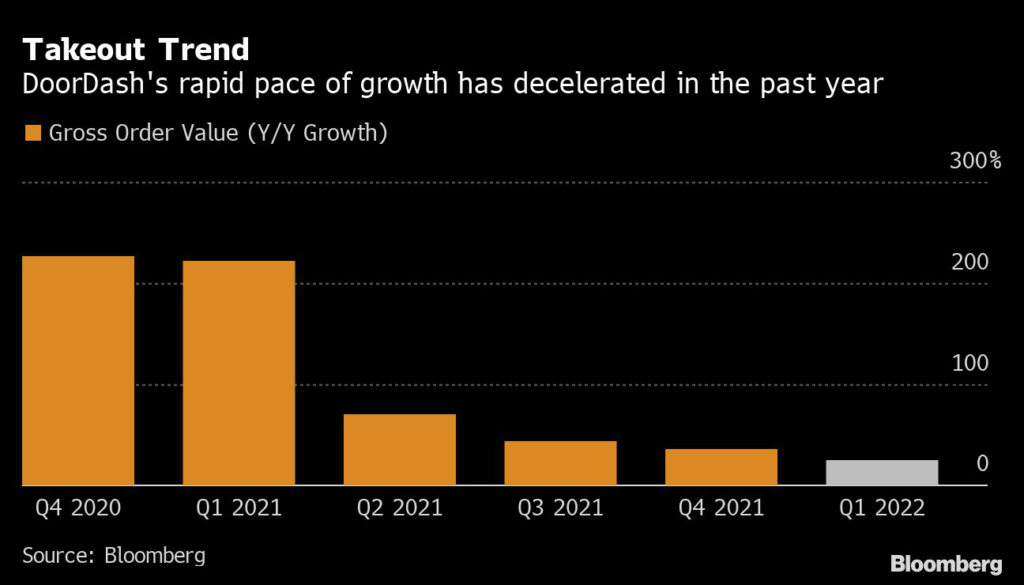
Customers placed 404 million orders in the three months ending March 31, representing a 23% increase from a year earlier.
People were also ordering more often and the value of those orders increased 25% to $12.4 billion. Wall Street expected $11.7 billion. The company projected gross order value of $12.1 billion to $12.5 billion in the current quarter and earnings before interest, tax, depreciation and amortization of $0 to $100 million.
DoorDash has expanded its services into grocery, alcohol and pet supplies to capitalize on a shift in consumer behavior and hedge against a deceleration in its pandemic-level pace.
While the company didn’t disclose figures for non-restaurant segments, the convenience category in particular has seen higher order frequency and growth in monthly users from last quarter, Adarkar said.
In November, DoorDash acquired Finnish food-delivery company Wolt Enterprises Oy for about $8.1 billion, its biggest purchase ever, in a bid to increase its footprint outside the U.S.
At the end of last year, DoorDash launched a 15-minute delivery pilot service in New York, joining rivals like Instacart Inc.
and Uber Technologies Inc. as well as a crop of startups led by Gorillas Technologies GmbH, Getir and Jokr, that are vying to ferry items to customers in record time.
San Francisco-based DoorDash reported a net loss of $167 million, wider than the $110 million loss a year earlier.
The loss per share was 48 cents, while analysts were expecting a loss of 42 cents.
Investors have grown more sensitive to the prospects for profitability of once-hot startups like DoorDash. The shares have fallen more than 50% this year and are down more than 70% from a record high last November.
“Growth companies like DoorDash have gotten a pass in the past and investors are very focused on the ability to deliver on the bottom line,” said CFRA analyst Angelo Zino. “The tension here is whether they can expand into new verticals and internationally without sacrificing profit.”
More stories like this are available on bloomberg.com
©2022 Bloomberg L.P.