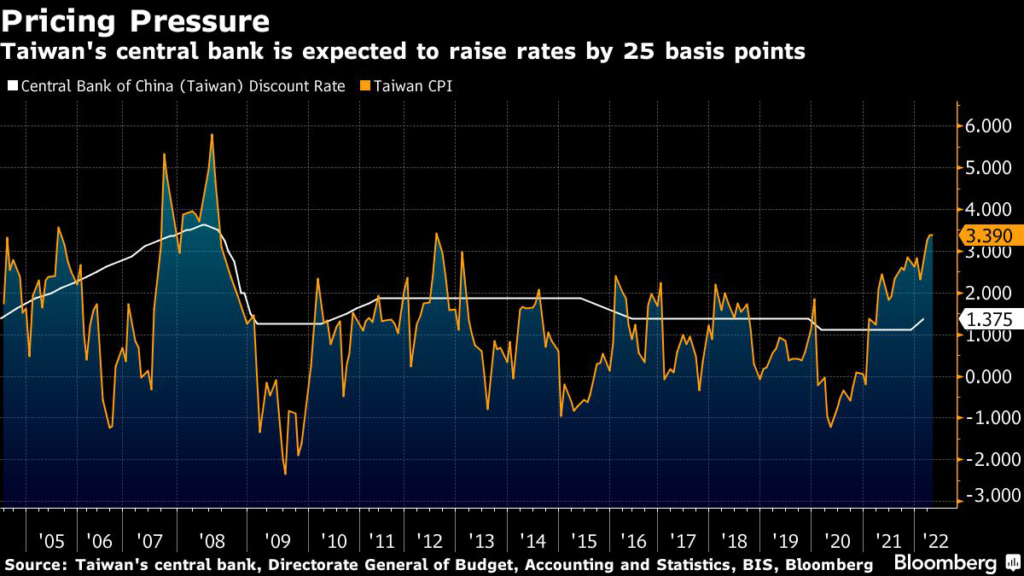
(Bloomberg) — Taiwan is poised to implement back-to-back interest-rate increases for the first time since 2011 as the central bank seeks to keep pace with the Federal Reserve and tame consumer prices expected to rise to their highest in more than a decade.
After springing a surprise rate hike of 25 basis points last quarter, policy makers in Taiwan are likely to increase the policy rate by the same margin to 1.625% on Thursday, according to 20 of the 25 economists surveyed by Bloomberg.
The rest see a hike of 12.5 basis points.
The central bank will likely reach 2% in the first quarter next year, with a move of 12.5 basis points in each of its subsequent meetings, according to economists.
Taiwan’s policy makers are joining their global peers in the rush to tighten policy faster than previously signaled amid mounting criticism central bankers were too slow to identify the risk of persistent high inflation.
The Federal Reserve raised interest rates by 75 basis points Wednesday, its biggest increase since 1994, in an effort to contain rampant inflation. Chair Jerome Powell signaled another big move is likely to come next month.
A widening gap between borrowing costs in Taiwan and the US could exacerbate downward pressure on the Taiwan dollar.
Taiwan’s central bank Governor Yang Chin-long has repeatedly said rates in the world’s major economies play a factor in the monetary authority’s decision-making process.
Taiwan’s benchmark Taiex stock index rose 0.49% as of 10:25 Thursday, its first gain in five days as the Fed’s move buoyed Asian shares.
The Taiwan dollar was largely unchanged.
If the Taipei-based monetary authority raise rates by 75 basis points this calendar year as economists expect, it would be the biggest annual jump in borrowing costs since the 2004-2008 cycle.
“While global semiconductor demand remains supportive, it is increasingly obvious that Taiwan will face a dilemma of decelerating economic growth and higher inflation,” said Gary Ng, senior economist at Natixis Asia in Hong Kong.
China’s lockdowns and the domestic Covid outbreaks have posed challenges for Taiwan to extend its growth trajectory in the short run, he said.
Economists see high prices as an increasingly severe problem Taiwan will have to contend with through the third quarter of 2023.
Inflation, which reached 3.39% in May, is forecast to average 3% this year, according to Bloomberg’s survey, well above the central bank’s traditional 2% comfort zone, before easing to 1.75% in 2023.
Growth Risks
In addition to inflation, Taiwan’s export-driven economy is facing multiple challenges to maintain last year’s strong growth.
Russia’s invasion of Ukraine and repeated Chinese Covid lockdowns has caused chaos to global supply chains at a time of sustained overseas demand for Taiwanese-made semiconductors. The first serious Covid outbreak at home has also dented sectors reliant on consumer spending.
Economists surveyed by Bloomberg cut their forecasts for Taiwan growth slightly for 2022 to 3.45% from 3.5%.
Citigroup Inc.
economist Adrienne Lui expects policy makers to limit Thursday’s rate hike to 0.125% as it tries to reduce the impact on smaller businesses.
“We believe the central bank is likely to factor into its policy rate calculus the impacts on SMEs who are less able to mitigate both operating cost pressures and Covid stresses, on the back of the scheduled June expiration of the NT$400 billion SME loan guarantee program and no other fiscal stimulus measures announced for this Covid round thus far,” Lui wrote in a note last week.
Fixed income and real estate are other sectors that will also be playing close attention to the central bank’s actions this week.
Traders will be looking to see if the authority raises its open-market rates by the same margin as the benchmark rate, given the direct impact it has on financial markets. Property developers and buyers meanwhile will be paying close attention to any central bank moves to further tighten its selective credit controls aimed at reining in housing prices.
(Updates with Federal Reserve’s rate hike starting in first paragraph.)
More stories like this are available on bloomberg.com
©2022 Bloomberg L.P.