(Bloomberg) — China’s local governments are caught in an unexpectedly severe budget squeeze, creating a dilemma for officials over whether to boost debt or tolerate weaker economic growth.
Maintaining the Covid Zero policy is both slowing the economy and also adding huge extra costs to government budgets, which have to pay for regular mass testing, quarantine hospitals, as well as food provision and other services during lockdowns in places like Jilin or Shanghai.
The mass-testing for Covid alone will add hundreds of billions of yuan, if not more, onto local authorities’ spending responsibilities beyond what was budgeted in early March.
Fiscal stress had been increasing even before the Covid spending pressures, with tax relief to businesses cutting government income and land sale revenue plunging because of a housing downturn.
The broad budget deficit ballooned to a record of nearly 3 trillion yuan ($448 billion) in the first five months of the year, official data showed on Thursday.
READ: China Budget Deficit Hits Record Due to Tax Rebates, Covid Pain
Authorities have two ways to deal with the revenue hole — borrow more or curb spending.
A weakening economy makes the latter option less appealing, meaning the government may be forced to leverage up further, either by issuing more official debt or by loosening the curbs on off-balance sheet debt.
Either one would mark a major setback to China’s efforts to deleverage.
If local governments don’t borrow more to pay for investment and stimulus, they could be forced to scale back spending in areas other than the fight against Covid, making the country’s annual growth target of around 5.5% even harder to reach.
“Since Beijing is less willing to expand central-government debt, it will probably also end up tolerating some further increase in hidden local debt” to pay for infrastructure spending, according to Gavekal Dragonomics analyst Wei He.
“This will make the long-term campaign to control local debt harder to manage but that is not the major concern for policymakers at the moment.”
Here is a look at some of the factors contributing to the financial woes faced by China’s local governments.
Covid Testing
China’s strategy of containing Covid relies on regular and repeated testing of the whole population around an outbreak and then isolation of those infected or exposed.
As outbreaks become more common with the highly transmissible omicron variant, more and more cities are telling residents to take regular nucleic acid tests to try and spot outbreaks quickly, with the costs so far borne by the public purse.
Around 814 million people, mostly urban dwellers aged between 5 and 64, could be covered by a Covid test mandate, according to Nomura Holdings Inc.
Assuming 70% of them take a test every two days, that will cost local governments 300 billion yuan a year, according to Lu Ting, the bank’s chief China economist.
That estimate is based on a per test cost of 3.5 yuan per person, and adds up to about 2.6% of budgeted local government general fiscal revenue this year, according to Bloomberg calculations.
Land Sales
Land auctions and property transactions have been hit hard this year, with Covid restrictions and lockdowns in cities like Shanghai and Beijing compounding already weak demand caused by the ongoing property crisis.
Consumers are also cautious about buying homes due to concerns about the future and worries that debt-laden developers’ may not deliver projects or could go bankrupt.
That pessimism and retrenchment means developers aren’t buying land from local governments.
Land sales in 50 key cities tracked by China Real Estate Information Corp. sank 70% from a year ago in May. That’s better than the record 78% dive in January, but still represents a fifth straight month of declines.
Tax Rebates
In an attempt to counter the economic slowdown, the Chinese government started returning some previously collected taxes to companies in April.
It had returned 1.34 trillion yuan through the end of May, figures from the Ministry of Finance showed.
That refund was equivalent to 54% of the 2.47 trillion yuan in the country’s total general fiscal revenue earned in the two months, according to Bloomberg calculations based on government data.
However, the impact of tax rebates could be temporary, given that officials have said they want to complete returns for small companies and manufacturing firms by the end of this month so that businesses can benefit sooner.
Debt Risks
Rising debt is an issue in China and around the world, and Beijing is trying to make sure that local governments don’t take on more debt than they can manage, bring off-balance sheet debt back onto their books, and use the money productively.
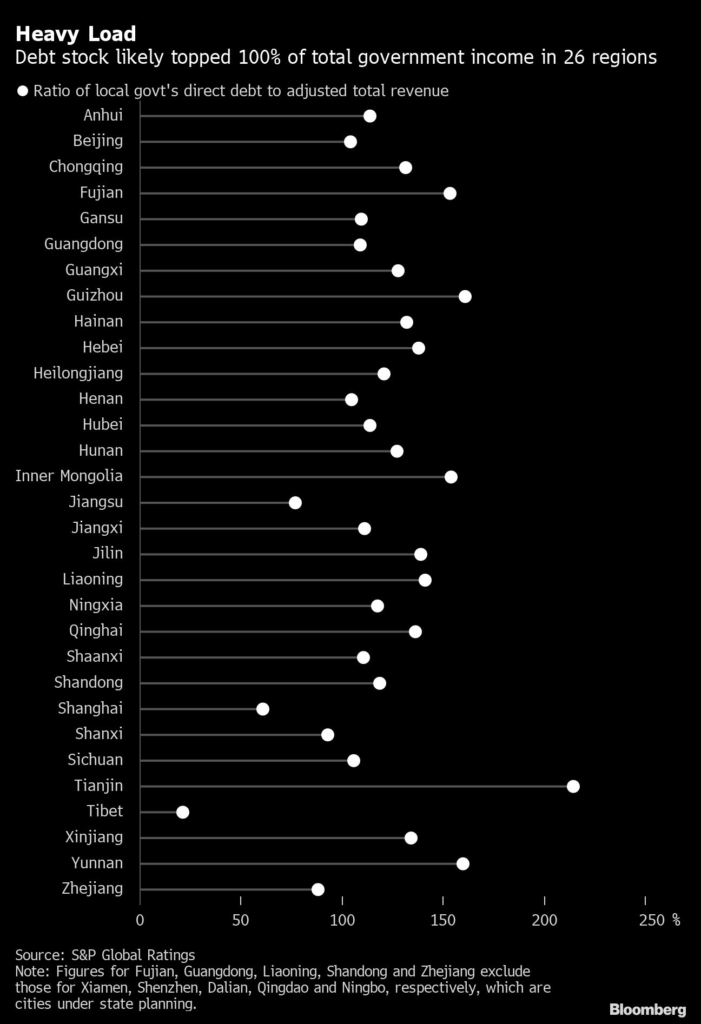
Even so, at the end of April 26 of 31 provinces had official debt worth more than 100% of their total 2021 revenue, according to S&P Global’s estimates.
That was three more than at the end of 2021, showing how quickly the regions are borrowing money to support their economies.
The northern port city of Tianjin tops the list with debt amounting to more than twice its annual income, followed by Guizhou and Yunnan in the southwest, Inner Mongolia in the north and Fujian in the east.
Efforts to control rising debt may make it more difficult for the regions to spend as required.
That financial strain will likely become apparent in weaker regions first and hit them harder, increasing the possibility that towns and cities need to undergo what’s called “fiscal restructuring.”
“Would there be another Hegang?
We think it’s highly probable,” said Susan Chu, a senior director of S&P Global Ratings, referring to the first municipal-level government restructuring, which was revealed late last year. With China’s debt stock rising by 20% every year and interest expenses likely increasing at a similar pace, “the pressure of fiscal restructuring will emerge in smaller and poor areas this year and the next,” she said.
(Updates with record budget deficit in the third paragraph.)
More stories like this are available on bloomberg.com
©2022 Bloomberg L.P.