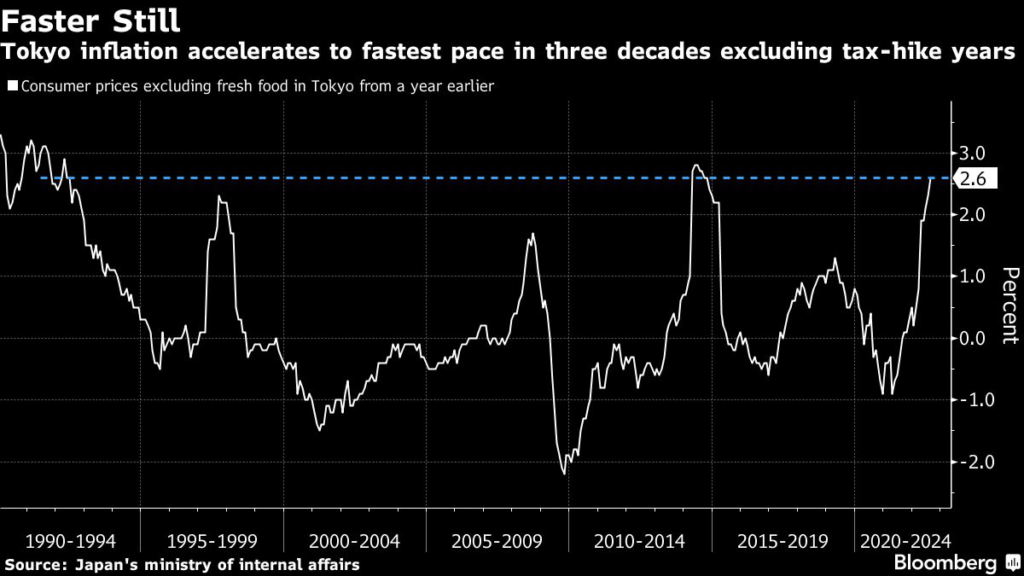
The cost of living in Tokyo rose at a quicker-than-expected pace in August to reach the fastest clip since 1992 excluding tax-hike years, adding to the communication challenges for the Bank of Japan.
(Bloomberg) — The cost of living in Tokyo rose at a quicker-than-expected pace in August to reach the fastest clip since 1992 excluding tax-hike years, adding to the communication challenges for the Bank of Japan.
Consumer prices excluding fresh food rose 2.6% in the capital this month, according to the ministry of internal affairs Friday.
The gain beat economists’ forecast of a 2.5% increase.
Energy and processed foods drove most of the growth in overall Tokyo prices, which rose 2.9% from a year earlier. The two factors accounted for 2 percentage points of increase, while a smaller drop in mobile fees also helped push up the rate by 0.1 percentage point.
The acceleration in the leading indicator of nationwide inflation is still unlikely to nudge BOJ Governor Haruhiko Kuroda toward an adjustment of policy at the central bank’s next meeting in September.
While his overseas counterparts have kept raising rates, Kuroda has insisted on the need for wage growth to achieve stable inflation before any policy change after nearly a decade of stimulus to generate rising prices.
“This confirms there is a good chance national figures will reach 3% or more in the final quarter of this year,” said Yoshiki Shinke, economist at Dai-Ichi Life Research Institute.
“But this inflation won’t make the BOJ consider tightening. Japan’s inflation is still driven by energy, commodity prices and a weak yen and those are all one-off factors.”
Still, people are seeing their spending power fall as paychecks fail to keep up with inflation, fueling both frustration among squeezed households and concerns that consumer spending will cool amid Japan’s already-slow recovery from the pandemic.
That leaves Kuroda with an increasingly tough job to convince both members of the public and the government that it makes sense to keep stimulating the economy with rock-bottom interest rates.
He also faces a difficult task to persuade market players that he will not buckle on rates like so many of his peers in the face of inflation.
What Bloomberg Economics Says…
“We see Tokyo’s core inflation hovering around 2.5% in 3Q and then rising slightly in 4Q.
A weaker yen could buoy prices of processed foods and other imports. Pushing the other way, fuel subsidies aimed at restraining gasoline prices and steps to cap imported wheat prices should restrain some inflationary pressures.”
— Yuki Masujima, economist
For the full report, click here
Japan’s inflation is expected to continue accelerating as an increasing number of businesses have announced they will bump up their prices this fall.
Food company price hikes will likely affect 6,305 items in October, according to a Teikoku Databank survey. That compares with a monthly average of 1,151 rising items through July this year.
In October another boost is expected from a further fading of last year’s cheaper cell phone fees.
After the government urged telecommunication firms to cut overly high fees, the companies responded in several waves with sharp cuts that put strong downward pressure on the consumer price index.
Considering all those factors, some economists including those at Citigroup are predicting the nationwide inflation to hit 3% or above in the final quarter of this year.
Even so that won’t push Kuroda to unwind stimulus before his term ends in April, according to analysts surveyed by Bloomberg this month.
They say 3% inflation needs to last for half a year at least to trigger policy action from the BOJ — a scenario that’s way beyond their current price forecasts.
“Prices aren’t rising on a solid economic recovery like elsewhere,” said Dai-Ichi Life’s Shinke.
“Japan’s situation remains completely different from the US and Europe.”
(Updates with more details from the report, economist comments)
More stories like this are available on bloomberg.com
©2022 Bloomberg L.P.