Manufacturers have been finding success with both mini and large cars and SUVs. The compact and mid-size segments could be next.
(Bloomberg) —
As electric adoption takes off, different purchasing patterns are taking shape around the world.
In some countries, automakers are mostly targeting the high end of the market and working their way down in terms of price points. Others are seeing more of a pincer movement, meaning manufacturers are attacking both entry-level and luxury segments.
Take the US and China, for example. Manufacturers led by Tesla have mostly succeeded in America by introducing EV models at the premium end of the market and slowly expanding into mid-price, higher-volume segments.
In 2019, only 322,000 plug-in vehicles were sold in the US. This year, BloombergNEF is expecting 1.4 million.
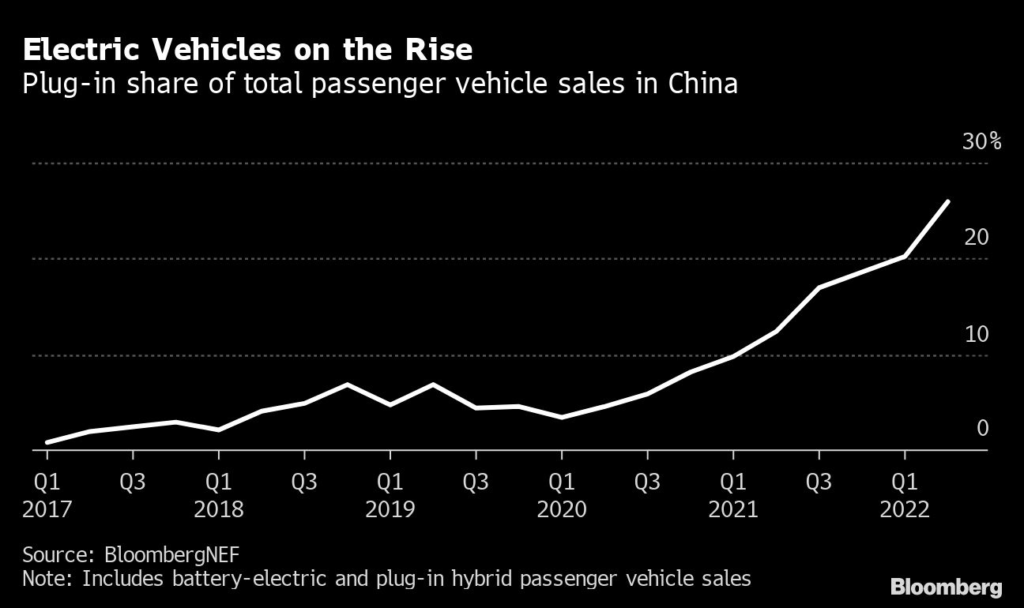
In China, EVs have been excelling both at the bottom and the top of the market. Roughly 567,000 plug-in passenger vehicles were sold just in July, up 120% from a year ago, and BNEF expects a total of 6 million deliveries this year.
The plug-in share of total passenger vehicle sales so far in 2022 is hovering around 24%, with much higher numbers likely in the next few years as consumer interest takes off. Sales of combustion vehicles are falling rapidly as a result.
That’s the overall picture, but the segment story in China is even more interesting.
If you plot the segments of the Chinese car market by vehicle size from smallest to largest, the EV adoption rate looks a bit like a pincer, or a vice.
The smallest cars — the mini segment — have already gone electric thanks to models like SAIC-GM-Wuling’s Hongguang Mini, which starts at just $5,000 and is the best-selling EV so far this year.
Large cars and large sport utility vehicles also have high EV adoption rates, with 29% and 32% of sales already electric, respectively. Those segments are led by models including the BYD Han and Volkswagen ID.6.
The compact car and compact SUV segments — the area in the middle of the vice — are high-volume segments, representing about half of China’s auto market.
EV adoption rates are much lower at around 16% of sales. These two segments are dominated by incumbent manufacturers such as Nissan, Toyota and VW. With the top and bottom of the market already going electric very quickly, this is where the next battles will play out.
New models, increased charging coverage and shared mobility fleets could help boost EV popularity in these middle segments, but it may take a bit longer to displace than the top and bottom of the market.
That’s because the EV success story in the smallest cars has been driven largely by cost-conscious urban buyers looking for a cheap, convenient option for commutes and short trips.
High margins in the larger car segments made it an attractive place to automakers to launch EVs. These EV models have also become the place where consumers can access the latest digital technologies, like over-the-air software updates and advanced driver-assistance features.
Still, it’s worth remembering China’s goals haven’t changed.
It’s pursing EVs primarily for industrial policy reasons, namely to help reduce oil imports and improve urban air quality. As EVs saturate the top and bottom of the market in the next few years, watch for more policies aimed at that middle market to help tip the scales favor of electrification.
Incumbents in these segments should take note once the shift gets going — the vice may start to close quickly.
More stories like this are available on bloomberg.com
©2022 Bloomberg L.P.