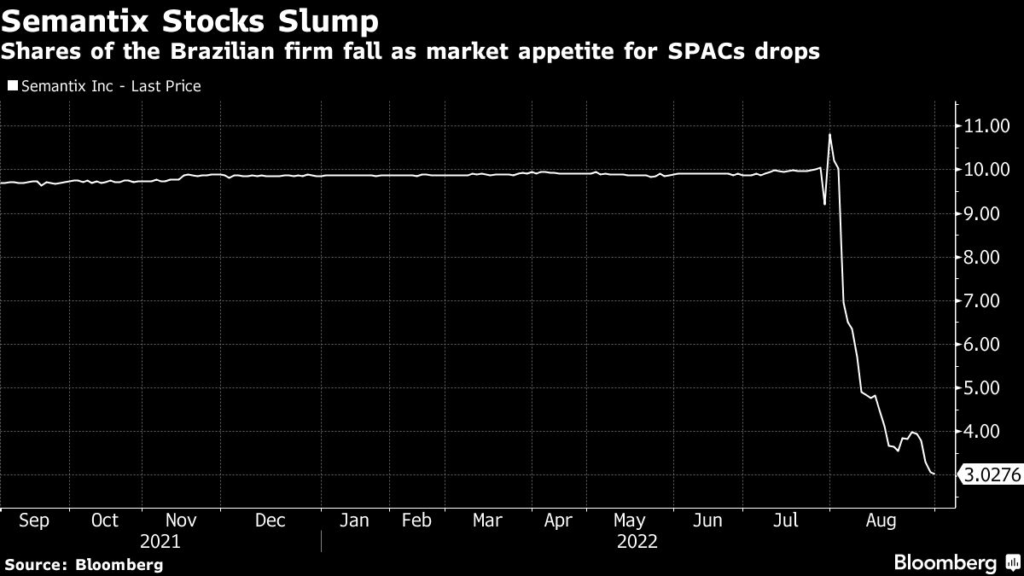
Brazilian data software provider Semantix Inc. has seen its shares sink 60% since going public in early August after completing a merger with Alpha Capital, a special purpose acquisition company, amid a slump in the tech industry.
(Bloomberg) — Brazilian data software provider Semantix Inc.
has seen its shares sink 60% since going public in early August after completing a merger with Alpha Capital, a special purpose acquisition company, amid a slump in the tech industry.
But with the $127 million that it raised in the process, it’s eyeing more acquisitions, looking to grow headcount and open a new office in the US in anticipation of a rebound for the beaten down sector, chief executive officer Leonardo Santos and board member Rafael Steinhauser said in an interview.
“SPAC redemptions now are extremely high, they collapsed,” said Steinhauser, a co-founder of Alpha, adding that the company faced the challenge of rising interest rates, a tech rout and changes in SPAC regulation.
“I don’t have a crystal ball, but I think all three things are going to come back to a more reasonable state. Technology is going to come back.”
The Sao-Paulo based company has a team working on potential purchases that could offer “complementary technologies” such as machine learning, Santos said.
The company announced the purchase of Brazilian data provider Zetta Health Analytics for just over 52 million reais ($10 million) on Wednesday, and others have been shortlisted for consideration.
Semantix is a “deep tech” company, which provides data software and analytics used by clients for tasks such as giving e-commerce recommendations or packaging potential financial products.
Its clients include Mercedes Benz, Bradesco, Hospital Care, among others.
The firm is hiring in Brazil, Mexico, Colombia and Chile, and plans to increase its work force to as much as 1,000 employees by year-end from 700 currently.
It’s also expanding operations in the US, opening a new office in San Francisco before the end of the year that adds to an existing one in Miami. With almost no spending on marketing so far, the company will begin to spend in growing its brand awareness.
“We’re growing very fast with practically zero investment in marketing,” Santos said.
“We want to spend more.”
The company’s proprietary software as a service (SaaS) revenue grew 25% in the first half of the year and 62% in June compared to the same month the previous year, according to the executives.
It plans to sell two times more in the second half of the year than in the first half, pushing the year’s total revenue to as much as 290 million reais ($55 million).
The company posted a loss of 86 million reais ($16.4 million) in the first half of the year.
Semantix started trading publicly on Aug. 3 after completing a merger with Alpha.
Alpha had initially announced the purchase of Semantix in late November, but the listing in Nasdaq was delayed by regulatory changes from the US Securities Exchange Commission that led the banks that were originally part of the deal to exit the transaction, said Steinhauser.
The merger process was then led by the Semantix and Alpha management, involving weeks of back and forth with the regulators.
Semantix was founded by Santos in 2010, who remains at the helm after the merger.
Original shareholders include a fund backed by Banco Bradesco SA and the private-equity firm Crescera.
SPAC Woes
SPACS, which are blank-check companies that connect private businesses to public capital markets without having to go through a traditional initial public offering soared in popularity in 2020 and early 2021 but have since lost steam.
The IPOX SPAC Index, which tracks the performance of a group of blank-check firms, is down more than 43% from its peak in February of 2021.
The redemption rate for the SPAC that took Semantix public was 85%, Steinhauser says, but that it’s lower than the average which is above 90%.
“Of course we wanted to have 0%.
But times are very different,” he said.
Even with the difficulties, Steinhauser said the Alpha team is interested in pursuing other SPAC vehicles further down the line.
“Nothing has changed from our original thesis, that SPACs are good for companies that have grown enough and have an ambition to go to the world and play in the first league,” Steinhauser said.
“Today the context is quite difficult, but we have demonstrated it’s possible.”
More stories like this are available on bloomberg.com
©2022 Bloomberg L.P.