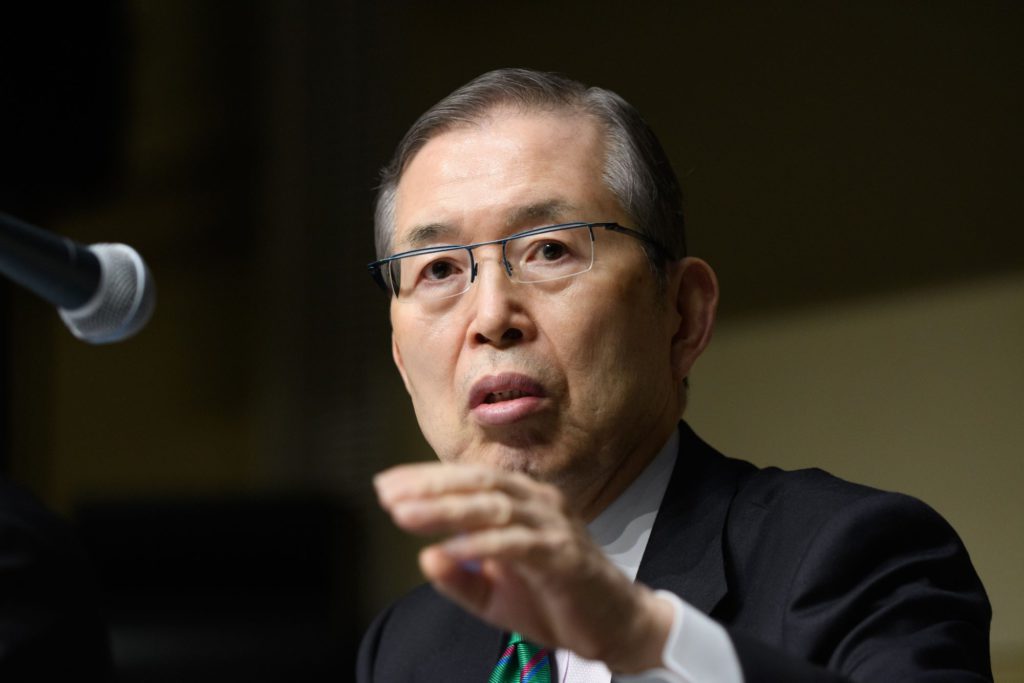
Japanese electric-motor giant Nidec Corp. named Vice Chairman Hiroshi Kobe as chief operating officer and president, putting him in line to possibly one day succeed founder Shigenobu Nagamori, who has struggled to share control of the company.
(Bloomberg) — Japanese electric-motor giant Nidec Corp.
named Vice Chairman Hiroshi Kobe as chief operating officer and president, putting him in line to possibly one day succeed founder Shigenobu Nagamori, who has struggled to share control of the company.
Kobe will step into the role effective Sept.
3 while current president and COO Jun Seki resigned, effective immediately, the company said in a statement Friday.
The appointment comes about a week after Seki was said to be planning on leaving Nidec after less than three years.
Nagamori, who demoted Seki from CEO earlier this year, is planning a management overhaul, people familiar with the matter told Bloomberg News. It follows months of Nagamori publicly disparaging Seki and questioning his ability to lead the manufacturer he started in a shack in 1973.
Friday’s statement said Seki was “stepping down to take responsibility for the deterioration of the business.”
Nagamori, 77, reclaimed the role of chief executive officer in April after souring on Seki, whom he hired from Nissan Motor Corp.
in early 2020.
Kobe comes into the position at a challenging time.
Nagamori has struggled for years to find someone to succeed him at what is the world’s top supplier of motors for everything from hard drives to power plants.
The founder said that he took back the reins from Seki because of his lackluster performance, saying in an interview with Bloomberg, that he “was in agony” every day as the manufacturer’s share price declined.
Nidec is facing a worsening global economic outlook and needs to prepare by putting in place leaders with deep experience within the company, Nagamori is said to have told senior managers.
Caught up in global supply chain turmoil and pandemic, Nidec’s shares are down 33% this year.
In its most recent earnings, Nidec reported operating profit of 44.7 billion yen ($318 million) for the fiscal first quarter through June.
That compares with analysts’ average projection of 43.5 billion yen. Revenue rose 21% to 540.4 billion yen, compared with the prediction of 510 billion yen.
Nidec’s travails reflect a wider dilemma across Japan’s corporate landscape, as leaders who came of age during the country’s economic boom run their company well into years when most people retire.
It’s not the only company grappling with succession. Despite promising to retire at 65, Uniqlo founder Tadashi Yanai, now 73, still runs Fast Retailing Co. with a tight grip. Masayoshi Son, SoftBank Group Corp.’s 65-year-old founder and CEO, has parted ways with several potential successors in high-profile exits in recent years.
Read more: A Startup Offers Japan’s Aging CEOs a Worry-Free Succession Plan
In his interview with Bloomberg in July, Nagamori said his goal was to see Nidec’s share price beat its 2021 record of 15,175 yen.
They were at 9,019 yen on Friday.
Once Nidec’s share price hits a new record, the founder said he’ll look to pass on the CEO post and transition into the role of honorary chairman.
But at the same time, Nagamori said as long as he’s living, he can’t accept handing off Nidec and seeing it stumble.
“I built this company from the ground up and Nidec is like a part of my body,” he said. “If the company were to become a failure it’d be like a physical wound for me.”
Indeed, what comes after Nagamori steps down is of key interest to investors in the company.
For years, analysts have been warning that a bumpy transition of power would mean Nidec could lose its “Nagamori premium.”
Nagamori said in July he’s given up on finding any one individual capable of filling his shoes.
He intends to break up his responsibilities between a number of individuals, he said. “At this level, there isn’t a person in Japan who can operate this company as CEO alone,” Nagamori said, “it needs to be managed by a group.”
Recently, Nidec has moved to significantly bolster its recruiting activities, poaching prominent executives including Mitsuya Kishida, the former head of Sony Group Corp.’s mobile communications business, and Shinya Yoshida an executive vice president at Mitsubishi Corp.
With regard to Seki, Nagamori in July said the former CEO had not done enough to learn and embody his methods of management since joining the company.
Nidec has a basic policy outlining that the person who contributes most to the company’s profit will claim the top job, Nagamori said.
“You may think this is an unsparing company but it’s really the proper way,” he said. “It’s a meritocracy.”
(Updates with context throughout.)
More stories like this are available on bloomberg.com
©2022 Bloomberg L.P.