In a world awash in technology stocks for sale, the last thing bulls want to see is more big sellers hitting the market. In China, that appears to be just what’s happening.
(Bloomberg) — In a world awash in technology stocks for sale, the last thing bulls want to see is more big sellers hitting the market.
In China, that appears to be just what’s happening.
Investors are fretting that Tencent Holdings Ltd. will add to pressure on the market if it moves ahead with a reported plan to offload 100 billion yuan ($14.5 billion) from its equity portfolio.
While the company denied the report, that was little comfort to stockholders, who pushed down the share prices of Tencent investees such as Pinduoduo Inc. and KE Holdings Inc.
A divestment would follow similar moves under consideration by Baidu Inc.
and Alibaba Group Holding Ltd. as the internet giants seek to assuage regulators concerned about their sway over the industry. And it would just deepen the gloom around Chinese tech stocks still reeling from Beijing’s regulatory clampdown.
The Nasdaq Golden Dragon Index of US-listed Chinese stocks has plunged 64% from its 2021 record.
“The current market environment is not favorable and may substantially exacerbate the negative impacts on the share prices of the targeted companies being off-loaded,” said Redmond Wong, Saxo Capital Markets strategist.
Investors are now paying attention to what is next.
Alibaba — which arguably faced the worst of the regulatory crackdown — holds a stake in at least six US-listed stocks, including XPeng Inc. and Weibo Corp., according to exchange filings. Baidu owns a controlling stake in iQiyi Inc., while e-commerce giant JD.com Inc.
is a shareholder of its peer Vipshop Holdings Ltd., Bloomberg data shows.
China’s tech titans have plenty of incentive to pare their stakes in listed companies. Besides appeasing regulators, reducing their holdings also slims balance sheets and gives firms the ability to invest those funds into more profitable operations.
The problem, though, is that these large caps are so deeply connected to other tech firms, having part-ownership of hundreds of startups and publicly traded firms worth hundreds of millions of dollars.
So any moves by big companies to trim their stakes can trigger an outsized reaction in shares.
Tencent responded to the Financial Times report by denying it has a target for divestments. Many investors say they still expect more shares to come on to the market.
“We do believe the major Chinese internet corporates will continue to sell off their investment portfolio position, especially for those major players in the industry holding a great amount of stakes,” said Kenny Wen, head of investment research at KGI Asia Ltd.
Investors appear to be more sensitive to the news of a stake liquidation given the weak market sentiment, he said.
Tech Chart of the Day
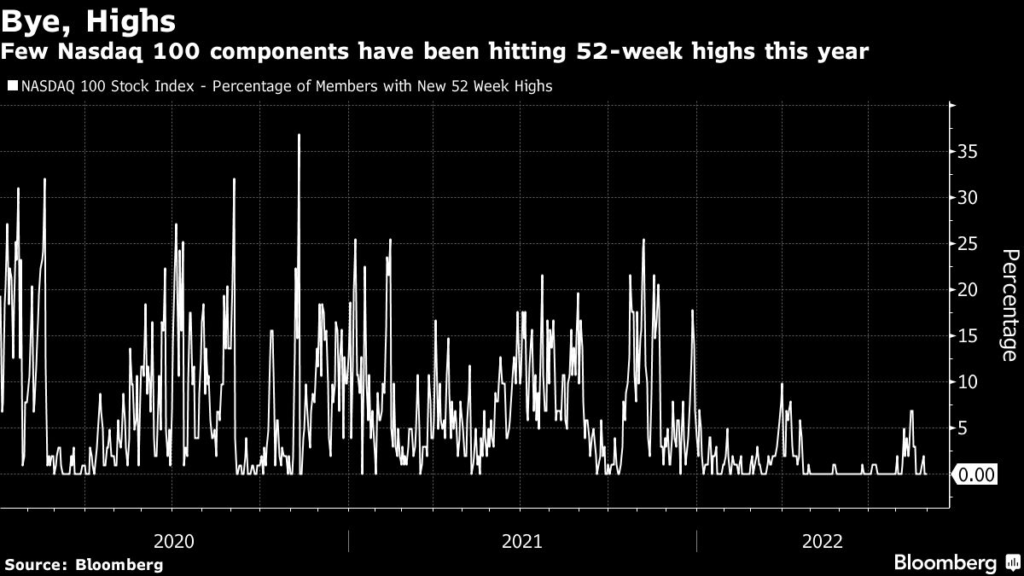
The weakness in the Nasdaq 100 Index throughout 2022 has meant an anemic number of companies hitting new 52-week highs, with none currently at such a peak.
While there was a brief spike in 52-week highs last month — with nearly 7% hitting that level — the percentage hasn’t topped 10% all year. In November, more than a quarter of Nasdaq 100 components hit a 52-week high.
Top Tech Stories
- Broadcom Inc., a chipmaker that supplies some of the largest companies in the tech industry, gave a strong sales forecast for the current quarter, allaying fears that spending on internet infrastructure is slowing.
- SoftBank Group Corp.
is planning to cut at least 20% of staff at its loss-churning Vision Fund operation, following public pledges from Masayoshi Son to reduce headcount at the world’s biggest tech investor, according to people familiar with the matter.
- The US government’s new restrictions on the ability of Nvidia Corp.
to sell artificial intelligence chips to Chinese customers threatens to deal a heavy blow to the country’s development of a sweeping range of cutting-edge technologies.
- Volkswagen AG and Foxconn Technology Group are keeping their workers on-site in their factories in Chengdu after the Chinese metropolis locked down its 21 million residents to contain a Covid-19 outbreak.
- With rising Covid cases, residents in China’s technology hub of Shenzhen are fearing a second city-wide lockdown, even as local authorities sought to quash such rumors fueled by restrictions imposed just hours earlier in another megacity to the west.
- Sea Ltd.
is trimming staff in its money-making gaming arm to rein in costs. It’s the e-commerce giant’s second round of job cuts this year, following a string of setbacks that is forcing the company to shift its focus away from unbridled growth to profitability.
- The Amazon Labor Union’s landmark victory at a Staten Island warehouse should be upheld, a US labor board official has recommended, dealing a major setback to Amazon.com Inc.’s efforts to have the vote overturned.
- Apple Inc.
workers in Oklahoma City petitioned Thursday to unionize their store, extending a wave of organizing within the company and the broader retail industry.
- Nikon Corp. agreed to buy SLM Solutions Group AG in a deal that values the German 3-D printing-machine maker and perennial takeover target at about 600 million euros ($597 million).
- Snap Inc.
is sunsetting efforts focused on building products for the much-vaunted next generation of the internet known as web3, according to a former research and development manager at the social media platform.
More stories like this are available on bloomberg.com
©2022 Bloomberg L.P.