Hedge fund managers were in an upbeat mood at last year’s Sohn Hong Kong investment conference, only for many to see their bullish bets derailed by the market turmoil that followed.
(Bloomberg) — Hedge fund managers were in an upbeat mood at last year’s Sohn Hong Kong investment conference, only for many to see their bullish bets derailed by the market turmoil that followed.
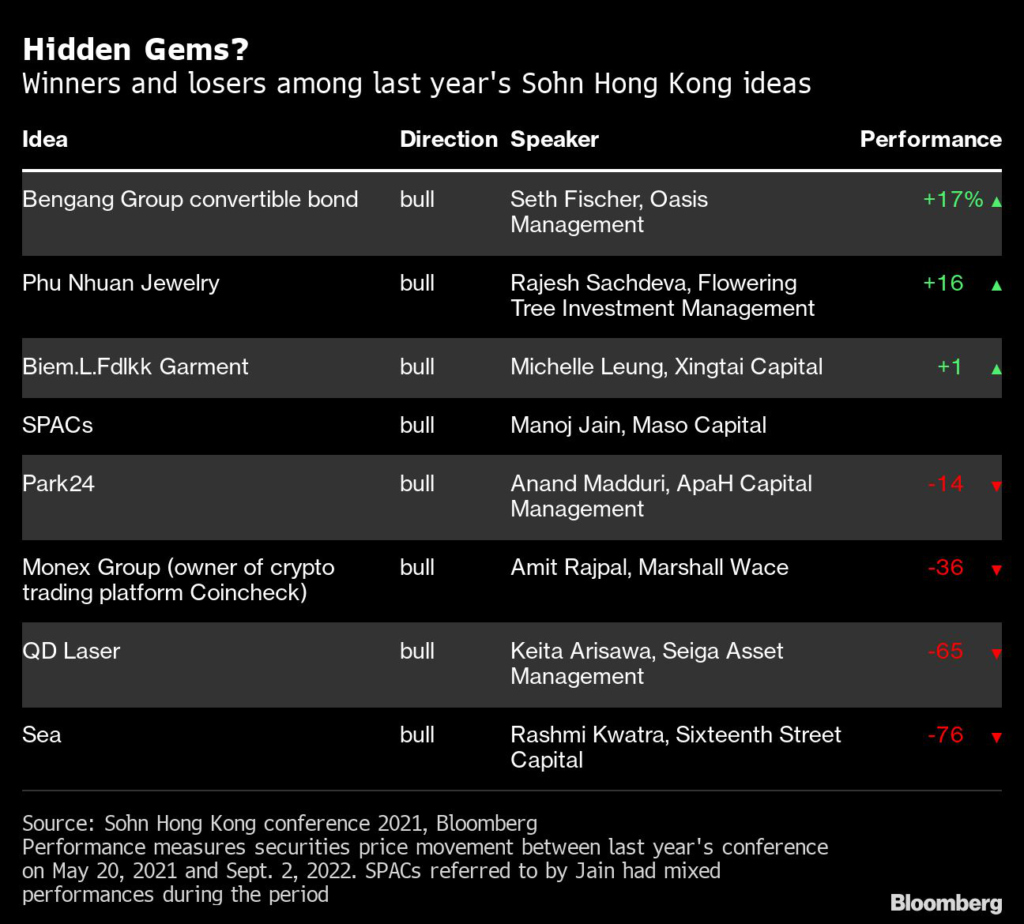
Among those who made investment calls at the May 2021 event, Sixteenth Street Capital’s Rashmi Kwatra touted Sea Ltd., Southeast Asia’s largest tech company that later tumbled during the industry sell-off.
Marshall Wace’s Amit Rajpal vouched for Japanese digital finance firm Monex Group Inc., which plunged in tandem with the crypto rout. Keita Arisawa at Seiga Asset Management picked QD Laser Inc., a Japanese eyewear maker that has lost momentum since its initial public offering in early 2021.
There were some winners, including Oasis Management Co.’s Seth Fischer and Flowering Tree Investment Management Pte.’s Rajesh Sachdeva, whose respective calls tied to Chinese steel making and Vietnam’s growing taste for jewelry paid off.
Regional hedge funds have been caught out by headwinds that have buffeted markets in the past year.
Surging inflation, aggressive interest rate hikes, Russia’s Ukraine invasion and other geopolitical tensions have plagued equities, bonds, currencies and riskier assets like crypto. China’s economic slowdown in the wake of its zero-Covid policy and regulatory clampdowns added to the pain.
The turmoil has clearly been felt in hedge fund returns.
The Eurekahedge Asian Hedge Fund Index is down 7.4% this year, heading for the worst annual performance since 2018, according to preliminary data through August.
Against this backdrop, ahead of the Sohn Hong Kong conference being presented by the Karen Leung Foundation on Wednesday, it should be no surprise that a number of the ideas pitched at last year’s event didn’t deliver their promises.
The worst performer was Sea, picked by Sixteenth Street’s Kwatra.
Bad news has been piling up for the Singapore tech giant, which had soared 24 times in the four years to its October 2021 peak.
After hitting a pandemic-era high, growth in Sea’s e-commerce arm is slowing, as high inflation and interest rates weaken consumer sentiment.
It has had to cut jobs and scale back its overseas footprint and peripheral businesses to boost profitability. India suddenly banned its most popular mobile game and the company shut its main e-commerce unit in the nation months after opening.
Marshall Wace’s Rajpal backed Monex to capitalize on the theme of blockchain, decentralized finance and crypto potentially redefining payments and investable asset classes.
But cryptocurrency prices have tumbled since May, with the collapse of the stablecoin project Terra setting off a wave of liquidations, bankruptcies and layoffs.
Although Monex went ahead with its plans for a crypto spinoff and US brokerage listing, the market downturn meant those couldn’t be completed. Still, its 36% share price decline, in yen terms, since last year’s conference was half of that for US peer Coinbase Global Inc.
Arisawa at Seiga touted QD Laser in part for its eyewear product that can help the vision-impaired see by directly projecting digitized information onto the retina.
But the spinoff from Fujitsu Laboratories Ltd. posted a bigger operating loss last fiscal year, citing stagnation of its overseas expansion as the pandemic impacted its laser eyewear business.
Still, two clear winners emerged.
Oasis Chief Investment Officer Fischer’s pick of Bengang Group’s convertible bond was a play on China’s pledge toward carbon neutrality by 2060.
He said the goal would trigger industry consolidation and lead domestic demand for steel to outstrip supply. Sure enough, state-owned Ansteel Group announced a deal to buy its smaller peer Bengang in August last year.
“Our thesis played out,” Fischer said.
“We predicted supply-side reform given China’s carbon neutrality goals, production cuts, and it happened. We predicted market consolidation and the acquisition of Bengang by Angang, and it happened.
We predicted strong demand post-Covid, and it happened. We predicted margin expansion given stable iron ore prices, and it happened.”
Sachdeva, who founded Flowering Tree around the global financial crisis, was another winner with his bullish call on Phu Nhuan Jewelry JSC to benefit as rising incomes boost jewelry sales in Vietnam.
His firm still holds the stock, which is up about 19% this year.
“They’re having a blockbuster year,” Sachdeva said in a Bloomberg Television interview this week. “There’s a lot of pent-up demand that continues to drive earnings for them, and so we remain very optimistic.”
More stories like this are available on bloomberg.com
©2022 Bloomberg L.P.