Bearish bets on the yuan are gaining momentum after the Biden administration curbed China’s access to US semiconductor technology and reports endorsing Beijing’s Covid Zero policy dashed hopes the curbs would be lifted soon.
(Bloomberg) — Bearish bets on the yuan are gaining momentum after the Biden administration curbed China’s access to US semiconductor technology and reports endorsing Beijing’s Covid Zero policy dashed hopes the curbs would be lifted soon.
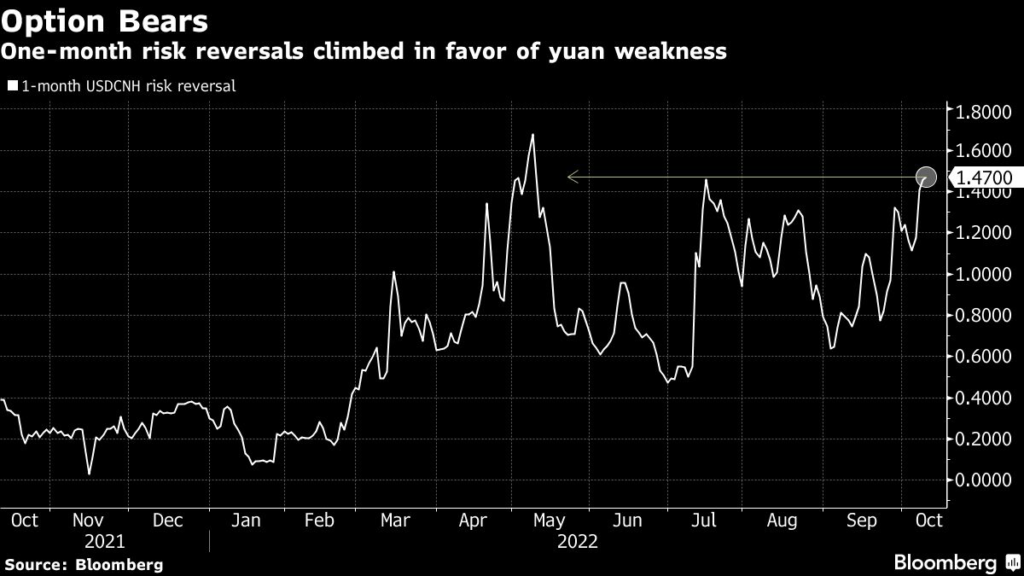
Option traders are boosting bearish wagers on the offshore yuan as indicated by the one-month risk reversal, which hit the highest level since May 10.
Onshore yuan implied volatility for the same period rose to the highest on record as demand for protection against yuan weakness grew. The offshore unit fell as much as 0.7% to weaken past the key 7.2 per dollar level, wiping out gains from the Golden Week holidays.
Concerns over the chip sector and China’s Covid policy are adding to existing worries over outflows.
That’s because the nation’s monetary policy diverges further from the US, with the Federal Reserve expected to aggressively hikes rates to tame inflation. Moreover, China’s domestic growth is also at risk from the turmoil in the property sector.
Covid Zero is “sustainable” and the country must stick to the policy because it’s key to stabilizing the economy and protecting lives, the People’s Daily said in a commentary Tuesday.
The commentary comes amid signs Covid Zero will persist well after the Party Congress this month, with Shanghai ordering mass testing for Covid until early November.
The state media report on China’s Covid policy dented market hopes for relaxation after sentiment was already hurt by US tightening sanctions against China’s semiconductor industry, said Qi Gao, a strategist at Scotiabank in Singapore.
Confidence in the yuan is lacking after most Fed officials recently reiterated intentions of another jumbo rate hike in November, he said.
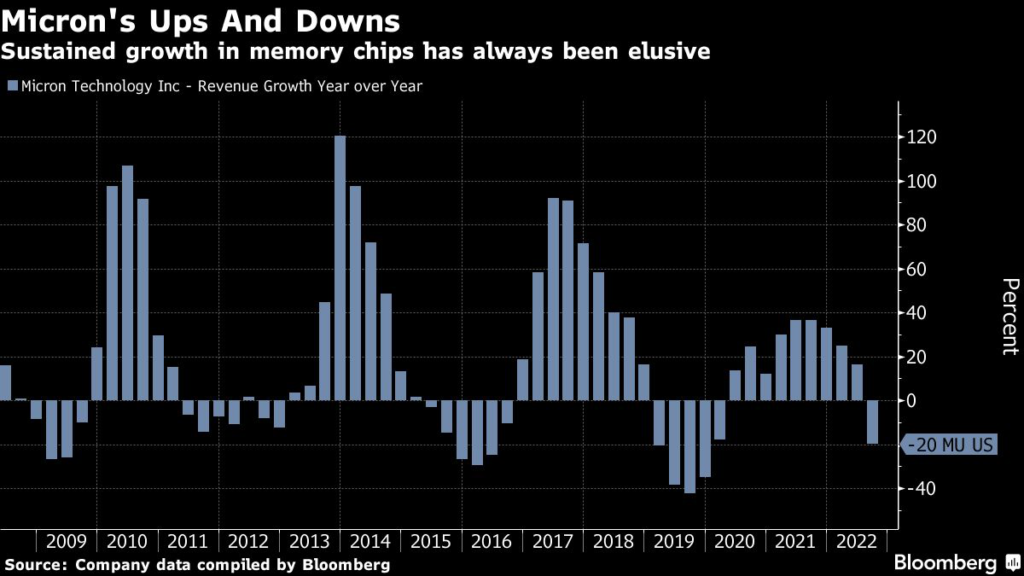
Fresh US curbs on China’s access to American technology also hit chip-related stocks in Japan, South Korea and Taiwan, erasing more than $240 billion from the sector’s global market value.
It’s not only adding to US-China tensions but non-US companies may also be under pressure to cut their supply to China, Tommy Wu, senior economist at Commerzbank AG wrote in a note.
China’s pushback against yuan weakness, with a 29th straight day of stronger-than-expected fixings, did little to stem the currency’s losses.
The onshore yuan opened stronger, near the People’s Bank of China’s fixing, before giving up gains. An organization formed by China’s biggest foreign-exchange traders had asked banks to trade the currency at levels closer to the central bank’s fixing at the market open, people familiar with the matter had said in late September.
The renewed pressure on yuan will put the PBOC back in focus, especially in the run-up to the twice-a-decade party congress that that starts Oct.
16 where President Xi Jinping is set to secure a precedent-breaking third term in power.
In late September, the central bank delivered a strongly-worded statement to warn against one-way bets on the yuan.
It also imposed a risk reserve requirement of 20% on currency forward sales by banks last month to make it more expensive to short the yuan. That’s after an earlier move to reduce the foreign-currency reserve requirement for banks.
“Onshore dollar buying will likely deter the PBOC from aggressive intervention, but I will still be cautious if the pair rises above 7.20,” Stephen Innes, Managing Partner at SPI Asset Management, wrote in a note.
“It is too early to say the PBOC will let the spot go up from here.”
(Updates with yuan volatility in the second paragraph and economist comment in the sixth paragraph.)
More stories like this are available on bloomberg.com
©2022 Bloomberg L.P.