South Korea’s trade minister said key chip producers Samsung Electronics Co. and SK Hynix Inc. won approval from the US to keep operating in China, but that concerns remain over the impact of Washington’s sweeping new restrictions.
(Bloomberg) — South Korea’s trade minister said key chip producers Samsung Electronics Co.
and SK Hynix Inc. won approval from the US to keep operating in China, but that concerns remain over the impact of Washington’s sweeping new restrictions.
“South Korea is fully cooperating with the US,” Ahn Duk-geun said in an interview with Bloomberg News, explaining that the US decisions were based on an understanding that Korean chipmakers’ fabs in China are crucial in stabilizing the global supply chain.
“But we’re trying to ensure there’s no unnecessary problem with purely commercial-scale, low-end chips like the automotive ones at the center of supply shortages,” he said.
Ahn was speaking after the US imposed drastic new curbs on the ability of chip companies to do business in China, actions that incensed Beijing and provoked accusations of unfair targeting.
The measures announced Oct. 7 also affect American allies, effectively forcing them to comply or to defy Washington.
South Korean memory maker SK Hynix said Wednesday it had received approval from the US Department of Commerce to supply equipment needed to produce DRAM chips in its Chinese facilities without additional licensing for one year.
Samsung also received a reprieve, according to people familiar with the matter. Samsung declined to comment.
The approvals are “absolutely different from a grace period,” Ahn said.
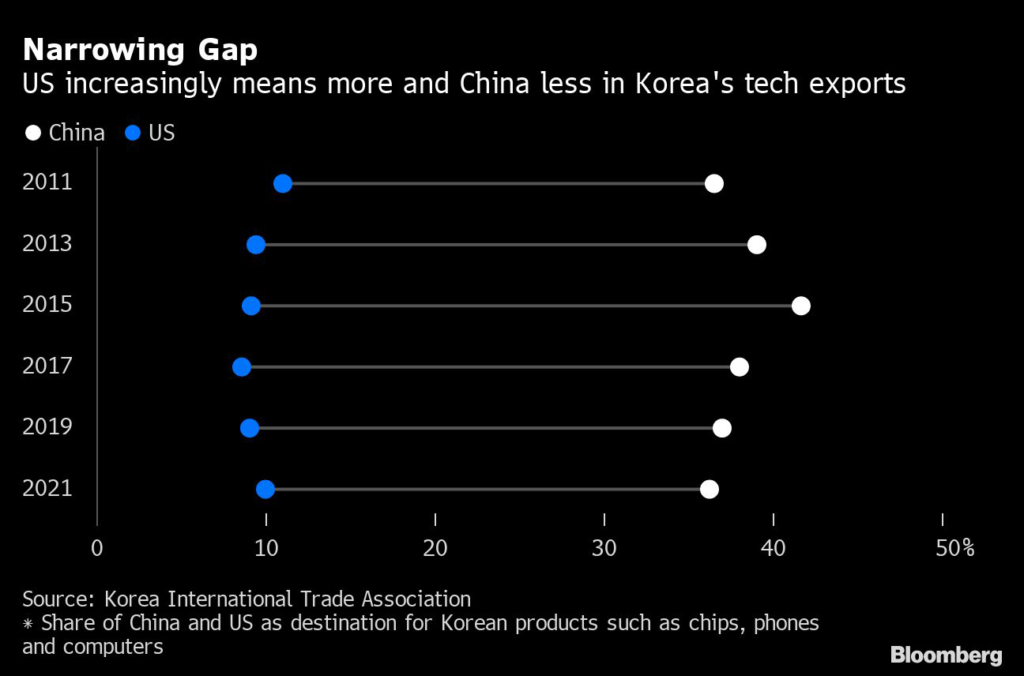
South Korea finds itself caught between its biggest trade partner in China and its US security partner over the Biden administration’s plans to secure supply chains for crucial components that steer clear of the government in Beijing.
Korean chip companies operating in China “might be doing their own calculations right now after the US export control measures were announced,” Ahn said.
The Biden administration measures erect barriers of entry to China’s market by limiting the ability of US firms to sell equipment and tech to their Chinese counterpart.
They led to a route of Asia’s top chip stocks this week, with more than $240 billion erased from the sector’s global market value at one point.
South Korea is finding it tough to keep pace with US plans for realignment of the semiconductor supply chains, Ahn said, adding: “But our stance is to cooperate and we’re trying to adjust the pace by considering the circumstances of our industries.”
Rahm Emanuel, the US Ambassador to Japan, told Bloomberg Television that the Biden administration’s moves present business opportunities for allies in line with US national security interests.
The US measures seek to stop China’s multibillion dollar drive to develop its own chip industry and advance its military capabilities.
The impact could extend far beyond semiconductors and into industries that rely on high-end computing, from electric vehicles and aerospace to gadgets like smartphones.
“This will trigger Korean chipmakers’ changes in global operation strategy,” said Jeff Kim, analyst at KB Investment & Securities.
He noted that about 45% of China’s memory chip demand is covered by South Korean semiconductors that are either imported from South Korea or made by Korean plants in China.
The flareup over chips follows South Korean anger at new US rules for electric vehicle and batteries that could disadvantage major South Korean brands like Hyundai and Kia, which don’t have operational EV plants in the US but are spending billions to do so in a matter a few years.
Ahn said major South Korean manufacturers are taking “a cautious” approach as they look at steps to strengthen cooperation with the US.
While South Korean chip companies may gradually phase out aspects of business with China that carry risks, it is too powerful economically to shun, he said.
“It’s true China is no longer the cash cow it used to be that we couldn’t do without,” Ahn said.
“China and Korea are still very important trading partners to each other.”
More stories like this are available on bloomberg.com
©2022 Bloomberg L.P.