Alarm over Elon Musk’s recent Russia-friendly tweets is driving Biden administration officials to explore using a secretive review panel to assess the national-security risks of his business interests.
(Bloomberg) — Alarm over Elon Musk’s recent Russia-friendly tweets is driving Biden administration officials to explore using a secretive review panel to assess the national-security risks of his business interests.
Yet experts say that deploying the Committee on Foreign Investment in the US to investigate Musk’s dealings — including his pending $44 billion purchase of Twitter — is unlikely to work and would face legal challenges.
There may be an argument for some sort of CFIUS review, but it’s thin, according to Emily Kilcrease, a senior fellow at the Center for a New American Security.
The panel would only get involved if foreign investors were taking a controlling stake in the new company, she said, something Musk doesn’t appear ready to allow.
CFIUS has the right to look at foreign investors, not Musk, Kilcrease said.
“So if there’s concerns around Musk, CFIUS is a really messy, imperfect tool to try to deal with that — and I suspect would be subject to legal challenge,” she said.
US officials have grown uncomfortable over Musk’s recent threat to stop supplying the Starlink satellite service to Ukraine and what they see as his increasingly Russia-friendly stance.
The rationale for CFIUS involvement is that Musk has lined up investors in Qatar and Saudi Arabia to help fund the bid, and CFIUS’s job is to review foreign acquisitions of US companies. Binance Holdings Ltd., a digital-asset exchange founded and run by a Chinese native, has offered $500 million.
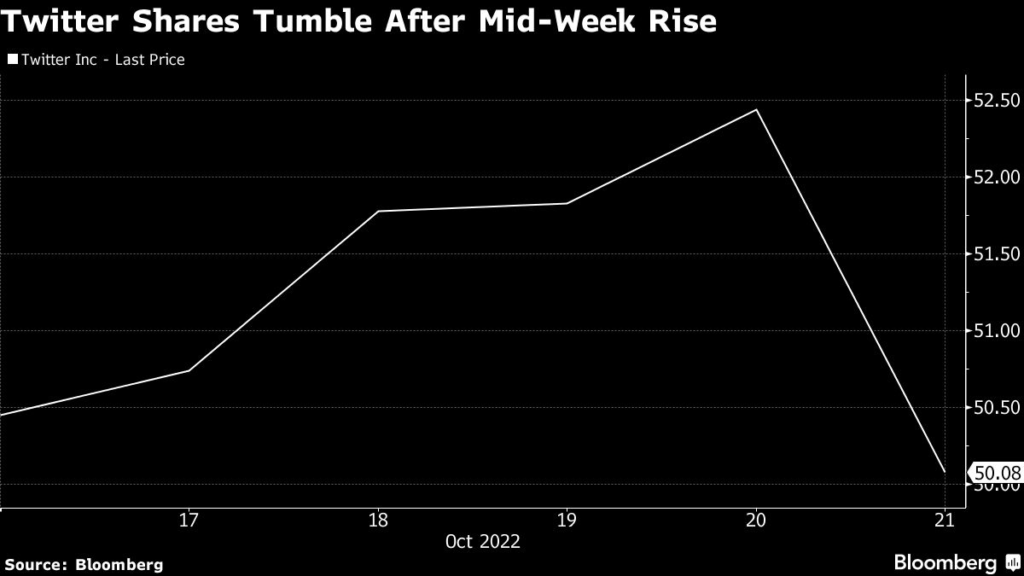
Twitter was down 4.6% Friday after Bloomberg News reported the administration’s proposal.
Musk didn’t respond to emailed requests for comment, though he did respond with a series of emojis to a fellow reader’s tweet that it “would be hysterical if the government stopped Elon from over paying for Twitter.”
Administration officials say discussions around Musk are in an early stage and bringing in CFIUS is just one idea to respond to what people familiar with the matter say is alarm over Tesla’s dependence on China and Musk’s recent tweets seen as friendly toward Russian President Vladimir Putin.
The panel, chaired by the Treasury Department, would likely shy away from a review given the political overtones.
“CFIUS wants to be seen as legitimate, it doesn’t want to be used as a poison pill,” said Sarah Danzman, a senior fellow at the Atlantic Council.
“It would not want to be manipulated into action for fear of the type of precedent that it could create. It really is supposed to be about national security and not about these other kind of sideshows.”
Asked about the report on Friday, Treasury Secretary Janet Yellen said she can’t speak about CFIUS cases.
But she praised Musk for providing Starlink services in Ukraine. Musk recently threatened to pull down that support, saying it has cost him $80 million, but then backtracked.
“I think almost all Americans are supportive of helping Ukraine ward off brutal attacks from Russia and supporting courageous people who are addressing great brutality and I’m glad he decided to continue providing that service,” Yellen said.
CFIUS is an opaque, secretive government body that has broad authority to review transactions involving foreign purchases of US assets.
In recent years, it’s forced the sale of dating app Grindr and blocked the sale of a chemical company to a Chinese buyer. It has also been reviewing the video-sharing platform TikTok for national security issues.
Investigating Musk’s Twitter deal would be a misuse of the panel, Senator Pat Toomey, a Pennsylvania Republican, said on the platform Friday.
He said that if CFIUS ends up conducting a review, an inspector general should investigate what he called a “potential leak.”
“The CFIUS process is meant to protect national security—not to punish U.S.
citizens who may disagree with the administration, however misguided that disagreement might be,” Toomey wrote.
In addition to Musk’s recent tweets advancing proposals to end the war in Ukraine and musings about whether to cut financial support for Starlink in the country, other officials have highlighted his close ties to China.
Senate Intelligence Committee Chair Mark Warner took aim at Musk’s ties to China in a recent interview, saying he is “dependent on the largess of the Communist Party.”
Elon Musk’s Reliance on China a Concern, Democrat Warner Says
But those ties center around Tesla, which gets about 25% of its revenue from China.
Experts said if there were a CFIUS review of the Twitter purchase, a possible outcome would be changes to the terms of the deal to address national security-concerns rather than a full-scale block or forced sale.
“Depending on the rights that various foreign investors may have they can certainly review and mitigate,” said Ivan Schlager, a partner at the law firm Kirkland & Ellis.
(Updates with Yellen, Toomey comment starting in 10th paragraph.)
More stories like this are available on bloomberg.com
©2022 Bloomberg L.P.