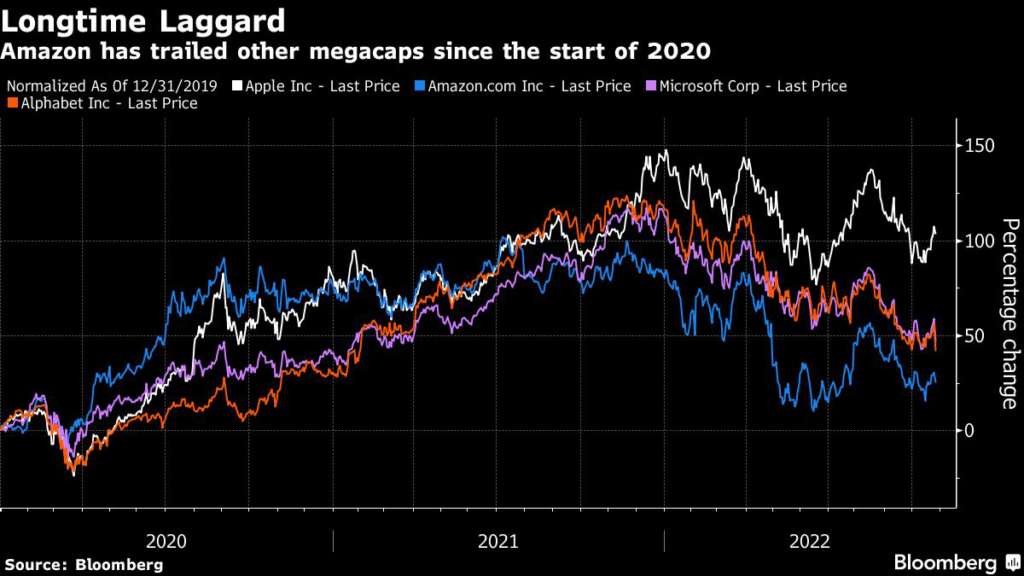
In both bull market and bear over the past two years, Amazon.com Inc.’s shares have lagged behind those of other megacap companies, and tepid results from some of its biggest peers suggest a long-awaited rebound could remain elusive.
(Bloomberg) — In both bull market and bear over the past two years, Amazon.com Inc.’s shares have lagged behind those of other megacap companies, and tepid results from some of its biggest peers suggest a long-awaited rebound could remain elusive.
Since the start of 2020, a period that includes the tailwind it saw from the pandemic, Amazon is up 23%, the weakest performance of Wall Street’s four largest companies — Apple Inc.
has more than doubled, and Microsoft Corp. and Alphabet Inc. are up more than 40%.
Amazon fell 1.9% on Thursday, while the Nasdaq 100 Index was flat.
Amazon’s third-quarter earnings after the market close on Thursday are likely to show the same signs of slowing growth that have afflicted Alphabet Inc.
and Microsoft Corp. The Seattle-based company’s cloud-storage business, Amazon Web Services, has been expanding quickly, but Microsoft gave a lackluster forecast this week for its own cloud unit, Azure.
“Big tech earnings haven’t been particularly positive, and it seems like there’s no place to hide,” said David Klink, senior equity analyst at Huntington Private Bank.
“What’s taking people a little by surprise is that the cloud, which had been viewed as something of a haven for the past few years, is showing some weakness.”
Microsoft’s results led to the biggest one-day drop for the stock since March 2020.
Alphabet sank 9.1% in the wake of its own earnings, and while weaker-than-expected ad revenue was the focus of the report, the Google parent’s cloud offering lost $699 million in the quarter. Facebook parent Meta Platforms Inc.
also gave a weak revenue forecast, sending shares to their lowest since 2016.
Both cloud and advertising are key pillars of Amazon’s growth narrative. While its overall revenue increased 21.7% in 2021, its advertising services business expanded by 58% and Amazon Web Services grew 37%, according to data compiled by Bloomberg.
The two businesses accounted for almost 20% of company revenue last year.
Klink is positive on Amazon’s long-term potential, but he wants to see an increased focus on earnings over revenue growth.
“It needs to move in that direction, because right now it is still valued like a growth stock and growth is slowing.”
Revenue is expected to rise 11% this year, considerable for a company valued at $1.18 trillion, but that would be its slowest pace on record.
Snap Inc. last week reported its slowest quarterly sales growth ever and the shares plunged 28%.
At the same time, Amazon’s stock trades at 40 times estimated earnings, well below its 10-year average of 61, but twice the multiple of the Nasdaq 100 Index.
High inflation has pushed the Federal Reserve to raise interest rates, contributing to the yield on the 10-year US Treasury moving above 4%, compared with 1.5% at the start of the year.
This has contributed to investors rotating out of high-valuation stocks and into ones that screen as value plays.
Barry Knapp, managing partner at Ironsides Partners, expects this trend will continue as inflation remains elevated and the Fed stays hawkish.
“Cloud is still a great business for Amazon and Microsoft, but it’s not going to keep growing at the pace it was, and right now you’re paying an above-average price for below-average growth,” he said.
“Big tech doesn’t look cheap the way financials or energy or materials do, and the higher-rate environment means the backdrop is just less favorable. The days of investors chasing growth at any price are over.”
Tech Chart of the Day
While stock losses have been widespread this year, the selloff in big tech has had an outsized impact on the Nasdaq 100.
The index, which is weighted by the market capitalization of its components, is down 30% this year, while an equal-weighted version of the index is down a narrower 26%. On Wednesday, the equal-weight index dipped 0.4%, compared with a drop of 2.3% for the cap-weighted index, which was pressured by Alphabet and Microsoft’s results.
Over the past five years, however, the Nasdaq 100’s 84% gain easily outpaces the 57% rise of the equal-weighted version.
Top Tech Stories
- Meta Platforms gave a forecast for revenue in the fourth quarter that was on the low end of analysts’ estimates, showing the social-media platform continues to struggle with a weak advertising market amid an economic slowdown.
- Meta Chief Executive Officer Mark Zuckerberg asked investors for patience with the social-media giant’s swelling investments in unproven bets at an already-challenging time for digital-advertising companies.
- Meta shareholders are paying dearly for its spending on the metaverse: The Facebook parent’s market value has collapsed by a whopping $520 billion in the past year, and now it’s on the brink of getting booted from the ranks of the 20 largest US companies.
- Elon Musk told Twitter Inc.
employees on Wednesday that he doesn’t plan to cut 75% of the staff when he takes over the company, according to people familiar with the matter.
- Samsung Electronics Co. named Jay Y. Lee executive chairman of South Korea’s largest company, finalizing a long-anticipated elevation just as a supply chain crisis and escalating geopolitical tensions roil the world’s biggest chipmaker.
- Over the past two weeks, every major memory chipmaker has warned of a supply glut and tumbling prices, announcing it was time to slash capital spending. Not so market leader Samsung.
- Huawei Technologies Co.’s net income fell about 40% in the first three quarters of this year as the Chinese telecom giant couldn’t revive its cash cow smartphone business and spent heavily on research and development.
- STMicroelectronics NV signaled its sales momentum in the fourth quarter may begin to slow amid signs that demand for chips globally is weakening.
The shares sank as much as 8.5% in Paris trading.
–With assistance from Subrat Patnaik.
(Updates to market open.)
More stories like this are available on bloomberg.com
©2022 Bloomberg L.P.