Russia’s central bank cited the inflationary impact of the Kremlin’s recent call-up of reservists to fight against Ukraine in pausing its run of six consecutive interest rate cuts.
(Bloomberg) — Russia’s central bank cited the inflationary impact of the Kremlin’s recent call-up of reservists to fight against Ukraine in pausing its run of six consecutive interest rate cuts.
Ukraine downed 23 out of more than 30 Iranian Shahed attack drones launched by Russia in the past two days, according to President Volodymyr Zelenskiy who called them “metal monsters.” Ukrainian forces also shot down a Kh-59 cruise missile, two Ka-52 attack helicopters and another Su-25 fighter jet during the same period.
Russia’s representative to the UN has denied that Moscow is using Iranian drones.
Russia’s defense minister said the call-up of 300,000 reservists to fight in Ukraine had been completed on schedule.
The partial mobilization prompted some 350,000 Russians, mostly draft-age men, to flee the country. Some 41,000 newly-mobilized troops are already part of active combat units.
(See RSAN on the Bloomberg Terminal for the Russian Sanctions Dashboard.)
Key Developments
- Russian Air Travel is Back, But Aircraft Lack Service, Parts
- Russia Pauses Rate Cuts as War Call-Up Stirs Economic Angst
- Biden Questions Putin Claim Russia Won’t Use Nuclear Weapons
- Putin Plays Down Nuclear Threat in Ukraine as He Lambasts US
- Tiremaker Nokian Renkaat to Exit Russia as Buyer Found for Plant
On the Ground
Russian forces struck Mykolaiv and several settlements in the Kharkiv region near the Ukrainian-Russian border overnight, local authorities said on Telegram.
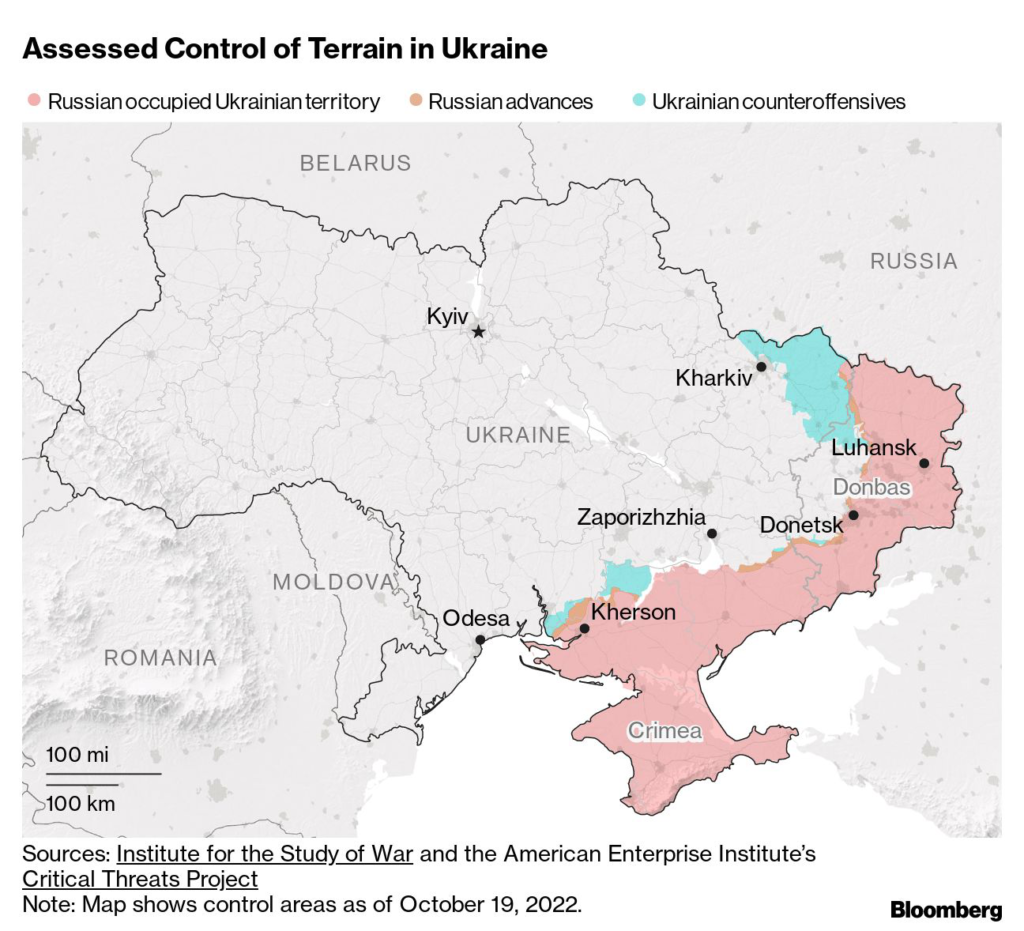
The Ukrainian army continued its counteroffensive in several areas, according to the General Staff. Citing Russian sources, the Institute for the Study of War reported that counteroffensive operations were conducted in the northeastern Kharkiv Region and along the Kreminna-Lysychansk line.
It also noted limited ground assaults by Ukrainian forces in the Kherson region, where Russian forces are continuing to make defensive preparations along the east bank of the Dnipro River. Russian forces continued offensive operations toward Bakhmut and Avdiivka in the Donetsk Region, according to the General Staff of the Ukrainian Army.
(All times CET)
Zelenskiy Scoffs at Russia Saying Its Call-Up Is Complete (8:41 p.m.)
Zelenskiy dismissed Russia’s announcement that it has completed its call-up of 300,000 reservists to fight in Ukraine.
“We feel completely different on the battlefield,” the Ukrainian president said in his nightly address.
“Russia is trying to increase pressure on our positions, using mobilized people, but their training and equipment are so poor that it allows us to assume that soon Russia will need a new wave of sending people to the front.”
Commenting on rolling blackouts, Zelenskiy said about 4 million Ukrainians now have a limited supply of electricity, underscoring his frequent calls for allies to “strengthen our air defenses.”
Ukraine Freezes Electricity Prices Through Winter (7:04 p.m.)
Ukraine’s government approved a decree to keep electricity prices for households unchanged for the winter heating season through March.
“Today, despite the war and massive shelling of energy infrastructure, a decision was made to keep tariffs for households unchanged to avoid additional financial burden on our citizens,” Energy Minister Herman Halushchenko said in an emailed statement.
Russia has intensified shelling of Ukrainian energy infrastructure since Oct.
10, damaging at least 30% of electricity production facilities. Ukraine was forced to introduce power supply limits across its regions and the capital Kyiv may face an electricity shortage of as much as 50%, Mayor Vitali Klitschko said.
Pentagon to Tap Inventories 24th Time for $275 Million in Weapons (6:29 p.m.)
The US Defense Department said it will provide Ukraine with an additional $275 million in weapons, the 24th such drawdown from existing inventories.
This batch will include an additional 500 precision-guided 155mm artillery rounds as well as 2,000 more 155mm rounds of Remote Anti-Armor Mine Systems that dispense tank-busting munitions.
It also provides for transferring 250 M1117 Armored Security Vehicles and more than 2.75 million rounds of small arms ammunition.
One new item is four satellite communications antennas. Pentagon spokeswoman Sabrina Singh said the “off-the-shelf” antennas are separate from equipment for Elon Musk’s Starlink satellite system.
Crowd Seeking End to War in Ukraine Interrupts Blinken in Montreal (5:50 p.m.)
Protesters demanding an end to hostilities in Ukraine briefly interrupted an event with Secretary of State Antony Blinken and Canadian Foreign Minister Melanie Joly in Montreal.
The pair were meeting members of Les Filles Fattoush, an organization that assists Syrian refugee women, when demonstrators began shouting “we don’t want you here” and “Yankee go home.” The two were forced to relocate remarks to the press but were never in danger.
Canada to Issue ‘Ukraine Sovereignty Bonds’ (5:30 p.m.)
The five-year bonds are among the measures Ottawa is putting in place to help Ukraine’s government.
The securities will help Ukraine with essential services including paying pensions and purchasing fuel before winter, Prime Minister Justin Trudeau said in an statement.
Equivalent proceeds will be sent to Ukraine through the IMF’s administered account.
The bonds will be offered via financial institutions. Investors will be, in effect, purchasing a regular top-rated Government of Canada five-year bond.
Zelenskiy later tweeted his appreication.
Shoigu Tells Putin ‘Partial Mobilization’ Complete (4:29 p.m.)
Russia’s “partial mobilization” — calling up 300,000 reservists to fight in Ukraine — is complete and won’t be extended, Defense Minister Sergei Shoigu said in a televised meeting with President Vladimir Putin.
The call-up, Russia’s first since World War II, shocked many citizens and led more than 350,000 to flee the country amid widespread reports of ineligible candidates being drafted and new troops getting inadequate equipment and poor treatment.
Putin on Friday ordered Shoigu to “modernize” Russia’s draft system to ensure such problems aren’t repeated.
Shoigu said 218,000 of the mobilized forces are still in training, while the remainder have already been deployed to Ukraine.
Russia’s Country Risk at Record High (4 p.m.)
Russia’s country risk rose to its highest on record, according to Geoquant indices which quantify risks to investors based on governance, social and security indicators.
The index rose to 63.4 on a scale from 0 to 100 where the higher the number, the greater the risk.
Serbia Needs to Align with EU Foreign Policy: Von Der Leyen (4:09 p.m.)
Like other countries seeking membership of the European Union, Serbia must ensure “a strong alignment with our common foreign and security policy,” said Ursula von der Leyen, head of the European Commission.
Speaking at a joint news conference with President Aleksandar Vucic during a visit to Serbia, von der Leyen said that “joining the EU means sharing the same values.” She added that Serbia has “done a lot already” in terms of reform.
Serbia has condemned Russia’s invasion of Ukraine, including in votes at the United Nations, but has failed to impose economic sanctions against Moscow.
Vucic insists that respect for Ukraine’s territorial integrity must also apply to Serbia, whose southern province Kosovo seceded with Western support.
Russia Holds Rates Steady on Impact of Partial Mobilization (13:40 p.m.)
Russia’s central bank held interest rates for the first time since the immediate aftermath of the attack on Ukraine, as risks of higher inflation intensify following the Kremlin’s call-up of reservists to fight in the war.
“While the partial mobilization may mainly create disinflationary pressure in the coming months due to subdued consumer demand, its subsequent effects will be pro-inflationary as it adds to supply-side restrictions in the broader economy,” policy makers said.
Read more: Russia Pauses Rate Cuts as War Call-Up Stirs Economic Angst
McDonald’s Reopenings Move Ahead Despite Recent Shelling (1:30 p.m.)
McDonald’s is reopening more branches in Ukraine, even as Russian forces shell many of cities and regions far from the front lines, aiming increasingly at the energy grid.
The US fast-food giant resumed operations in Zhytomyr in west-central Ukraine, following restarts in Kyiv and in far-western Lviv, Interfax reported, citing the company’s press office.
McDonald’s halted its operations in Ukraine following Russia’s invasion, but has been gradually reopening since September and seeing strong demand.
The company in a tweet referenced rolling power outages after Russian attacks, saying its menu is “more romantic…by candlelight.”
No Recent Exodus From Ukraine, Border Service Says (1:20 p.m.)
This month’s widespread Russian strikes on Ukraine’s energy grid and the blackouts that have followed in many areas haven’t caused a new exodus from the country, said Andriy Demchenko, spokesman for Ukraine’s state border service.
From Russia’s invasion on Feb.
24 through the end of September, 20.5 million people crossed Ukraine’s western borders — 9.3 million for entry and more than 11 million who departed. More than 50% of those people crossed the border with Poland, Demchenko said.
Russia Focuses Missiles Against Energy Targets, Air Force Says (12:50 p.m.)
Russia has effectively stopped using cruise and ballistic missiles to target military goals in Ukraine, instead hitting energy objectives amid a growing shortage of such weapons, Ukrainian Air Force spokesman Yuriy Ignat said during a video briefing.
Ukraine estimates Russia may have depleted its missile stockpiles to 13-15% of pre-war levels, according to Ignat.
In order to attack Ukrainian troops near front lines, Russia now mostly uses S-300 air defense missiles, adjusted to extend their range to 150 kilometers (93 miles) even though this makes them less precise.
Russia has thousands of such missiles in stockpiles, Ignat said.
Russia Says Ukraine Grain Ship Backlog Was ‘Artificially Created’ (11:15 a.m.)
Russia’s foreign ministry said a backlog of ships waiting to sail under Ukraine’s grain deal had been “artificially created in the port of Istanbul in order to put pressure on our experts, weaken controls and speed up the cargo inspection procedure.” Ukrainian President Zelenskiy last week accused Russia of deliberately slowing the pace of grain exports.
The foreign ministry said that vessels had been detained during the Black Sea safe-corridor deal, and some suspended due to non-compliance and smuggling attempts.
A spokesperson for the grain initiative said no ships had been detained, but that the average waiting time between departure and clearance of outbound ships increased to 15 days in October.
Russian Air Travel is Back, But Aircraft Lack Service, Parts (10:20 a.m.)
Airbus SE said Russian airlines are flying more domestically than before the pandemic, raising concern that they’re doing so without the necessary maintenance requirements because import sanctions prevent the aircraft from receiving spare parts or software upgrades.
“We are worried about the conditions for maintenance as actually the planes are flying a lot,” Airbus Chief Executive Officer Guillaume Faury said on Friday as the manufacturer reported earnings.
“Because of the sanctions, we cannot really monitor and support as we do with our customers in normal times.”
Russia Export Windfall Finds Sanctions Haven in Yuan, Quasi-Bank (10:15 a.m.)
A little-known unit of Russia’s main stock exchange has become a vital link to the global financial system as tens of billions of dollars and euros flood in from sales of oil and other commodities.
The National Clearing Centre has seen its foreign-exchange holdings surge this year, according to people familiar with its operations.
A key link in the gas trade, it has so far avoided the US and European sanctions that have hit the central bank and Russia’s major lenders.
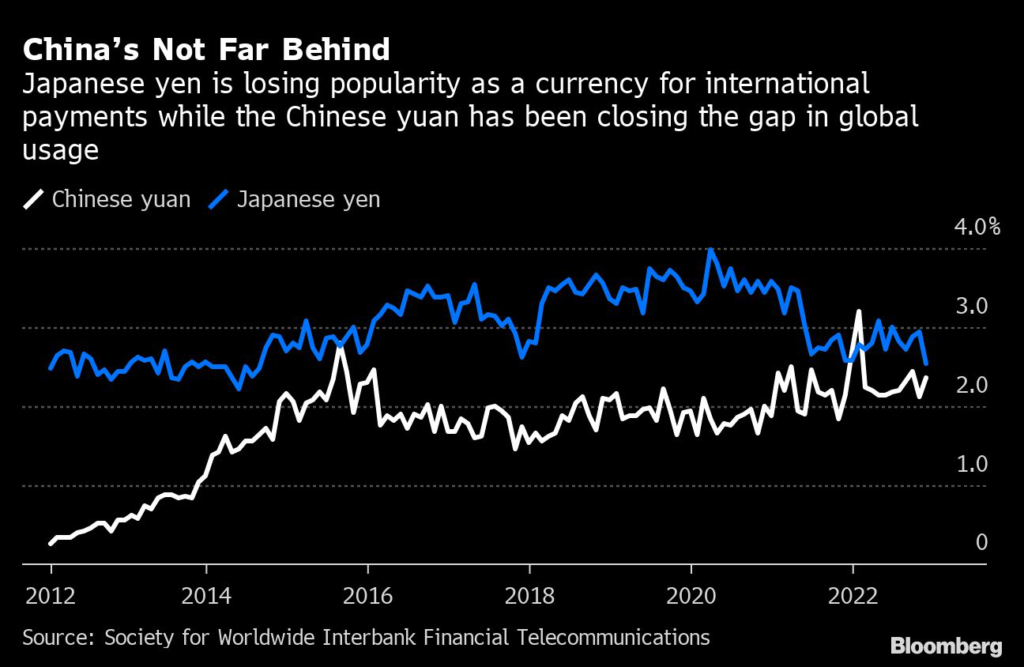
Much of the money at NCC, which is held on behalf of Russian banks and their clients, is in yuan, shifted out of dollars and euros and other “unfriendly” currencies at the behest of the central bank, the people said.
Ukraine Continues to Limit Power in Kyiv, Ukrenergo Says (9:35 a.m.)
The Ukrainian national electricity grid operator Ukrenergo continued power cuts in Kyiv and the surrounding region, the company said on Facebook.
Power supply is also limited in regions in the country’s center and north-east, including Chernihiv, Cherkasy, Zhytomyr, Kharkiv, Poltava and Sumy which suffered the most infrastructure damage from Russian attacks this week.
Ukraine’s Economy Seen Growing Up To 1.9% Next Year (9:15 a.m.)
Ukraine won’t see a full-fledged economic recovery until the second half of 2024 at the earliest, in a worst-case scenario based on high war-related risks persisting through mid-2024, according to the country’s central bank.
The economy would grow by as much as 1.9% in 2023.
In that scenario, inflation will ease faster than expected next year due to reduced consumer demand and frozen utility tariffs, the central bank said in a report published on Thursday.
In a more optimistic base-case scenario that envisages a reduction of military risks next year, the National Bank of Ukraine expects the economy to expand by 4% in 2023.
Chechen Leader Acknowledges Losses in Kherson Region (8:30 a.m.)
Ukrainian shelling killed 23 Chechen troops in the Kherson area and wounded 58, according to Ramzan Kadyrov, the Kremlin-backed leader of the Russian region.
The Telegram comment was an unusual Russian public admission of losses, which Kadyrov called “great” in the latest attack.
The Chechen leader has provided thousands of troops to support the invasion of Ukraine.
Ukraine Shot Down Most Single-Use Attack Drones in Past Two Days, Zelenskiy Says (8:05 a.m.)
Ukraine downed 23 out of more than 30 Iranian Shahed drones launched by Russia in past two days, according to President Zelenskiy.
“I thank the guardians of our sky.
I am grateful to everyone who participated in the fund raising for the ‘catchers’ of such Shaheds,” Zelenskiy said. “Together, we will certainly clip the wings of all metal monsters, no matter how many of them and from where they fly in the direction of Ukraine.”
Russia has launched 4,500 missile strikes and carried out more than 8,000 air-raids on Ukraine since the beginning of its invasion in late February, Zelenskiy said in his regular nightly address to the nation.
Biden Questions Putin Claim on Nuclear Weapons (6:31 a.m.)
US President Joe Biden questioned whether Putin was sincere in saying he had no intention of using nuclear or chemical weapons in Ukraine.
“If he has no intention, why’s he keep talking about it?” Biden said after he was asked if he believes Putin’s denials in an interview with NewsNation, a cable outlet, broadcast on Thursday.
“Why does he talk about the ability to use a tactical nuclear weapon?” Biden added.
“He’s been very dangerous in how he’s approached this. He can end this all. Get out of Ukraine.”
More stories like this are available on bloomberg.com
©2022 Bloomberg L.P.