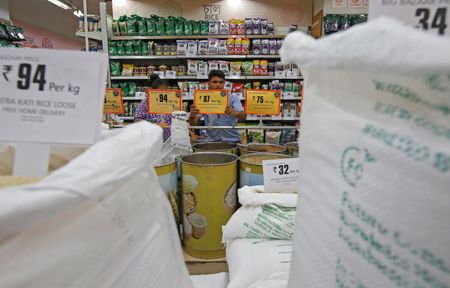
(Reuters) – India’s annual retail inflation eased below its central bank’s upper tolerance level for the first time this year in November, on the back of softer rise in food prices, easing pressure on policymakers.
The annual retail inflation rose 5.88% in November from 6.77% in the previous month, government data showed on Monday.
The Dec. 5-8 Reuters poll of 45 economists had predicted the second consecutive decline in inflation to an annual 6.40% from 6.77% in October.
COMMENTARY
UPASNA BHARDWAJ, CHIEF ECONOMIST, KOTAK MAHINDRA BANK, MUMBAI
“The headline inflation came in sharply softer than expectations. However, the internals suggest that downside is largely led by select food items while core inflation remains quite sticky.
“We continue to see scope for another 25bps repo rate hike in the February policy, but the recent softness in data if continues clearly points towards the repo rate nearing the peak at 6.5%.”
KUNAL KUNDU, INDIA ECONOMIST, SOCIETE GENERALE, BENGALURU
“Unexpected and a rather strong deceleration in food prices has resulted in India’s headline inflation coming in at 5.9% YoY, much lower than our and market expectation, the first sub-6.0% print this year, and the first time it came in within the RBI’s tolerance band.
“However, core inflation remained stubbornly high at 6.5% YoY, suggesting that inherent price pressure might not have eased too much. While this is good news for the RBI, the headline print is still subject to volatility in case food prices reverse from the unusually low levels.
“This print, however, reinforces our belief that the RBI is near the end of its rate hike cycle and we expect the central bank to raise the policy rate one final time in February by 25bps before coming to a pause.”
RUPA REGE NITSURE, GROUP CHIEF ECONOMIST, L&T FINANCE HOLDINGS, MUMBAI
“Inflation has given a pleasant surprise and fallen below 6.0% after a gap of 11 months.
But industrial production has again contracted in a broad-based fashion. This is really worrisome.
“Given the spillover effects of global headwinds and the fragility of domestic demand, the RBI may like to avoid the overshooting of tightening.”
SUJAN HAJRA, CHIEF ECONOMIST, ANAND RATHI, MUMBAI
“Retail inflation and industrial production data released today came substantially below our and consensus expectations.
In line with usual seasonality, food prices declined in November 2022 versus the previous month.
“The decline, however, was significantly more than expected. Non-food inflation also came down on month-over-month basis.
The fall, however, was marginal and core inflation continues to remain elevated at about 6%. With the retail inflation falling below 6%, it is now within the comfort zone of the Reserve Bank of India.
“This, coupled with sharp contraction in industrial production, particularly manufacturing activities, macroeconomic concerns are now likely to shift from high inflation to decelerating growth.
“Sticky core inflation would also be a reason for worry.
While monthly data can be considerably volatile, the current trend suggests that the RBI would be in the pause mode during the next monetary policy decision and may subsequently change the policy stance to neutral.”
SUVODEEP RAKSHIT, SENIOR ECONOMIST, KOTAK INSTITUTIONAL EQUITIES, MUMBAI
“We continue to see CPI inflation around 6% till February 2023 before dipping sharply to 5% in March and to around 4.5% in 1QFY24.
The inflation trajectory is likely to be slightly below the RBI’s latest estimate.
“The case for a pause in the February policy itself will get stronger, especially as the next few CPI inflation prints possibly remain below 6%.
“However, with the focus increasing on sticky core inflation, the February policy will be a tough choice between further tightening and a prolonged pause, especially if global and domestic growth impulses start softening.
“The skew, for now, remains towards a last 25 bps hike, followed by a prolonged pause.”
GARIMA KAPOOR, ECONOMIST, INSTITUTIONAL EQUITIES, ELARA CAPITAL, MUMBAI
“Favorable base effect and seasonal correction in food prices drove the Nov CPI inflation to a 10-month low of 5.88%.
Going ahead, easing supply side impulses, commodity price correction, especially Brent crude, and seasonal softening in food prices led by vegetables are likely to be key tailwind for inflation trajectory.
We see CPI below 6% by Feb 2023 and anticipate the MPC to hike rate by another 25-35 bps in Feb 2023, given its focus on core inflation. We expect a pause thereafter.”
(Reporting by Chris Thomas, Nallur Sethuraman, Nishit Navin and Ashish Chandra in Bengaluru; Editing by Dhanya Ann Thoppil)