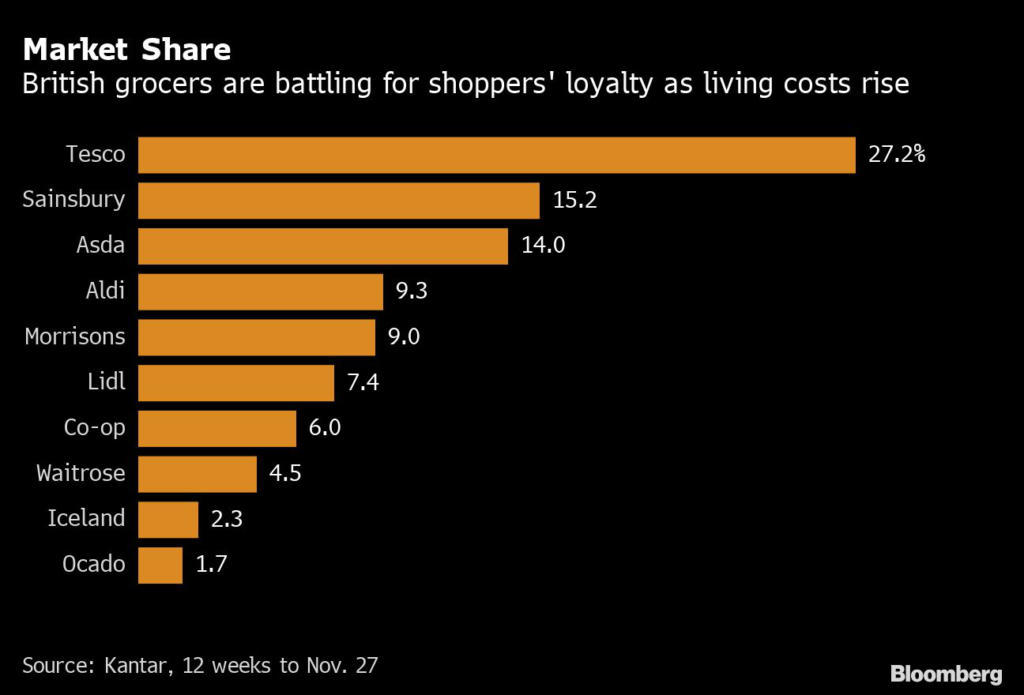
Britons normally splash out on food at Christmas, trading up to more premium grocers for turkeys, mince pies and Champagne. This year, amid the worst cost-of-living squeeze in memory, they’re heading to Aldi and Lidl.
(Bloomberg) — Britons normally splash out on food at Christmas, trading up to more premium grocers for turkeys, mince pies and Champagne.
This year, amid the worst cost-of-living squeeze in memory, they’re heading to Aldi and Lidl.
The German discounters have escalated their challenge to traditional supermarkets like Tesco Plc, slashing prices of fowl and vegetables to try to attract last-minute shoppers.
As competition heats up, grocers are facing eroding profit margins, with J Sainsbury Plc pledging more than £15 million ($18 million) worth of price reductions to keep Christmas costs down.
Aldi and Lidl, which have been on the ascent for years, have gained further ground in 2022 amid soaring inflation.
Aldi overtook Wm Morrison Supermarkets in September to become Britain’s fourth-largest grocer. Now the discounters are turning into holiday shopping destinations.
Demand for Lidl’s holiday range began building last month, with panettone sales up 10% on last year.
Aldi is predicting its biggest UK Christmas haul ever, with goals to sell 38 million pigs in blankets and 50 million mince pies.
“There is no doubt that Aldi and Lidl have become part of the Christmas shopping scene,” said Clive Black, a retail analyst at Shore Capital.
“Because of the straitened times they’re gaining unnatural business, so it will be a fight for the other supermarkets.”
That’s evident in the grocery aisles, where stores have cut vegetable prices this week as a potential loss-leader to get shoppers through the door.
Aldi, Lidl, Tesco and Sainsbury are selling Brussels sprouts, carrots and parsnips at 19 pence a pack. Even upmarket Waitrose has reduced its offering to 30 pence.
Tesco, Aldi and Lidl have also dropped the price of turkeys to as low as £3.99 per kilo just days before Christmas.
“The competition is much more intense than previous years,” said Maureen Hinton, global retail research director at GlobalData Plc.
“Everyone is looking for value at the moment.”
Traditional supermarkets are using loyalty programs to encourage customers to come back. Budget supermarket chain Iceland Foods started its Christmas bonus card-savings program in August to try to get ahead of rivals.
Morrisons offered money-off vouchers to loyalty card customers who shopped with the grocer for four weeks in the run-up to the festive period.
Others are improving their digital services to compete.
Asda is offering delivery on Christmas Eve this year for the first time and increased the number of online delivery slots to 1 million for the week leading up to Christmas. Morrisons has added more than 150,000 click and collect slots in December and lowered the minimum spending requirement.
Britain’s traditionally more expensive grocers, Marks & Spencer Group Plc and Waitrose, are betting that shoppers will still trade up to make the most of the first Christmas without Covid restrictions in two years.
M&S has seen sales of its Christmas party food and hampers rise above pre-pandemic levels while Waitrose’s buffet and party food sales have increased 67% on last year.
Shoppers aren’t trading down and away from Waitrose this Christmas, a spokesperson said.
Analysts are split on M&S with JPMorgan downgrading the shares to underweight on Monday, warning that shoppers are trading down.
The grocer has lowered prices this year through its Remarksable value range including bread, milk and ground beef to encourage fuller baskets.
“We are optimistic that this will be a good Christmas and that people will continue to trade up because the quality speaks for itself,” M&S Chief Financial and Strategy Officer Eoin Tonge said in a phone interview last month.
“People are gearing up for a proper celebration.”
It may be that the worst-hit chains are those that are squeezed in the middle between discount and luxury. Morrisons saw its sales fall 4.7% in the 12 weeks to Nov.
27.
But higher-end Waitrose also suffered during that period, and the discounters have their eyes on that part of the market, betting that some shoppers will pick up a few vol-au-vents or profiteroles along with their budget sprouts.
“We’ve worked hard on premium ranges and we have a really strong Christmas offering,” Ryan McDonnell, Lidl GB chief executive officer, said in a phone interview.
“People can trade up within our range.”
More stories like this are available on bloomberg.com
©2022 Bloomberg L.P.