Turkey’s central bank left interest rates unchanged for the first time in five months, holding true to its word that a cycle of cuts is over.
(Bloomberg) —
Turkey’s central bank left interest rates unchanged for the first time in five months, holding true to its word that a cycle of cuts is over.
The Monetary Policy Committee led by Governor Sahap Kavcioglu kept the benchmark at 9% on Thursday, in line with a guidance given last month and matching the forecasts of almost all economists surveyed by Bloomberg.
“Considering the increasing risks regarding global demand, the committee evaluated that the current policy rate is adequate,” it said in a statement.
The decision sets the stage for a new phase of an effort to fire up economic growth ahead of elections in six months, even as inflation still hovers near a quarter-century high.
After policymakers brought rates into single digits as demanded by President Recep Tayyip Erdogan, the Turkish leader signaled the cost of money is now low enough to encourage investment.
Kavcioglu heeded Erdogan’s calls, defying economic convention in a year that saw the most aggressive global monetary tightening in decades.
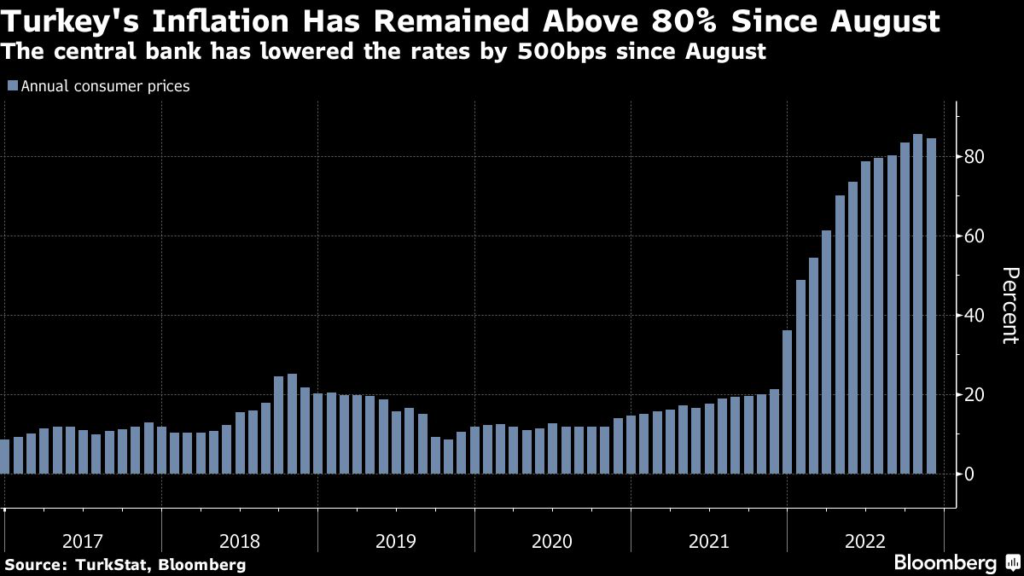
Four rounds of Turkish rate cuts starting in August delivered 500 basis points of easing during a period when inflation topped 80%.
The unorthodox approach has been a hallmark of Erdogan’s tenure as he increasingly tightened his grip over monetary policy in recent years.
Three previous governors who didn’t toe the line ended up being removed by the president.
What Bloomberg Economics Says…
“The central bank’s current accommodative stance will weaken the lira and further pressure price gains.
It will try to contain this negative feedback by relying on non-interest rate tools that have so far guided the financial sector toward lira-based assets and liabilities, favoring lending to exporters.
We also expect the central bank to continue with its currency market interventions.”
— Selva Bahar Baziki, economist. Click here to read more.
The outlook for prices is now slightly less dire.
Inflation slowed in November for the first time in over a year and a half, thanks in large part to the statistical effect of a high base in 2021.
The central bank expects inflation to end the year at 65%.
But the year-end expectations are still 13 times higher than the official inflation target. Erdogan believes it will “tumble down” and fall to 40% in the coming months.
Lacking a buffer against market selloffs, the central bank has instead relied on fringe measures and currency interventions — which Bloomberg Economics estimates at $98 billion this year through October — to support the lira.
Still, the currency remains among the worst performers in emerging markets.
In the time left before the ballot, Erdogan’s priority is kicking the economy into higher gear.
To that end, this week he announced an $11 billion package of cheap loans backed by the government and targeting small and medium-sized enterprises.
Eager to cushion households from soaring living costs, Erdogan has also offered aid programs, affordable housing projects and subsidized utility bills.
On Thursday, he announced that Turkey’s minimum wage will go up 55% in 2023.
But Erdogan is largely pinning the success of his campaign on low interest rates.
“We want investors to make investments,” Erdogan told his ruling party deputies in a speech on Wednesday.
“Here you go 9%; now invest.”
–With assistance from Harumi Ichikura.
(Updates with central bank comment in third paragraph.)
More stories like this are available on bloomberg.com
©2022 Bloomberg L.P.