(Bloomberg) — Lower-rated won corporate notes have lagged the rebound in high-grade peers after South Korea’s credit rout, a trend that may continue on concerns about an economic slowdown.
(Bloomberg) — Lower-rated won corporate notes have lagged the rebound in high-grade peers after South Korea’s credit rout, a trend that may continue on concerns about an economic slowdown.
That’s the view of Joo Tae-young, a senior managing director who heads the corporate finance division of KB Securities Co., Korea’s top arranger of local debt.
The property sector’s uncertain outlook is also making investors cautious about weaker credits, especially those related to the construction industry, he said in an interview.
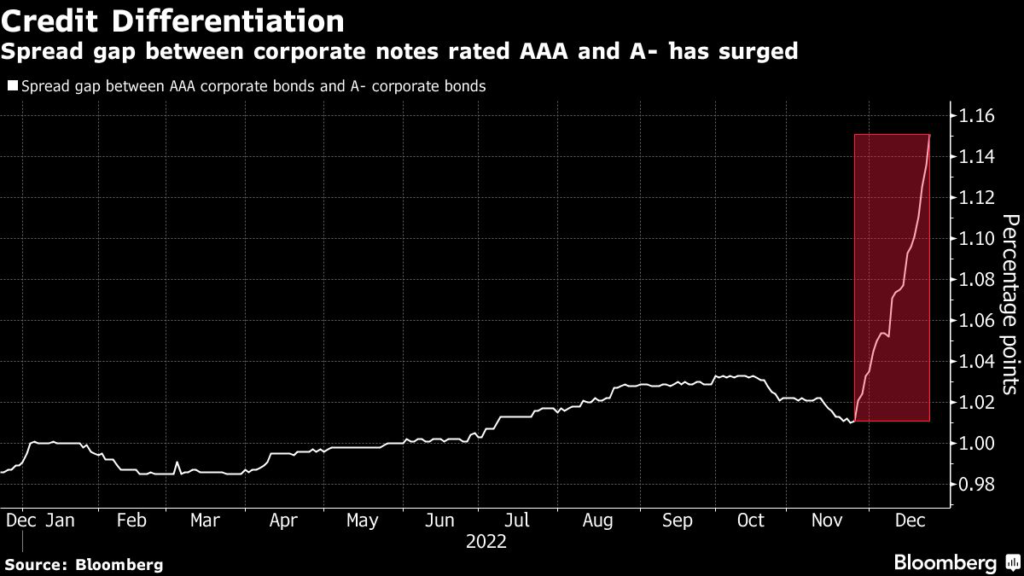
The divergence is reflected in the surging spread gap between corporate notes rated AAA and A- to the widest in almost two years.
Yield premiums on AAA rated company notes fell 24 basis points this month through Friday compared with an 11 basis-point drop in A- rated corporate debt.
Korea’s credit market had been considered one of Asia’s safest for debt, but troubles began when the developer of an amusement park defaulted on a type of asset-backed security related to property projects.
The market’s chaos has now largely subsided after the government, central bank and financial firms stepped in to support borrowers and prevent the crisis from spreading.
Yields on three-month local commercial paper fell for an 11th day, the longest streak since September 2020, a sign that it’s getting easier for companies to raise funds for short-term expenditures like payroll.
Read more: Korea Strains Ease as Yields Drop for First Time Since 2021
Still, in what looks like bad news for bond arrangers, Korean companies sold less debt this year than the amount that’s maturing, the first negative net sales in six years, according to KB Securities data.
The firms sold 40 trillion won ($31 billion) of bonds this year while 53 trillion won of their notes came due.
There will likely be negative net issuance in 2023 too, but overall sales will rise roughly 20% in KB’s base-case scenario, Joo said.
The gloomy economic outlook may also weigh on corporate notes.
South Korea lowered its economic growth forecast for next year while predicting inflation would stay elevated.
The nation will face challenges in exports and in attracting investments amid a global slowdown and a sluggish semiconductor market, while higher interest rates will limit how much consumer spending recovers, the Finance Ministry said earlier this month.
More stories like this are available on bloomberg.com
©2022 Bloomberg L.P.