Hindenburg Research’s attack on the Adani Group is sparking a flurry of bets in the options markets, with a wide divide between those behind the short seller and others predicting a rebound in the shares.
(Bloomberg) — Hindenburg Research’s attack on the Adani Group is sparking a flurry of bets in the options markets, with a wide divide between those behind the short seller and others predicting a rebound in the shares.
Data from the options chain show that all the Adani stocks that trade in the derivatives segment are closer to their support levels relative to their resistances, so a continued decline here will exacerbate downside volatility as investors are either forced to book losses or hedge their open positions.
The optimists view stems from the fact that implied volatility for most of the group’s stocks is already at a 12-month high, so unless more bad news trickles in, swings are likely to come off.
Publicly traded shares in billionaire Gautam Adani’s empire saw a wiping off of about $70 billion of value in the last few sessions, as most of the group firms extended a selloff on Monday.
The conglomerate’s rebuttal of fraud allegations from American short seller Hindenburg Research is largely failing to convince investors.
The rout — triggered by a report from Hindenburg accusing Adani-controlled firms of stock manipulation and accounting fraud – began on Wednesday, the day monthly derivatives contracts were set to expire, resulting in a spurt in investor positioning for the February series.
Here are four charts that show the impact the price plunge had on Adani Group stocks with underlying derivatives exposure:
Outstanding Options
Open interest — a measure of outstanding positions in call and put options — surged as some investors sought protection against the wild swings in the group’s shares.
Adani Enterprises, the conglomerate’s flagship firm, saw outstanding call options jump by 12,578 contracts on Friday, the biggest one-day surge since 2015. Adani Ports saw 19,612 put contracts being added, the highest such change on record.
Option Walls
The extent of price declines seen on Friday saw open positions being created at deep-out-of-money strikes for February 23 expiry.
For instance, in the case of Adani Enterprises, the open interest concentration at the 3200 and 3300 strike calls suggests a “wall of resistance” with put sellers currently expecting the 2400-2500 rupees a share to serve as support, more than 10% lower than where it was trading on Monday morning in Mumbai.
Trading Volumes
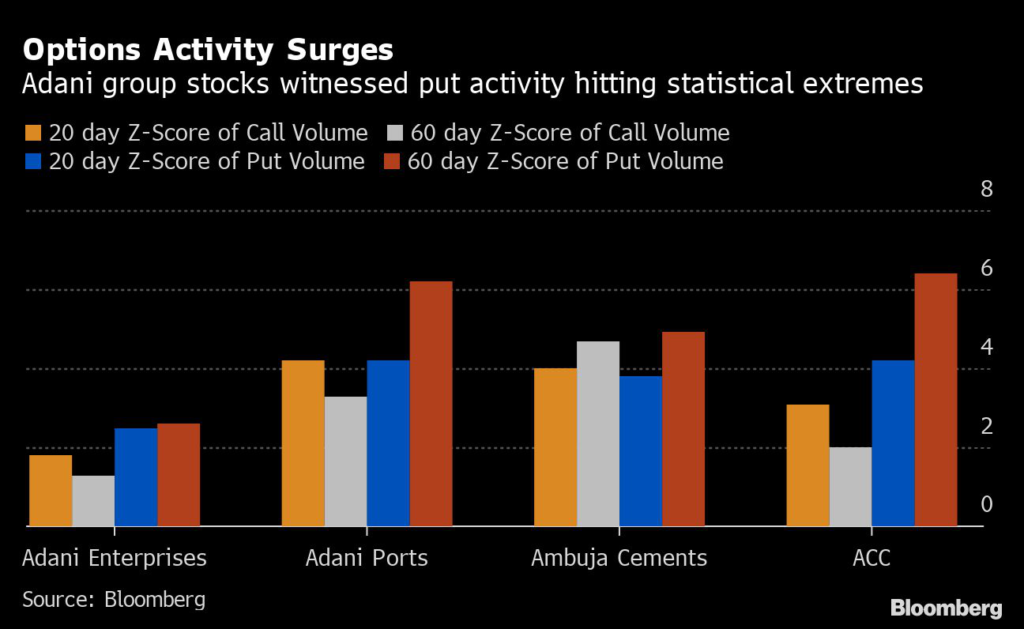
Friday’s rout saw options activity based on the so-called Z-Score — a standard deviation- based measure of the extent that a value differs from an average — reach extremely high levels.
Adani Ports & Special Economic Zone Ltd., whose 60-day Z-Score for the quantity of put contracts traded hit 6.2 standard deviations, the highest since August and one of only 13 instances in history where the measure topped a reading of six.
Such readings have been a precursor to even greater volatility.
In the case of Adani Ports, the last two times the 60-day Z-Score of put activity exceeded a threshold of 6, the stock was down an average of 11% before the decline was arrested. For Ambuja Cements, put activity exceeding a threshold of 4 standard deviations saw the stock lose 7% on average in 2022.
Implied Volatility
Gauges of future implied volatility have surged, showing extreme nervousness among investors and heightened demand for protection against continuing uncertainty.
With the sole exception of Ambuja Cements, the three-month implied volatility for each of the group stock that trades in the derivatives segment — Adani Enterprises Ltd., Adani Ports and Special Economic Zone Ltd.
and ACC Ltd. — hit the highest levels in 12 months.
More stories like this are available on bloomberg.com
©2023 Bloomberg L.P.