The UK’s labor unions emerged emboldened from the country’s worst day of strikes for a decade, threatening further coordinated action to force the government’s hand in pay negotiations.
(Bloomberg) — The UK’s labor unions emerged emboldened from the country’s worst day of strikes for a decade, threatening further coordinated action to force the government’s hand in pay negotiations.
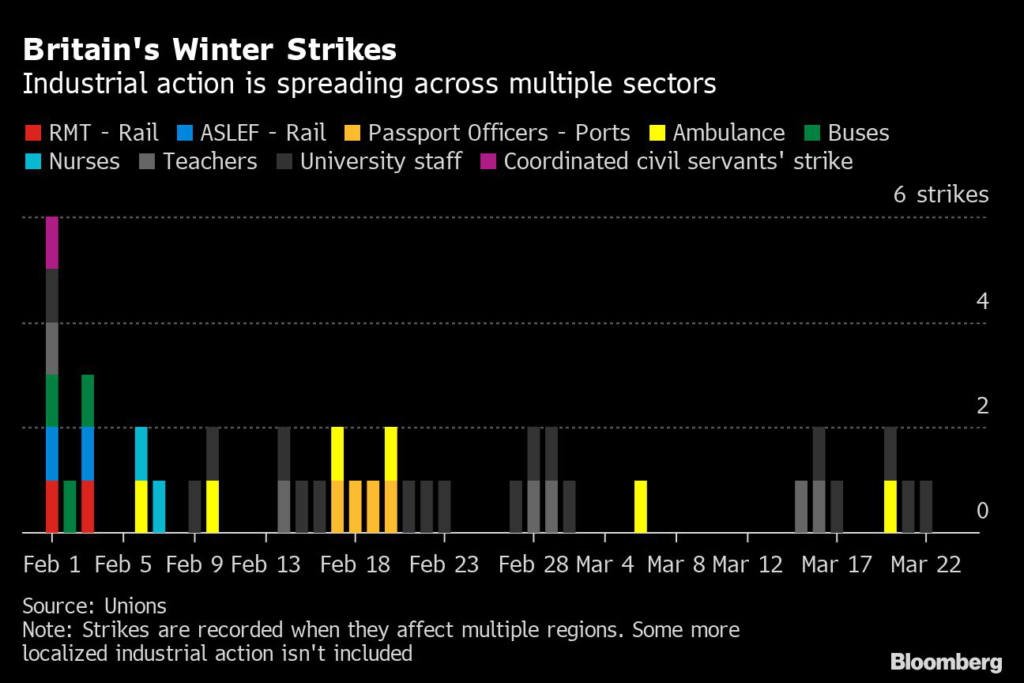
As many as half a million workers walked out on Wednesday, disrupting airports and ports, closing mainline stations and shuttering schools.
The day of coordinated strikes came after months of action in some industries, but there’s little sign the government’s hard-line stance of refusing to revisit pay settlements for the current fiscal year is grinding down the unions’ will to strike through a long and cold winter.
Instead, it appears to have renewed their passion for mass protests.
RMT boss Mick Lynch on Wednesday described action that started last summer as having “reached a crescendo.”
“Hopefully it will get bigger and it will probably need to get bigger to get our demands,” Lynch said on Wednesday in an interview on the sidelines of a rally at Westminster.
Rail Offer
Lynch is renowned as one of the toughest negotiators among Britain’s labor groups and his organization, the RMT, is currently mulling two offers to rail staff following months of strikes — one from the train operators, and another from Network Rail, which manages the tracks.
the union could accept both, but you wouldn’t have bet on it as he stood shoulder to shoulder with fellow union bosses.
Lynch’s words will provide little comfort to Prime Minister Rishi Sunak’s government, which is pushing back against demands for pay awards to match double-digit inflation.
Instead, ministers argue they’ve accepted in full the pay recommendations made by independent bodies for nurses, doctors, teachers and senior civil servants.
While the government doesn’t set pay for rail staff, it ultimately provides the funding that determines how much train companies and the track operator can pay.
Until now, ministers may have held out some optimism that several rail unions were close to agreeing deals, potentially putting pressure on other public sector groups to write off their demands for 2022 and look toward the next pay offer.
EXPLAINER: Why Strike-Averse Britain Is Gripped by Labor Unrest
‘Historic Moment’
But that prospect looks less likely after Wednesday’s strikes, at which representatives of teachers, university staff, train drivers, Border Force officials and many other civil servants seized the opportunity to rally together against the Conservative government.
“This is a hugely historic moment,” Jo Grady, general secretary of the University and College Union, said in an interview, referring to the half million people on strike.
“There is a good chance that in March there will be another day where unions take action together and it will go even higher.”
Wednesday’s mass walkout came after the Trades Union Congress, an umbrella organization for labor groups, urged people to protest on Feb.
1 against a proposed new law imposing minimum service levels during strikes. Unions representing totally different sets of workers subsequently scheduled their next strikes for the same day.
“It’s essential we have more days like this,” Public and Commercial Services Union General Secretary Mark Serwotka told Bloomberg at the London rally.
“The more unions that join, the better.”
‘Farcical’
Serwotka described recent meetings with the government as “farcical,” a sentiment shared by other union bosses after meetings at which ministers refuse to discuss current pay.
Education Secretary Gillian Keegan, asked on Sky News why she was holding meetings while not being willing to negotiate on this year’s pay, said teachers were concerned about other factors such as their workload and “aspects of bureaucracy.”
“You are not supposed to collaborate or coordinate strikes,” she added.
The National Education Union is in no mood to back down, however, and is contemplating future strike coordination.
“I think it could happen again,” said NEU general secretary Kevin Courtney.
“I think it could happen in greater numbers.”
Solidarity
Mick Whelan, general secretary of the train drivers’ union Aslef, was also keen to plan mass strikes spanning multiple corners of the UK economy.
“We will have that discussion and hopefully we will be out with other workers showing our unity and solidarity,” he said at a picket in Euston.
“This isn’t unique to the railways. This an industrial problem created by the politics of a government that doesn’t know what to do.”
Workers who strike don’t receive pay — though many will receive hardship funds from their unions.
But for now, there’s little sign of the appetite for action waning.
Absent from Wednesday’s walkouts were National Health Service workers — but they have their own plans. Catching the mood of coordinated action, the labor group Unison said that next week will see NHS strikes on all but one weekday.
On Monday Feb. 6, nurses and ambulance workers will protest together for the first time.
–With assistance from Irina Anghel.
More stories like this are available on bloomberg.com
©2023 Bloomberg L.P.