For the first time in years, the euro is poised to offer better returns than its Nordic counterparts.
(Bloomberg) — For the first time in years, the euro is poised to offer better returns than its Nordic counterparts.
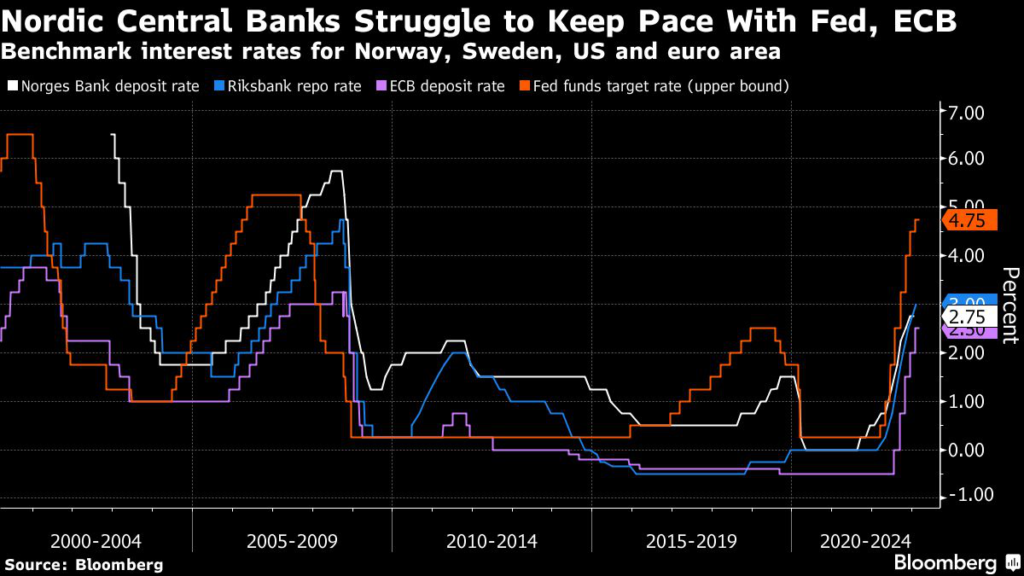
Should money-market wagers materialize, the European Central Bank deposit rate will climb above the Norges Bank key rate for the first time ever and will surpass the Riksbank’s benchmark after five years lagging.
That’s bad news for Nordic currencies, which are already underperforming their Group-of-10 peers.
The fragility was clear this week, when hawkish comments from ECB and Federal Reserve officials sent the Swedish krona and the Norwegian krone tumbling.
“You’re damned if you follow the Fed and the ECB in hiking rates — because your economies are more sensitive to interest rate hikes — but you’re damned if you don’t, because inflation will remain a big problem,” said Dane Cekov, a currency strategist at Nordea Bank Abp in Oslo.
“It’s a bleak, hopeless situation.”
Traders are no longer betting on rate cuts from the ECB and the Fed this year as inflation remains sticky. They now see the central banks’ key rates climbing above 4% and 5.6%, respectively.
Sweden’s rate, meanwhile, is expected to rise to around 4% at most, while Norway’s benchmark is predicted to peak around 3.75%, market pricing tracked by SEB shows.
Both the Riksbank and the Norges Bank are struggling to keep raising interest rates aggressively as economic growth slows down.
In the case of Sweden, the situation is aggravated by households’ high debt burden and mortgage rates that are fixed for a short term, making them even more sensitive to hikes.
The Riksbank has raised borrowing costs from zero a year ago to 3%, the highest since the global financial crisis.
The Norges Bank started tightening in late 2021, taking the deposit rate from zero to 2.75%. That compares with a 300 basis points rate-hiking campaign by the ECB and 450 basis points of increases from the Fed.
Scandinavian interest rates have typically been higher than those of the euro area, providing support to their currencies.
Any change to that dynamic would dim their appeal as carry-trade bets.
The Norwegian krone is down almost 7% versus the euro this year, the worst performance among G-10 peers. The Swedish krona, in the meantime, is trading near a 14-year low despite efforts from policy makers to prop it up.
Last month, the Riksbank pledged to start bond sales and declared it wants a stronger krona, the first demonstration of Erik Thedeen’s monetary stance since he took office.
“Previously we expected a ‘soft-landing’ narrative to begin for Europe, including Sweden and Norway, with inflation peaking which would have supported the Swedish krona and the Norwegian krone,” said Karl Steiner, chief quantitative strategist at SEB in Stockholm.
“As long as we stay in this ‘no-landing’ it is difficult to see what would support the krona and the krone.”
–With assistance from Niclas Rolander, Kati Pohjanpalo and Ott Ummelas.
More stories like this are available on bloomberg.com
©2023 Bloomberg L.P.