The Swedish krona’s unrelenting weakness has alerted traders to the risk that the central bank could intervene directly in currency markets for the first time in more than two decades.
(Bloomberg) — The Swedish krona’s unrelenting weakness has alerted traders to the risk that the central bank could intervene directly in currency markets for the first time in more than two decades.
The potential for official buying of the krona has come into view following its recent slump to a 14-year low versus the euro.
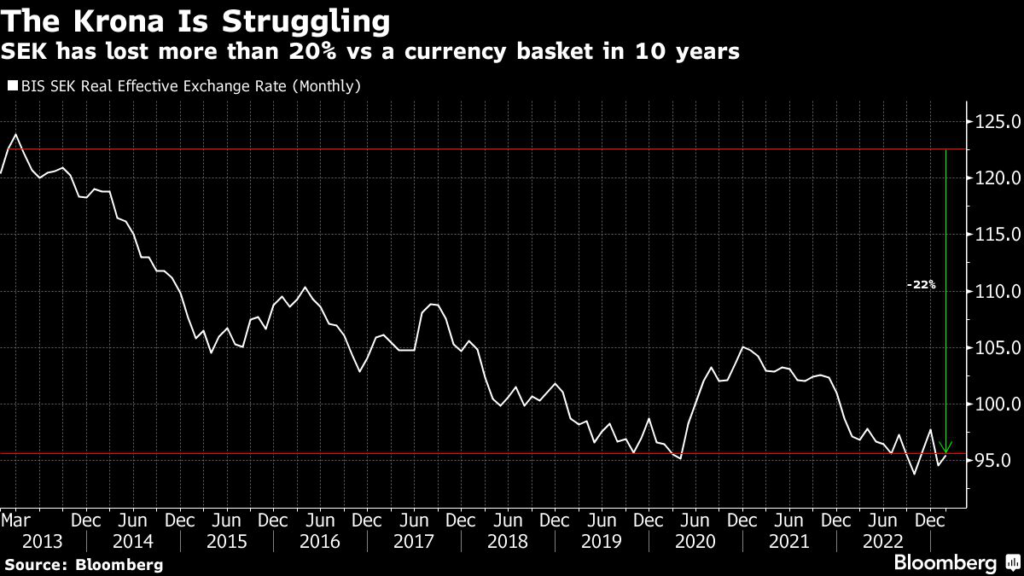
While the Swedish currency has since recovered some ground, it’s still down around 8% in the past year, not far off levels that could spur intervention, according to strategists at Societe Generale SA and RBC Capital Markets LLC.
“Markets are on the alert for intervention if the krona falls again,” Societe Generale strategist Kenneth Broux said, describing levels around 11.40-11.50 per euro as “high-risk” territory.
“The ammunition is in place to intervene if needed, though first they will try to talk it up,” he added, referring to Sweden’s central bank. The currency was trading at around 11.3 per euro on Monday.
Krona weakness is a headache for the Riksbank as it battles near-double-digit inflation.
It has pledged higher interest rates and sped up asset sales to support the currency. Sweden’s property market meltdown and economic recession could make the bank wary of jacking up rates too sharply from its current policy rate of 3%.
Riksbank deputy governor Aino Bunge said that while a stronger krona would be beneficial, buying the currency has so far remained off the table.
“We target the inflation rate, and in the current situation, a stronger krona would be positive from that perspective,” she said. “But we haven’t talked about any intervention. Of course it is part of the toolbox but it’s not anything that we have raised.”
Rare Events
Currency interventions are rare in advanced economies, and the Riksbank last resorted to one in 2001.
But a shift in tone was seen at the bank’s February meeting, when governor Erik Thedeen fired a warning shot to “those who speculate against” the nation’s currency.
The krona is 15% to 20% undervalued in real terms versus its long-term average, RBC Capital Markets strategist Adam Cole estimates, adding this could justify action.
But he says the move would be risky, because it could “open a pandora’s box, if they set a target for markets to aim at.”
Also, official purchases may not offer the krona lasting relief, given that the Swedish inflation-adjusted, or real, interest rate — the return which investors receive after stripping out inflation — is at minus 9%, versus minus 3.4% in the euro bloc, according to data compiled by Bloomberg.
Anders Eklof, a strategist at Swedbank in Stockholm, reckons the krona at 11.50 per euro would make policymakers “really stressed,” but doubts they would intervene, given such action usually needs to be supported with bigger hikes than what are priced in.
“History shows that you need to follow up with punishing speculators with more negative carry,” said Eklof, predicting inflation to gradually cool as the economy slows and tighter policy starts to bite.
Any decision to intervene will hinge too on Riksbank reserves, which at end-2022 totaled SEK482.4 billion ($46.5 billion).
That might be insufficient, given it equates to a single day of krona turnover, noted Simon Harvey, a strategist at Monex Europe Ltd., citing data from the Bank of International Settlements.
Meanwhile, cooling bets on further rate hikes in the euro zone, alongside intervention speculation, may have given the krona some breathing space.
“The chatter is out there and may be giving investors reason to pause if the risk is perceived to be great,” RBC’s Cole said.
–With assistance from Niclas Rolander.
More stories like this are available on bloomberg.com
©2023 Bloomberg L.P.