In the US, ESG has become a political wedge issue. In China, it’s a national rallying cry.
(Bloomberg) — In the US, ESG has become a political wedge issue.
In China, it’s a national rallying cry.
“Environmental, social responsibility and governance,” according to a promotional documentary running on Chinese state media, is a way of “using the power of corporations to achieve a more beautiful society.”
Spurred by Beijing, government-controlled enterprises are beefing up their voluntary ESG disclosures.
Asset managers are introducing new products to appeal to the investing public. And Guo Xiangjun, deputy chief investment officer of China’s $1.35 trillion sovereign wealth fund declared at a forum last month that sustainable investing “will prevail.”
Beijing hopes the embrace of ESG — as it defines it — will encourage investors at home and abroad.
So far, the response has been mixed.
Still, China’s enthusiasm stands in marked contrast to the political attacks on the movement in the US. Many Republican politicians at the state and national levels have campaigned against ESG, and an alliance of about 20 states, led by Florida governor and presumptive presidential candidate Ron DeSantis, says it’s intent on banning ESG investing outright.
In response, money managers have backed away from the term in pitches to conservative states, which have threatened to pull billions from BlackRock Inc.
in protest of Chief Executive Officer Larry Fink’s support for ESG.
China is moving in the other direction. Beijing, which has pledged to be carbon neutral by 2060, is trying to cut the country’s coal consumption and ramp up what is already among the world’s largest stock of wind and solar farms.
Many of the country’s biggest companies are falling in line.
Some 65% of publicly listed central state-owned enterprises (SOEs) issue ESG reports, twice the disclosure rate for all Shanghai- and Shenzhen-listed companies at the end of 2022, according to Hwabao Securities Co.
All publicly listed central SOEs are expected to disclose ESG information by year end, a representative from the State-Owned Assets Supervision and Administration Commission’s research center said at the Boao Forum last month.
Chinese Characteristics
Some investors seem encouraged by the increased emphasis on ESG and the promise of better disclosures.
Since China’s top securities regulator proffered a “valuation system with Chinese characteristics” in a speech in November, an index that tracks the performance of central SOEs has gained 11%, outstripping broader China indexes.
The concept could imply a premium for SOEs that support national goals, which “converges” with ESG investment principles, said Yang Zhenjian, a fund manager at Bosera Asset Management Co.
“Central SOEs have an edge in ESG disclosure, and investors should pay attention to SOEs that take up more social responsibility and are market oriented.”
Lack of disclosure has long been an obstacle for global investors interested in China, and the additional information on ESG will be welcome, Morgan Stanley analysts said in a March research note.
Influential ESG ratings firm MSCI Inc.
is also seeing improvement. Among the mainland China SOE issuers in the MSCI ACWI Index, a fifth of them received ESG upgrades last year, compared with 13% that were downgraded.
ESG Funds
More disclosures may not be enough for global ESG investors, particularly those whose criteria differ from Beijing’s.
Russia’s invasion of Ukraine has made asset managers more aware of the risks of investing in an autocratic country, and even prior to the war, China’s record on human rights was a disqualifier for many.
MSCI last month red-flagged state-owned PetroChina Co.
for links to forced labor in Xinjiang, prompting ESG funds run by foreign asset managers including BlackRock to sell. Beijing has denied the labor allegations. Dozens of foreign ESG funds recently divested from Tencent Holdings Ltd.
on censorship and regulatory concerns, pulling more than $1 billion. Chinese banks meanwhile still account for 87% of global coal financing, and may soon be the only backers for the sector, according to Bloomberg Intelligence.
Recent market performance has also proved a headwind.
ESG fund performance suffered along with the broader markets last year, and investor appetite waned. Net ESG flows in China plunged 98% in 2022 to $1.3 billion, according to Morningstar Inc. data, joining a global pullback.
Net flows into US ESG ETFs dropped 90%, according to Bloomberg Intelligence.
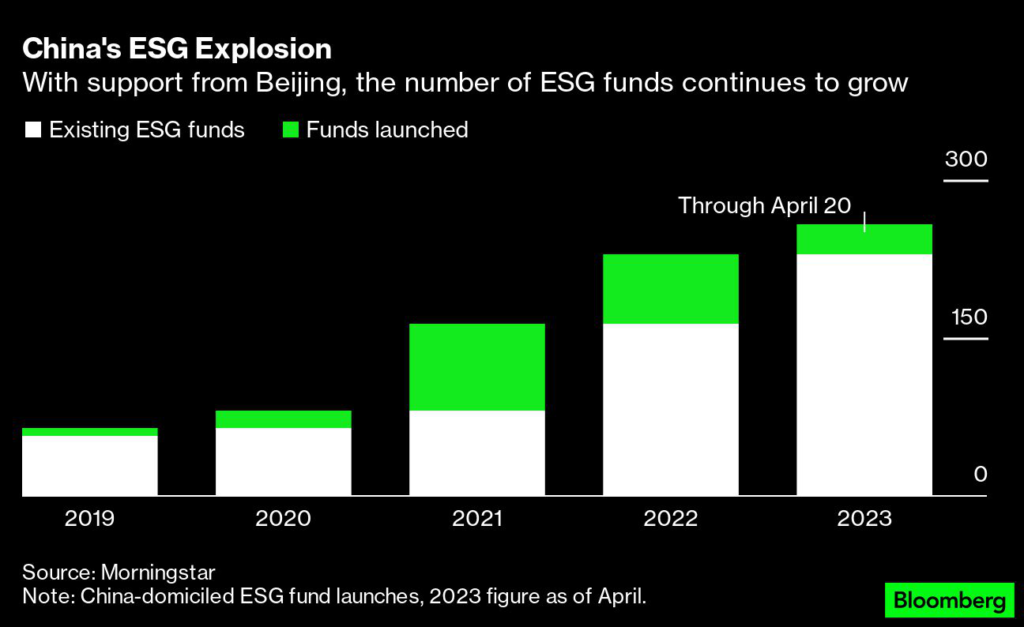
Domestic asset managers believe investors will return. China Securities Index Co. this month said it would release two new SOE-focused ESG indexes, adding to more than 120 ESG-related products across equities, bonds and multi-assets.
Meanwhile, investment firms are keeping up a “steady flow” of ESG fund launches, adding to the existing 140 billion yuan ($20 billion) mutual fund market as a “tactical move” even if there hasn’t been a huge uptick in assets, said Harry Handley at Z-Ben Advisors Ltd.
in Shanghai. “Alignment with high-level policy goals is likely the key driver.”
To attract green capital from abroad, China is bringing its ESG standards in line with international norms. Anti-greenwashing rules for ESG funds could be in place as soon as the first half of this year, according to a Reuters report.
Meanwhile, China and Europe’s “Common Ground Taxonomy” for green finance will boost confidence among global money managers, Ma Jun, president of the Hong Kong Green Finance Association, said at a conference last month.
China is “learning to speak the same regulatory language and ESG is gaining importance worldwide,” said Morningstar analyst Boya Wang.
More stories like this are available on bloomberg.com
©2023 Bloomberg L.P.