Turkey’s central bank will likely heed the market at its last policy-setting meeting before pivotal elections next month, even if it means going against the wishes of President Recep Tayyip Erdogan for ever-lower interest rates.
(Bloomberg) — Turkey’s central bank will likely heed the market at its last policy-setting meeting before pivotal elections next month, even if it means going against the wishes of President Recep Tayyip Erdogan for ever-lower interest rates.
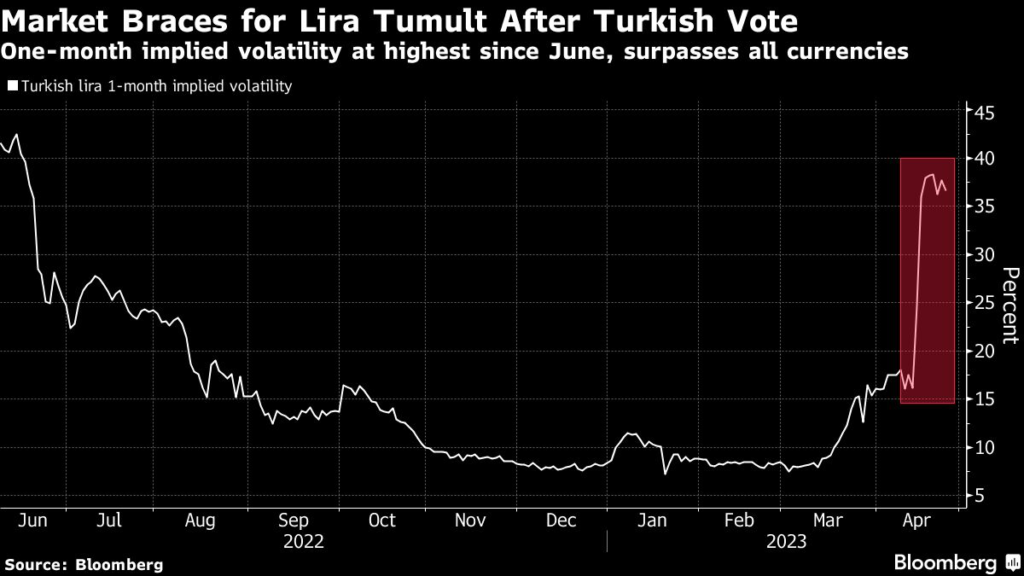
A surge in the Turkish currency’s volatility and expectations for steeper depreciation ahead, regardless of the outcome at the ballot box, may prove decisive on Thursday.
Most economists surveyed by Bloomberg predict the benchmark will stay at 8.5% for a second month.
Read more: Lira Volatility Surges to World’s Highest as Election Nears
Still a small minority that includes HSBC Holdings Plc and Standard Chartered Plc forecasts a decrease of half a percentage point, while others like Goldman Sachs Group Inc.
say a symbolic easing is possible now that just weeks remain before the ballot. The lira’s volatility prompted Bloomberg Economics to revise its call from a reduction to a hold.
“While there is a slight risk for a token rate cut given the upcoming elections are less than a month away, we think the Turkish central bank’s primary focus for the moment is to keep the lira stable amid mounting depreciation pressures, at least until after the elections,” Goldman economists including Basak Edizgil said in a report.
In just over two years at the helm, Governor Sahap Kavcioglu has delivered nine rate cuts and not a single hike, despite having to navigate Turkey’s worst cost-of-living crisis in decades.
It was also a period that saw the world’s most aggressive and synchronized monetary policy tightening in 40 years, leaving Turkey an outlier with borrowing costs among the world’s lowest when adjusted for inflation.
What Bloomberg Economics Says…
“While we cannot fully rule out a rate cut, we see a hold as more likely given the Turkish central bank’s concerns for the current lira turmoil.
That should trump other motivations for further easing. The change in our call is also in line with the policy pivot we expect to see from policymakers once the election results are known.”
— Selva Bahar Baziki, economist.
Click here to read more.
A pause this week would follow an intensifying effort by the central bank to stiffen financial regulations in defense of the currency, even asking lenders to limit their dollar purchases as part of a meddling approach that’s been a hallmark under Kavcioglu.
But pressure on the lira has only built with demand for foreign exchange rising as the elections approach.
Worry has also spread beyond the currency market, pushing the cost of protecting against a default on Turkish debt up rapidly last week.
The Turkish currency has meanwhile been plumbing record lows, down by nearly 4% against the dollar since the start of this year.
Even assuming a policy normalization after the elections, the Turkish currency may decline 30% against the dollar from its current levels, according to JPMorgan Chase & Co.
Long fixated on pushing rates lower, Erdogan has taken a heavier hand in dictating monetary policy since expanding his powers five years ago.
At most recent meetings, the central bank was receptive to the president’s calls in reducing its benchmark by 5.5% percentage points since August.
Though inflation is cooling off in Turkey, it’s been above 50% for over a year.
The alarm among investors hasn’t resonated with Erdogan, who said last week that rates would fall as long as he is in power and bring inflation down with them.
“We will be an example to the world with the Turkey model,” he said.
–With assistance from Joel Rinneby.
More stories like this are available on bloomberg.com
©2023 Bloomberg L.P.