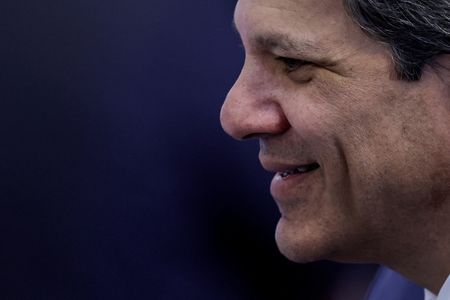
BRASILIA (Reuters) -Brazilian Finance Minister Fernando Haddad said on Tuesday that the country is working on a solution to ensure that Brazilian exporters are paid for sales to Argentina, which is currently facing a severe economic crisis and a shortage of U.S.
dollars.
Haddad emphasized that Brazil does not want to lose its export market share to Argentina, where over 200 Brazilian companies are not exporting or not receiving payments due to the lack of foreign currency, he told journalists.
Argentina is Brazil’s third largest trading partner after China and the United States.
“We are trying to find a mediated solution,” he said, adding that it “necessarily” involves the granting of collaterals by Argentina, which are being currently studied.
Haddad will take part in a meeting between Brazilian President Luiz Inacio Lula da Silva and Argentine Alberto Fernandez later on Tuesday.
Despite the scenario, Brazilian exports to Argentina surged 38% in April and 26% year to date, government data showed on Tuesday.
Herlon Brandao, the director of Foreign Trade Intelligence and Statistics, highlighted that the neighboring country is a major soy producer but has been importing the product from Brazil to supply its processing plants for biofuel production.
He also noted the growth in exports of auto parts and vehicles.
Given that the two countries’ automotive industries are integrated, “there is an effort by businessmen to maintain the markets, wait to receive exported value, and also intra-company trade, which ends up being strong.”
In January, the two countries announced their intention to advance discussions on a common South American currency to be used in clearing houses to execute trade payments between the two countries, helping in part to trim reliance on the dollar.
Brazil also decided to recently simplify procedures of the local currency payment system (SML), an infrastructure that brings together the central banks of Brazil, Argentina, Paraguay and Uruguay.
(Reporting by Marcela Ayres; Editing by Steven Grattan and Sandra Maler)