Brazil’s central bank called for patience on monetary policy, warning that the disinflation process will be more gradual in coming months as the government turns up pressure for lower interest rates to bolster the economy.
(Bloomberg) — Brazil’s central bank called for patience on monetary policy, warning that the disinflation process will be more gradual in coming months as the government turns up pressure for lower interest rates to bolster the economy.
Policymakers gave no indication of discussing rate cuts, saying instead that growth was more vigorous in the first months of the year and that core price measures stripping out volatile items remain resilient, according to the minutes to their May 3 decision, when they held borrowing costs steady at 13.75% for the sixth straight time.
“The disinflation process at its current stage demands serenity and patience,” central bankers wrote in the minutes published Tuesday.
Copom, as the board is known, “emphasized that the conduct of monetary policy, at this moment, requires serenity and patience to incorporate the inherent delays in the inflation control through interest rates and, therefore, to reach the goals in the relevant monetary policy horizon.”
Policymakers led by Roberto Campos Neto are staying cautious even after annual inflation eased within their tolerance range, saying they are “concerned” with expectations that consumer price increases will pick up again.
President Luiz Inacio Lula da Silva slammed the decision over the weekend, saying the central bank chief has “no commitment” to the nation. His remarks added to recent criticism of monetary policy from key members of his administration and business leaders.
Read More: Lula Slams Brazil’s Interest Rates Saying They Hold Nation Back
“Their flight plan seems to be steady rates for a while,” said Caio Megale, chief economist at XP Investimentos.
“There’s certainly no signals of rate cuts at their next meeting” in June.
Central bankers repeatedly mentioned above-target inflation expectations in the minutes, noting that a more persistent movement in long-term forecasts raises the cost of their work.
Part of the unanchored forecasts, they wrote, is related to talk of possible changes to their inflation goals.
“The anchoring of expectations is a key factor for price stability,” they wrote.
Decisions that lower investors’ estimates for consumer price increases “and that raise confidence in the inflation targets would contribute to a faster and less costly disinflation process.”
Central bankers also discussed the current level of neutral rates, which neither stimulate nor hold back economic activity.
Some board members argued the recent “resilience” in activity and a slower disinflationary process point to a higher than 4% neutral rate, though the interpretation “still seems premature.”
What Bloomberg Economics Says
“The minutes of the Brazilian central bank’s May meeting showed policymakers are focused on inflation expectations and worried the neutral interest rate may have risen.
The neutral rate talk is not necessarily an impediment to a rate cut, but may signal that the easing process would be more gradual and end with a higher terminal rate.”
— Adriana Dupita, Brazil economist
Click here to read the full report.
Reduced Uncertainty
Consumer prices rose 4.16% in early April from a year prior, the lowest annual pace since 2020.
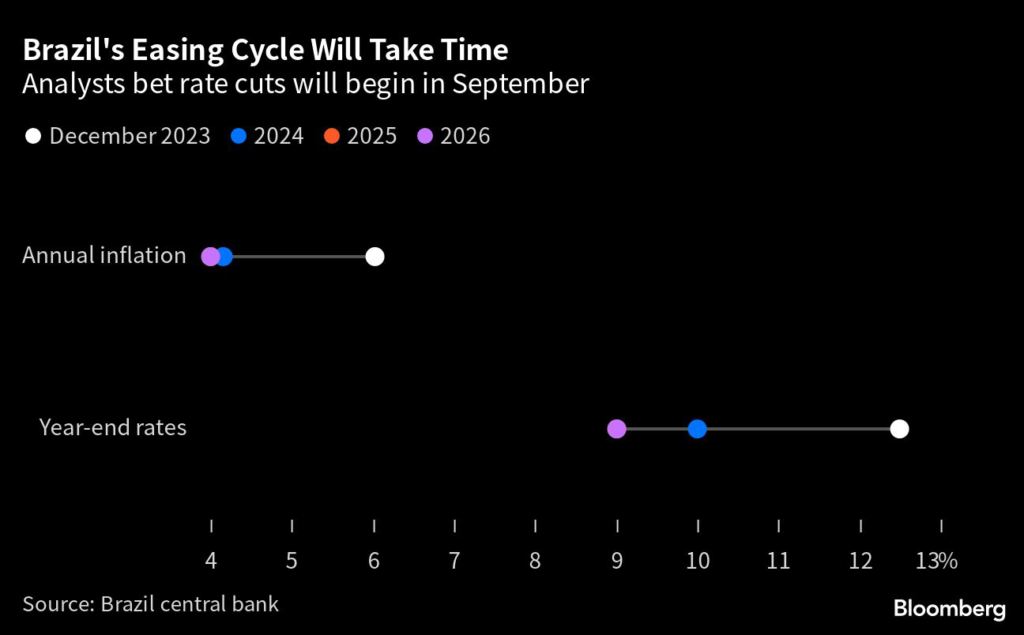
Still, most economists see annual inflation around 6% by year’s end, as core measures remain pressured.
Central bankers see inflation at 5.8% at the end of 2023 and 3.6% for 2024 in their reference scenario, which uses the path for rates laid out in their weekly economist survey.
They target price rises at 3.25% this year and 3% next.
Recent data in Latin America’s largest economy has been mixed. On one hand, credit flows are seen moderating further in the next months, with a stronger decrease in specific modalities “in line” with a tightening cycle that added 11.75 percentage points to borrowing costs.
The labor market remains stable, though some members noted a partial recomposition of real wages. Activity, on the other hand, proved resilient with stronger consumption and agricultural production.
Congress is preparing to debate a bill to shore up public finances, a plan which Lula allies are also counting on to allow for looser monetary policy.
The legislation was initially welcomed by markets, but questions remain on how the government will raise revenues as forecast.
In the minutes, central bankers reiterated there’s no “mechanical” relationship between the presentation of the bill and lower rates.
Still, the plan reduces “the uncertainty associated with extreme scenarios of public debt growth,” while a credible fiscal framework “may lead” to a more benign disinflation process.
Adding to recent investor bets that the central bank may start cutting rates sooner than expected was Lula’s decision on Monday to tap Finance Minister Fernando Haddad’s deputy, Gabriel Galipolo, for the central bank board along with career public servant Ailton Aquino dos Santos.
Both will have to be cleared by the senate before starting their mandates.
Read More: Lula Taps Haddad’s Right-Hand Man for Central Bank Board
(Updates with more details, economist comments throughout)
More stories like this are available on bloomberg.com
©2023 Bloomberg L.P.