The European Central Bank has only a “marginal” distance left to cover in raising interest rates to combat inflation, according to Governing Council member Francois Villeroy de Galhau, who sounded a more cautious tone on future monetary tightening than some of his colleagues.
(Bloomberg) — The European Central Bank has only a “marginal” distance left to cover in raising interest rates to combat inflation, according to Governing Council member Francois Villeroy de Galhau, who sounded a more cautious tone on future monetary tightening than some of his colleagues.
Inflation in France — where Villeroy heads the central bank — is moving past its peak and may ease to about 4% by year-end before meeting the ECB’s 2% goal as soon as end-2024, he told the Ebra group of regional French newspapers in an interview published Wednesday.
Most of the required impact on consumer-price growth will come from the 375 basis points of increases in borrowing costs already enacted since last summer, Villeroy said.
“We’ve already completed most of the journey,” he said.
“What’s left to cover is more marginal.”
After slowing the pace of its unprecedented tightening campaign last week, other ECB policymakers have continued to emphasize that hikes aren’t over.
While economists mostly envisage two more quarter-point moves to bring the deposit rate to 3.75%, officials are starting to accept that increases may need to continue for longer, according to people familiar with the debate.
President Christine Lagarde said earlier Wednesday that there’s still “more ground to cover,” while Executive Board member Isabel Schnabel said Tuesday that the ECB will continue raising borrowing costs “with full determination until there are signs that core inflation is also falling on a sustained basis.”
Villeroy’s remarks coincided with the publication of the Bank of France’s monthly economic survey in April, which showed inflation pressures abating in industry.
For the first time since 2020, more French business leaders reported raw material costs falling than rising. The share in industry increasing prices that month also slipped to the lowest since January 2021.
“There’s clearly a change in price trend for production prices in manufacturing,” Bank of France Chief Economist Olivier Garnier said in a presentation of the poll’s results.
The survey also showed increased economic activity in April for industry, services and construction.
While a May slowdown is likely due to several public holidays, gross domestic product should still record a “slightly positive” second-quarter result, the central bank said.
Villeroy said that outlook confirms the Bank of France’s 0.6% growth forecast for 2023.
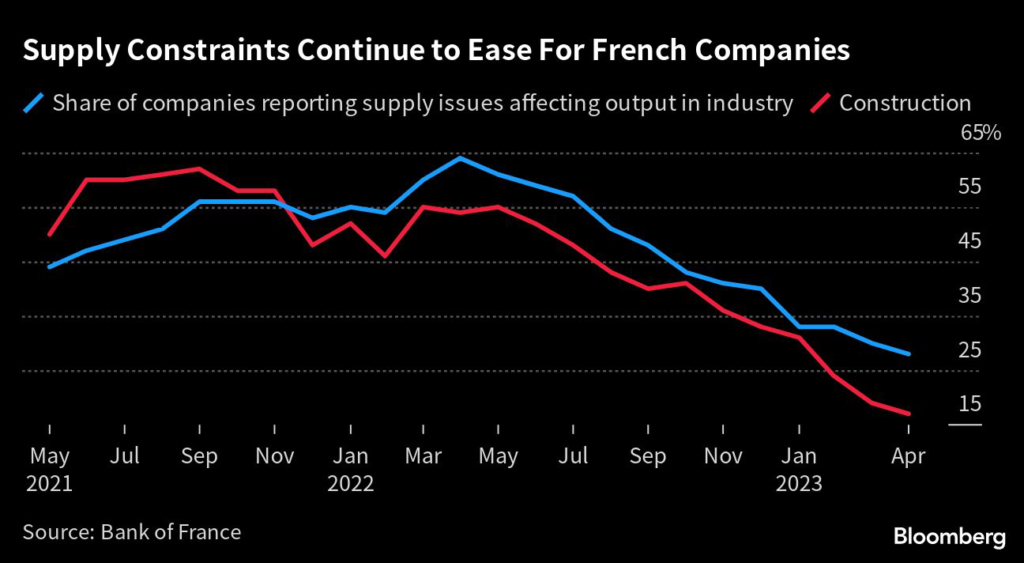
In a further boost to the economy and efforts to tackle inflation, supply constraints also moderated for a second straight month in industry — reaching their lowest since the measure was created two years ago.
More stories like this are available on bloomberg.com
©2023 Bloomberg L.P.