For all the latest calls to prohibit short selling amid the banking turmoil, there’s an argument to be made that such a ban would actually hurt investors.
(Bloomberg) — For all the latest calls to prohibit short selling amid the banking turmoil, there’s an argument to be made that such a ban would actually hurt investors.
Short sellers may have reaped billions of dollars this year by betting against banks, but some market pundits say they’re also helping to shed light on overvalued companies in the sector.
And a ban on the tactic, similar to one imposed by the Securities and Exchange Commission during the Global Financial Crisis, seems unnecessary as other regulatory measures could be explored.
“There’s a robust academic record showing that past bans on short selling of banks harmed investors and failed to arrest falling stock prices,” Managed Funds Association President and CEO Bryan Corbett said in a statement.
“It would be regulatory malpractice to repeat these past mistakes.”
Banks have been facing pressure from rising interest rates since the Federal Reserve embarked on aggressive monetary tightening last year.
Short sellers targeted companies like SVB Financial that didn’t have sound business models, according to Christopher Whalen, chairman of Whalen Global Advisors, a financial consulting firm.
“The fundamentals are such that these banks should be cheaper,” Whalen said, noting that short sellers may have contributed to SVB’s woes but should not be blamed for its collapse.
Shares of “healthy companies don’t go to zero simply because there is an abundance of short sellers,” said Steve Sosnick, chief strategist at Interactive Brokers.
Bank failures, however, have the industry rattled and short sellers raking in $7 billion so far this year, according to data from S3 Partners LLC.
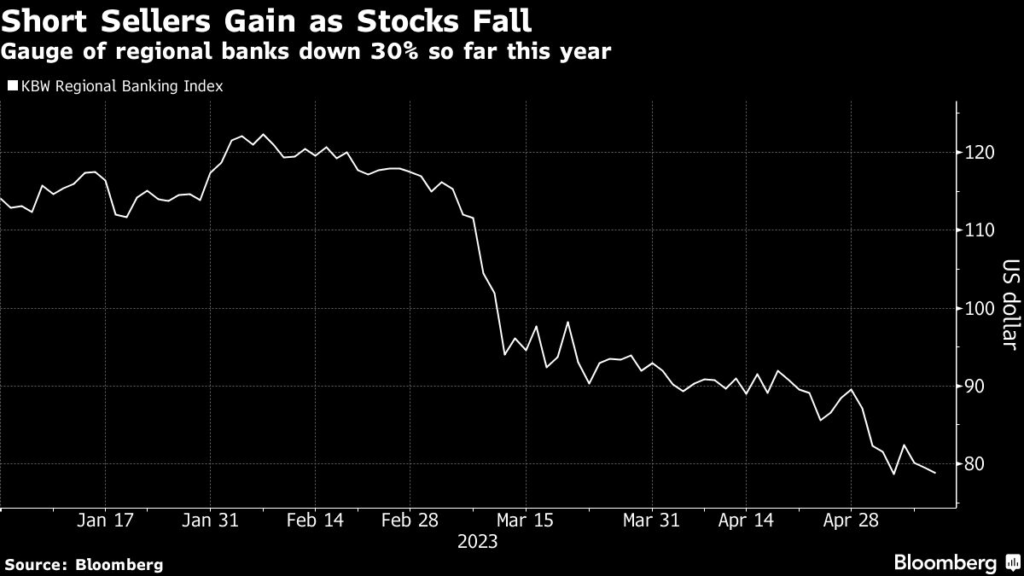
The KBW Regional Banking Index is down 30% in that period.
The current situation is the reverse of the 2021 meme-stock craze, as banks with solid fundamentals are having equity valuations pushed down, unnecessarily eroding confidence in the entire system, Piper Sandler analyst Mark Fitzgibbon said in a note.
“We believe that the SEC, Congress, and the banks themselves should act swiftly and decisively to stabilize the sector,” he said.
The selloff has led US prosecutors to examine bank short-seller activity for potential securities market manipulation, Reuters reported Wednesday.
QuickTake: What’s Short Selling?
Who Is Hindenburg Research?
A SEC spokesperson told Bloomberg it does not comment on the existence or nonexistence of a possible investigation. A representative for the Justice Department also declined to comment.
Recently, the agency said it isn’t currently considering a short-selling ban, but SEC Chair Gary Gensler said in a recent statement, “in times of increased volatility and uncertainty, the SEC is particularly focused on identifying and prosecuting any form of misconduct that might threaten investors, capital formation, or the markets more broadly.”
The White House also downplayed any need to prohibit short selling to stabilize the banking system, but maintained that President Joe Biden is keeping all options open.
And, while prohibiting short selling is rare in the US, it’s more common in countries looking to curb steep losses.
South Korea, Russia and Taiwan have all placed restrictions on the practice to limit downside in their equity markets.
South Korea is looking to lift its ban as prohibiting the practice has kept foreign investors from buying local stocks.
A resumption of the practice would help the country get an upgrade in MSCI Inc.’s equity index.
Read more: Short Seller Marc Cohodes Mulls Wagers Against US Regional Banks
Meanwhile, in March Russia lifted its month-long ban on shorts for professional investors only and a month before that, Taiwan unwound a similar restriction on the practice but kept in place requirements such as high costs to control market volatility.
To be sure, in the US there are curbs to short selling that are already in place.
The SEC implemented a rule in 2010 to preserve investor confidence by limiting short selling when a stock is plummeting by at least 10% in one trading session.
There are also other ways to help protect US regional bank stocks, JPMorgan analyst Steven Alexopoulos wrote in note defending the sector even as bearish sentiment grows.
They include the Federal Deposit Insurance Corp.
lifting its bank deposit insurance cap, the Fed pivoting on policy or reforms that would limit the type of information is allowed to be shared on social media, he said.
“Enough pressure is building that with every passing day it gets more likely that some form of relief will be provided to the sector,” Alexopoulos wrote.
–With assistance from Katherine Doherty and Lydia Beyoud.
More stories like this are available on bloomberg.com
©2023 Bloomberg L.P.