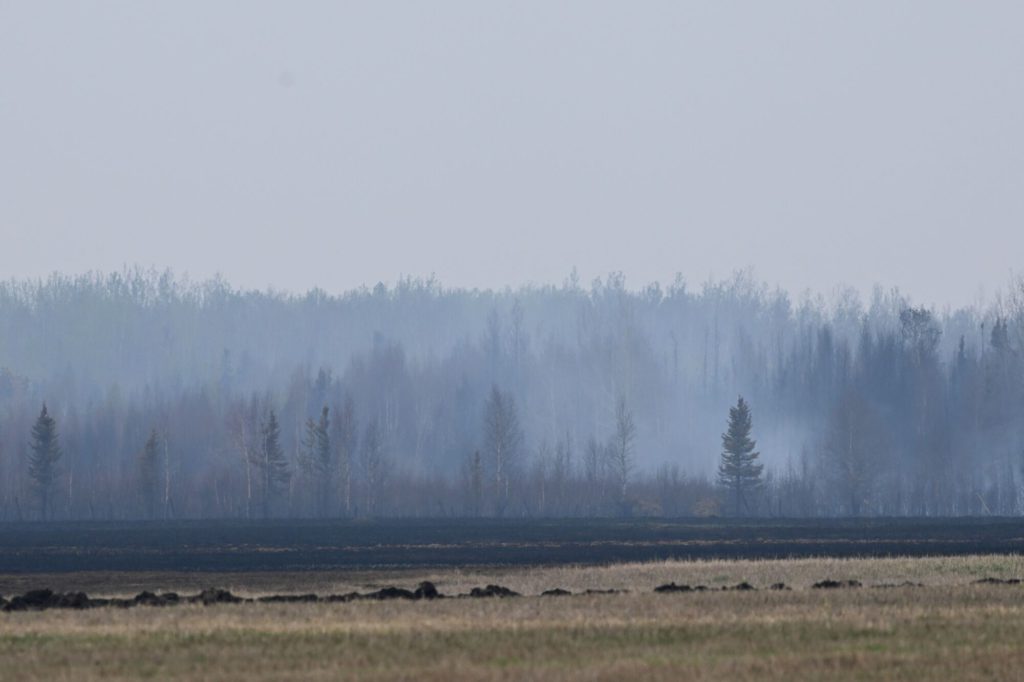
While the number of fires and evacuees across Canada’s top energy-producing province continues to decline, officials are preparing for a possible resurgence of the blazes when warmer, drier weather moves into the area this weekend.
(Bloomberg) — While the number of fires and evacuees across Canada’s top energy-producing province continues to decline, officials are preparing for a possible resurgence of the blazes when warmer, drier weather moves into the area this weekend.
Provincial officials said firefighters have been building firebreaks around vulnerable areas, moving resources to new locations and coordinating with personnel that have come from the US and across Canada to help.
“Firefighters have been working hard, preparing for more challenging conditions,” Christie Tucker, information unit manager for Alberta Wildfire, said during a media briefing Wednesday.
The number of evacuees is down to fewer than 18,000, Colin Blair, executive director of Alberta Emergency Management Agency, said at the briefing.
That compares with 30,000 over the weekend.
Among companies working in the region, TC Energy Corp. and Keyera Corp. said Wednesday that it had restarted facilities it had previously shut down.
Canadian Heavy Oil Prices Strengthen Further (1:04 p.m.
MT)
Heavy Western Canadian Select’s discount to the US benchmark continued to narrow on Wednesday, shrinking 20 cents to $13.30 a barrel, the smallest in a year. While the wildfires have had minimal impact on heavy crude output, they may be freeing up pipeline space and could affect the flow of light condensate to the oil sands, where it’s mixed with bitumen.
Local AECO natural gas prices declined for a second day, falling 7.2% to C$2.06 per million British thermal units.
Canadian Gas Outages Shrink as Fire Count Falls (12:49 p.m.
MT)
The amount of Canadian natural gas production curtailed by wildfires was less than 1 billion cubic feet a day on Wednesday, according to Gary Cunningham, director of gas market research at Tradition Energy.
The effect of the outages on the US gas market has been muted as the Canadian production wouldn’t have flowed south anyway, he said.
About 2.5 billion cubic feet per day of natural gas production — about 15% of all of Canada’s output — was shut down by the blazes, Wood Mackenzie estimated on Tuesday.
US gas market traders and analysts were monitoring the impact of the wildfires in western Canada, noting that the smoke layer formed by the fires was helping keep temperatures lower and mitigating gas demand, said John Kilduff, founding partner at Again Capital.
Companies including Crescent Point Energy Corp.
and Tourmaline Oil Corp. reported the resumption of some production and operations in the area.
Output Cuts Linger as Fire Count Drops (10:24 a.m. MT)
The number of fires burning in Canada’s top energy-producing province of Alberta declined overnight, bringing some relief to drillers and residents.
Alberta reported 76 active wildfires as of 10:24 a.m.
Calgary time on Wednesday, with 24 of those listed as out of control. That’s down from more than 100 fires and 30 out of control over the weekend.
Still, oil and gas output disruptions continue.
Meanwhile, Pipestone Energy Corp. said some of its output had come back online. See below for a rundown of energy companies’ latest or most significant announcements.
GHG Emissions From Blazes Reach 5 Megatons (6:22 a.m.
MT)
The fires burning across western Canada have released more than 5 megatons of carbon emissions this year, according to the Copernicus Atmosphere Monitoring Service. For context, Canada’s total greenhouse gas emissions in 2021 were about 670 megatons, according to government data.
The plume of smoke from the blazes has crossed Canada toward the northeastern US and is expected to continue into the Atlantic Ocean, Copernicus said.
“The scale and intensity of the current fires are reflecting increased fire risk following some weeks of drier than usual conditions,” CAMS Senior Scientist Mark Parrington said in a report.
“Wildfires are not particularly unusual in the boreal forests spring, and we have monitored fires in both Canada and Eurasia at this time of year in the past. Nonetheless continue to monitor these conditions as we approach summer when the boreal fire season starts to reach its peak.”
Operational Updates
Below is a summary of operational updates from companies working in the area:
- TC Energy restarted all compressor stations that were shut as precaution “as conditions have improved with evacuation alerts/orders lifted in many areas across Alberta.” The company said it isn’t aware of any material damage to its assets.
- Keyera said in an email statement that it restarted the Wapiti Gas Plant on Wednesday and is prepared to resume operations at other facilities when conditions allow.
- Crescent Point has restored about 75% of the 45,000 barrels of oil equivalent a day of output that was shut in the Kaybob Duvernay due to fires.
No damage has been reported and the company plans to fully restore the remaining production when its safe.
- Tourmaline has restored operation to seven of nine of its facilities that were shut due to the fires and they are running at the same rates as before the fires.
West Wolf and Columbia are awaiting final start-up clearance from Ministry of Forestry, expected in the next few days. This leaves the equivalent of 16,000 barrels of oil offline.
- Chevron Corp.
evacuated staff within fire zones, and fully halted its Kaybob Duvernay production. Last year, net oil equivalent production was 40,000 barrels per day and net crude oil production of 11,000 barrels per day.
This accounts for Chevron Canada’s 70% owned and operated interest in its Duvernay shale play.
- Kiwetinohk Energy Corp. halted roughly a third of its production has been shut-in for the past few days due to third-party disruptions downstream.
Last quarter, the driller reported about 24,000 barrels of oil equivalent a day of total production. Its assesing the situation daily. and hasn’t initiated any force majeure yet.
- Pipestone said the amount of production curtailed by the fires has shrunk to 5,000 barrels a day, down from 20,000 barrels previously.
- Paramount Resources Ltd.
has shut the equivalent of about 50,000 barrels a day of oil production as of May 5 as a precaution and because of disruptions to third-party infrastructure, the company said Sunday. Its operations in the Grande Prairie and Kaybob regions are being affected.
- Cenovus Energy Inc.
said the equivalent of about 85,000 barrels of oil production has been affected by the fires, primarily dry gas from the company’s Rainbow Lake, Kaybob-Edson, Elmworth-Wapiti and Clearwater operating areas.
The company maintained its guidance for output of 790,000 to 810,000 barrels of oil equivalent a day for the year.
- Canadian Natural Resources Ltd. has temporarily shut the equivalent of about 39,000 barrels of oil production, including all sites in proximity to wildfires.
Oil-sands mining operations haven’t been affected.
- NuVista Energy Ltd. shut about 40,000 barrels a day of production after depressurizing operations close to fires.
- Vermilion Energy Inc.
temporarily shut 30,000 barrels a day of production, but added in a statement that initial assessments indicate minimal damage to key infrastructure.
–With assistance from Danielle Bochove and Brian K.
Sullivan.
More stories like this are available on bloomberg.com
©2023 Bloomberg L.P.