The Biden administration updated the status of its deployed nuclear forces while taking a dig at Russian opacity two months after the Kremlin left a landmark arms-control treaty.
(Bloomberg) — The Biden administration updated the status of its deployed nuclear forces while taking a dig at Russian opacity two months after the Kremlin left a landmark arms-control treaty.
The US will continue a “tradition of transparency despite Russia’s purported suspension of New START,” the State Department said in a statement Monday, referring to the treaty signed in 2010 that limited the number of nuclear warheads the two nations can deploy at any one time.
Russian President Vladimir Putin suspended participation in the treaty on Feb.
21, eliminating inspections and data exchanges needed to verify commitments under the last accord between the two powers that restricted their nuclear arsenals. US President Joe Biden called the decision a “big mistake.”
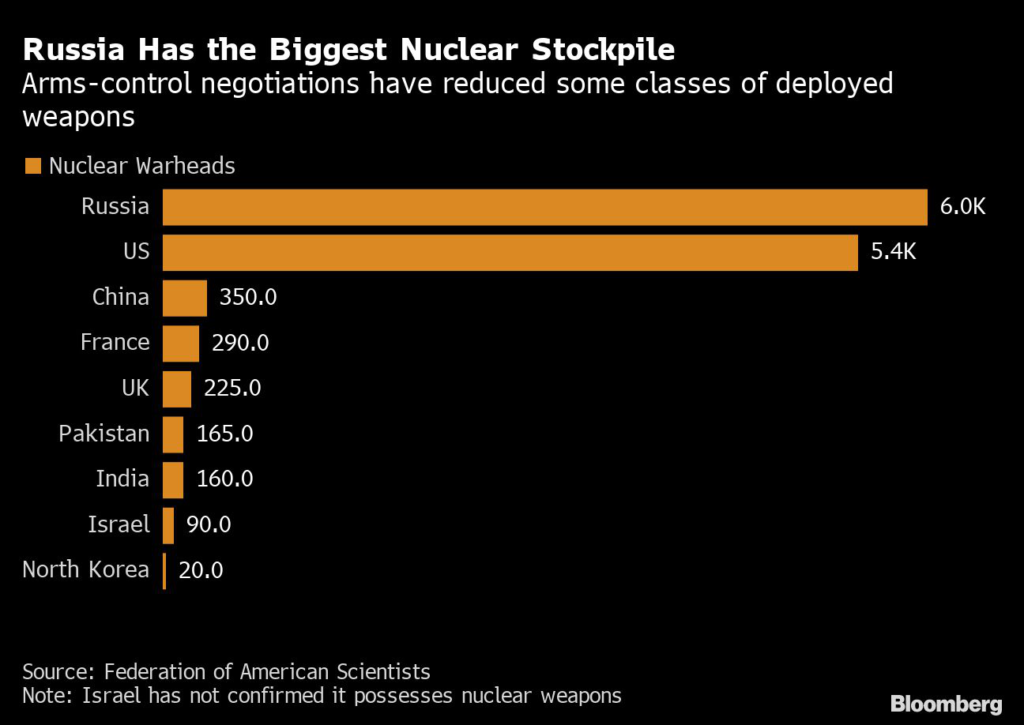
Washington currently has 1,419 warheads deployed on a combination of 662 land- and submarine-launched missiles as well as heavy bombers, according to the declaration.
That’s well within the limit of 1,550 warheads on 700 vehicles. Russia didn’t provide updated figures.
“The US continues to view transparency among nuclear weapon states as extremely valuable for reducing the likelihood of mis-perception, miscalculation, and costly arms competitions,” according to the US statement.
“Such measures are especially important in periods of high tension.”
Why US-Russia ‘New START’ Nuclear Treaty Is in Peril: QuickTake
Nuclear tensions have spiked in the wake of Russia’s February 2022 invasion of Ukraine.
The Kremlin’s state-controlled Rosatom Corp. took over Europe’s biggest atomic power plant located outside the Ukrainian city of Zaporizhzhia and Putin has hinted at the potential use of nuclear weapons.
The US called on Russia to return to all of its “legally-binding obligations” under the New START Treaty.
Biden and Putin agreed to a five-year extension of the treaty shortly after the US president took office in January 2021, after his predecessor Donald Trump had sought to renegotiate the deal.
More stories like this are available on bloomberg.com
©2023 Bloomberg L.P.