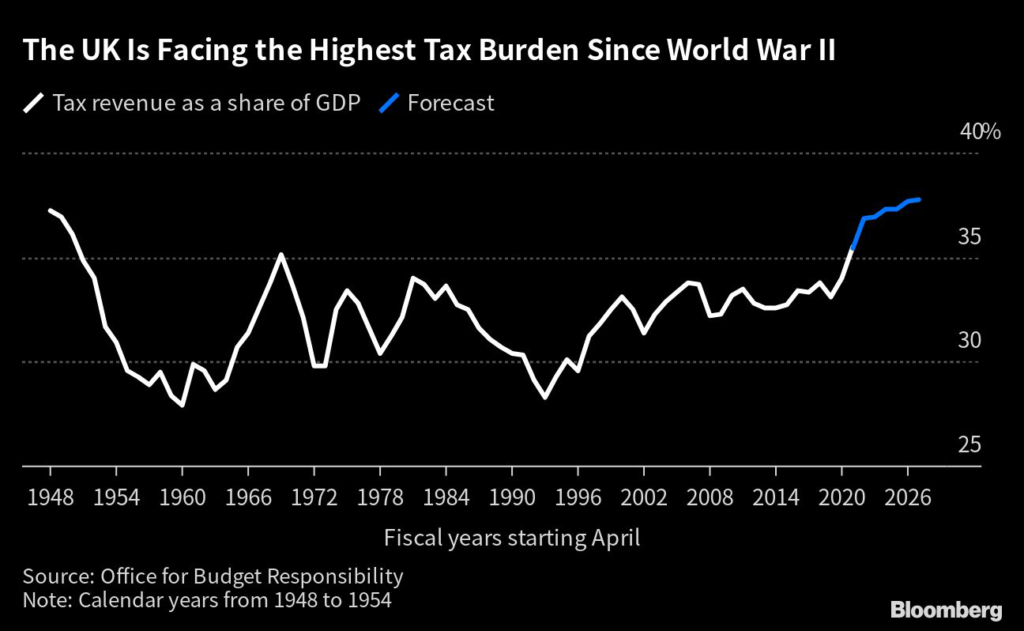
The UK tax system is still hindering economic growth and equality with the total collected by the government on course to top £1 trillion ($1.3 trillion) in the next few years, according to the Resolution Foundation.
(Bloomberg) — The UK tax system is still hindering economic growth and equality with the total collected by the government on course to top £1 trillion ($1.3 trillion) in the next few years, according to the Resolution Foundation.
In a report published Wednesday, the think tank called for a radical overhaul of the tax structure to boost business investment, encourage dynamism and protect the living standards of low and middle-income families.
Britain is heading for the highest tax burden since World War II, according to official forecasts, with levies on companies and individuals on track to reach 38% of GDP by 2028 compared with 33% in 2010.
The increase, equivalent to a tax rise of £4,200 ($5,350) per household, has angered rank-and-file Conservatives with polls showing the party is heading for defeat at a general election expected next year.
Prime Minister Rishi Sunak describes himself as a “low-tax Conservative” but his room to deliver the cuts demanded by many Tories is limited by the state of the public finances.
Soaring inflation and interest payments saw the national debt exceed the size of the economy last month for the first time since 1961.
“Taxes have jumped up overall and are more likely to rise further than fall in future, despite the political rhetoric around cuts,” said Adam Corlett, principal economist at the Resolution Foundation.
“But this rising quantity of tax revenue has not been matched by a rising quality of tax policy.
“Britain’s tax system needs a complete overhaul so that it is focused on helping rather than hindering economic growth, reducing inequality and creating a level playing field,” he added.
“These are basic principles that most taxpayers would expect, but that our current system frequently fails to deliver.”
Resolution criticized the government for “flip-flopping” by cutting and then raising the tax rate on corporate profits, and accused it of “wishing away problems” such as the £9 billion loss of revenue from fuel duty as the country transitions to electric vehicles.
The tax burden, it said, should be shifted away from ordinary families to pollution, wealth and other income sources.
The report, carried out with the Centre for Economic Performance and funded by the Nuffield Foundation, made a series of recommendations it said were revenue neutral, with higher taxes in some areas used to fund reductions elsewhere.
They include:
- Extending and reforming the full expensing tax allowance, which allows firms to write off the cost of investments against tax in one go
- Cancelling a planned 2025 increase in stamp duty on property purchases to make it easier to move jobs and homes
- Halving stamp duty for main homes and non-residential property
- Evening out the marginal tax rate across different revenue streams by increasing self-employment and rental income tax
- Increasing capital gains tax on second homes and shares
Read more:
- Tories Ramp Up Pressure on Sunak to Abolish UK Inheritance Tax
- Sunak Thinks Timing UK Tax Cuts Just Right Can Save the Tories
- UK’s Sunak Says He’ll Cut Taxes Once Inflation, Borrowing Tamed
- Sunak Looks For Two Pence UK Tax Cut Before Election: Telegraph
More stories like this are available on bloomberg.com
©2023 Bloomberg L.P.