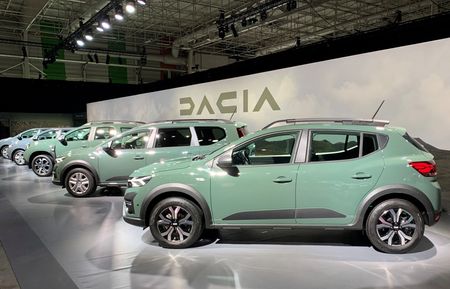
(Reuters) – Sales of Renault’s Dacia brand posted annual growth of 24.2% in the first six months of the year, the French carmaker’s low-cost unit said on Tuesday, underlining the importance of the affordable brand amid economic uncertainty.
Dacia, which boasts best-sellers such as the Sandero city car and which is expanding its range of electric vehicles (EVs), sold 345,432 vehicles between January and June, the Dacia unit said.
That compares to 277,885 units in the same period of 2022, which was heavily impacted by COVID-19 and component shortages.
Dacia’s four main models all recorded growth in the first six months of the year, with sales of the hybrid Jogger model growing by 130% and accounting for over one in four customer orders.
Sales of the Chinese-made Spring, one of the most affordable electric models on the French market, soared by 38%, while sales of the Sandero city car were up 24%.
Sales of EVs and hybrid cars – which have both a battery and combustion engine – have soared in the European Union in the last three years, boosted by government subsidies and corporate fleets looking for low- or zero-emission vehicle options.
“We expect to continue taking our fair share of the EV market with the Spring (model) in the next few months,” Dacia marketing, sales and operations director Xavier Martinet said in a call with journalists.
The brand has no plans to cut prices as it aims to maintain an affordable price-performance ratio, he said.
Weak demand in many countries, caused by issues such as high mortgage rates or unfavourable exchange rates, have made consumers more price sensitive.
“This is where Dacia can be a very interesting alternative for many customers”, Martinet said.
Dacia, originally a Romanian firm bought by Renault in 1999, was the second largest seller of European passenger vehicles to retail customers during the period for the first time, reaching an 8.4% market share, the brand said.
(Reporting by Diana Mandiá; Editing by Conor Humphries)