Mexico’s annual inflation eased roughly in line with expectations in August, as the central bank says it’s not yet ready to discuss lowering record high borrowing costs given the “complex and uncertain” global outlook.
(Bloomberg) — Mexico’s annual inflation eased roughly in line with expectations in August, as the central bank says it’s not yet ready to discuss lowering record high borrowing costs given the “complex and uncertain” global outlook.
Consumer prices rose 4.64% from the same month a year earlier, down from 4.79% in July, the national statistics institute reported Thursday.
The result was roughly in line with the 4.62% median estimate of economists surveyed by Bloomberg, giving some relief to policymakers who maintained borrowing costs at 11.25% in August for the third decision in a row.
Core inflation, which excludes volatile items like fuel and food, eased to 6.08%, compared with the 6.12% median estimate from analysts.
The metric has been a persistent concern for the central bank, known as Banxico, and remains well above both the headline reading and the central bank’s target of 3% plus or minus 1 percentage point.
“This is a positive report that will surprise Banxico to the downside, as the deceleration of core inflation could be stronger than expected,” said Marco Oviedo, a senior fixed income strategist at XP Inc., while cautioning that September tuition fees could drive a climb in prices.
On “the goods price front, the print is also very encouraging. The disinflation process continues.”
Banxico Governor Victoria Rodriguez said last week the board hasn’t even discussed cutting rates.
“The discussion on whether we will reduce the interest rate is not on the table yet, it’s not a topic we’ve touched in our meetings,” she said while presenting the bank’s quarterly inflation report.
“The outlook ahead continues to be complex and uncertain. It’s important to remember that disinflation periods are not linear.”
Mexico has faced seasonal inflationary pressures explained in part by vacation expenditures, though persistent domestic demand is also behind some of the more stubborn price rises.
Higher salaries and steady growth have also bolstered willingness to spend. Those trends mark a change from the pandemic, when global supply shocks drove much of the cost-of-living increases.
The wage growth of more than 10% compared to a year earlier has led to a “stickiness” in core services prices, which climbed 0.31% on a monthly basis, faster than the 0.24% for core goods, Jason Tuvey of Capital Economics wrote in a note.
More Hawkish
Rodriguez’s remarks tamed expectations that the famously hawkish central bank might start easing its monetary policy in the last part of the year, as some economists had forecast.
The central bank’s five-member board has been unified about the need to remain vigilant on prices and had been saying since its May meeting that it would keep the key rate unchanged for a “prolonged period.”
The central bank has been more hawkish than some counterparts in Latin America, including those in Chile and Brazil, which have already started lowering borrowing costs.
Monthly inflation reached a peak of 8.70% a year ago — the bi-weekly printing at a slightly faster 8.77% pace — before taking on a near-steady descent to current levels.
Mexico’s economy has performed better than expected, with the Finance Ministry predicting that growth will be above 3% this year.
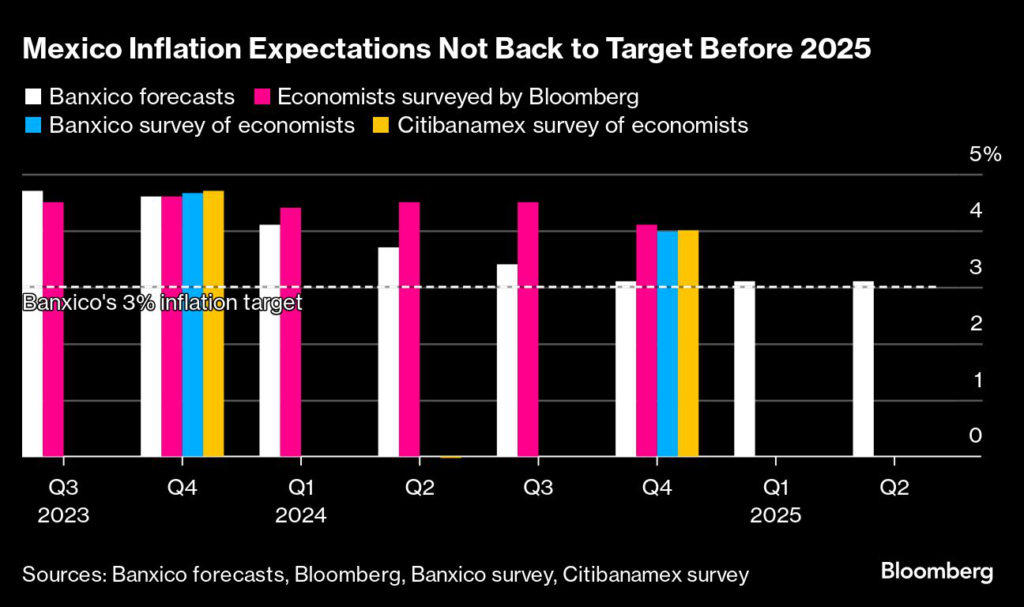
Analysts in the most recent Citibanamex survey published this week expect annual inflation will stand at 4.70% in December and 4% at the end of 2024.
–With assistance from Rafael Gayol.
(Adds comments, data from paragraph 4)
More stories like this are available on bloomberg.com
©2023 Bloomberg L.P.