By Lewis Krauskopf and Saqib Iqbal Ahmed
NEW YORK (Reuters) -A benign U.S. inflation report is bolstering hopes that the Federal Reserve can bring down consumer prices without hurting the economy, a so-called Goldilocks environment that investors believe will benefit stocks and bonds.
Both asset classes have ripped higher in November following a months-long wobble, fueled by hopes that the Fed was unlikely to deliver any more of the rate increases that have spurred volatility throughout markets since early last year.
Inflation data released on Tuesday supported the view that a turning point is near: consumer prices were unchanged on a monthly basis for October, the first such reading in more than a year and a softer figure than analysts were expecting.
At the same time, there have been few indications that tighter monetary policy is severely hurting the economy, backing the idea that prices can cool further without damaging growth. “The broader market has been challenged with this consensus negative view about both a recession and inflation,” said Eric Kuby, chief investment officer at North Star Investment Management Corp.
“Reality is telling a different story. This does feel like a Goldilocks moment for the entire market.”
The data fueled a powerful rally in stocks and bonds. The S&P 500 was up about 2% on the day, on track for its biggest one-day rise since January.
The index is up 9% from its October lows, putting its year-to-date gain at 17%. The benchmark 10-year yield, which moves inversely to bond prices, was at its lowest level since late September – having fallen over 50 basis points from a 16-year high set last month.
The jump in stock prices was accompanied by a wave of bullish bets in the U.S. equity options markets, as traders ramped up wagers on more gains and threw in the towel on bearish positions.
Call options, which benefit from rising prices, outnumbered bearish puts by their biggest margin in four months, with 1.44 call options projected to trade for every put contract by the end of the day, according to Trade Alert data.
Meanwhile, investors scrambled to cover bearish positions – especially on the high growth and technology stocks that have struggled amid elevated interest rates.
The Thomson Reuters United States Most Shorted Index rose 5.5%, on pace for its third-largest one-day gain this year.
“Crowded short names are also up a lot … that to me is a lot of chasing and covering,” said Daniel Kirsch, head of options at Piper Sandler.
DOVISH EXPECTATIONS
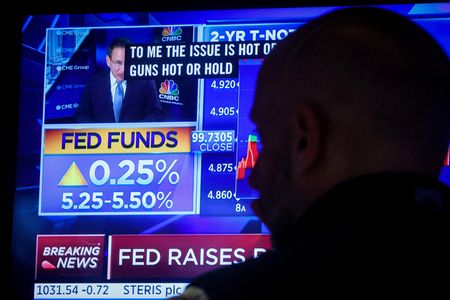
Fed funds futures traders on Tuesday expected the Fed to forgo any more hikes and enact about 100 basis points of interest rate cuts in 2024, compared to 75 basis points of cuts before the inflation report.
That tallied with expectations heading into the data.
According to BofA’s Global Research’s monthly survey out Tuesday, 76% of fund managers were convinced the Fed had finished its rate hike cycle, up from 60% in October and the highest level since the survey began tracking the topic in May.
The CPI data is “telling us that the Fed is done, there’s nothing left for it to do here,” said Thomas Hayes, chairman at hedge fund Great Hill Capital.
The data also supported the views of investors who had been growing more optimistic about the market.
Fund managers turned overweight equities in November for the first time since April 2022, according to the BofA survey.
They also reported the third-largest overweight in bonds in the past two decades, according to the survey, as cash levels dropped to 4.7% from 5.3%.
Still, some investors believed it was too early to call a victory in the fight against inflation.
“Inflation is still too high and the labor market still too tight for the Fed to … announce an end to the rate-hiking cycle,” wrote Brian Rose, senior US economist at UBS Global Wealth Management.
“Such an announcement is likely to be at least three months away unless the data takes a sudden turn toward the weaker side.”
Others were wary that the Fed could risk hurting the economy by keeping monetary policy too tight for too long.
“The question now for the Fed is whether they continue to believe that slowing the economy into recession is needed to completely conquer inflation,” said Jamie Cox, managing partner for Harris Financial Group.
“I certainly hope not.”
(Reporting by Lewis Krauskopf and Saqib Iqbal Ahmed; additional reporting by Davide Barbuscia in New York and Ankika Biswas in Bengaluru; Editing by Ira Iosebashvili and Nick Zieminski)