By Amir Orusov and Anastasiia Kozlova
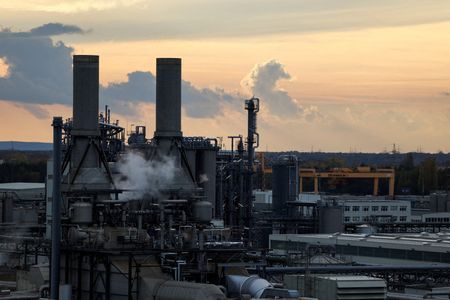
(Reuters) -Confidence in Germany’s chemical industry fell sharply in October due to higher competition and weak order momentum, according to an Ifo survey published on Monday.
The economic expectations indicator for the sector fell to a seasonally adjusted -13.3 points, from -3.7 points in September, while the evaluation of the business climate deteriorated further, falling to -19.4 points from -12.0, Germany’s Ifo Institute for Economic Research said.
Germany’s chemical sector, the country’s third-largest industry employing around half a million people, is facing mounting pressure from high production costs, increasing bureaucratic burdens, intense competition and a stagnating economy, with U.S.
tariffs further compounding the challenges.
Many chemical industry players, including BASF and Covestro, have lowered their annual forecasts at least once this year, with their shares falling significantly since the start of 2025.
ORDER BACKLOG INDEX AT ITS LOWEST IN OVER 30 YEARS
Business momentum remains very weak, with an index gauging order backlogs dropping to its lowest level in more than three decades at -68.9 points, the institute said.
Capacity utilization declined to 71%, well below the long-term average of 81% seen in the past 10 years, it added.
“To see any real normalization in industry margins, we need to be closer to 85% utilization,” said Geoff Haire, Head of EMEA Chemicals Equity Research at UBS.
INDUSTRY PROSPECTS REMAIN MUTED
China’s capacity increase backed by government incentives has led to structural overcapacity that is pushing down global prices, Ifo industry analyst Anna Wolf told Reuters.
Competing with a 20–30% price gap is extremely challenging without some form of state support for EU players, Wolf said, adding the industry in Germany could remain only partially competitive, mainly in niches of special chemicals.
Germany has introduced a series of major fiscal measures to stimulate its economy, including a 500-billion-euro infrastructure fund and a 46-billion-euro tax relief package to support businesses through 2029, but Wolf said more needed to be done.
“Without major structural reforms to improve Germany’s attractiveness as a business location, particularly in terms of energy costs, taxation and bureaucracy, there is no prospect of a near-term turnaround,” Wolf said.
“Companies will most likely continue to respond primarily through relocations, cost reductions and further staff cuts, and in some cases even insolvencies cannot be ruled out,” she added.
(Reporting by Amir Orusov and Anastasiia Kozlova; Editing by Conor Humphries and Milla Nissi-Prussak)