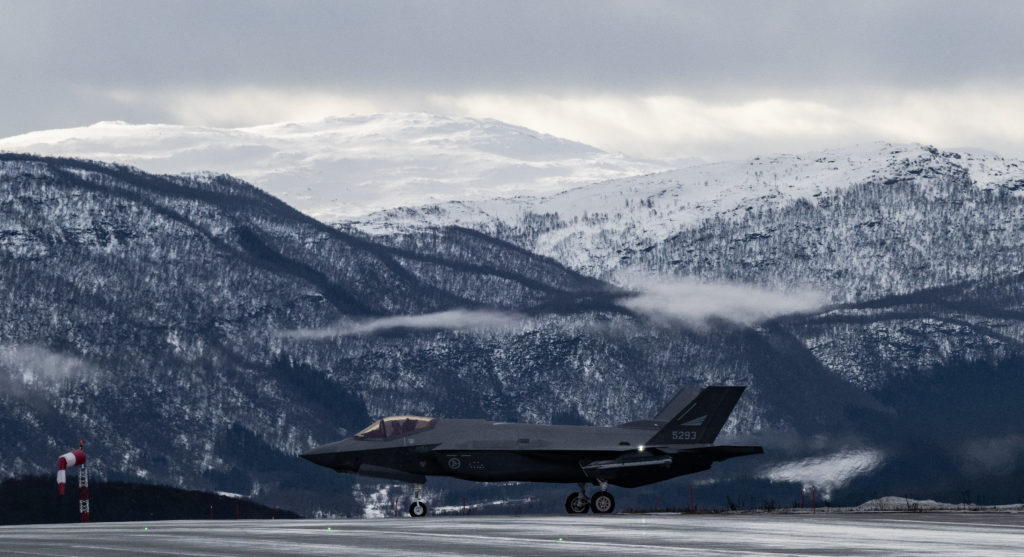
Canadian, German and Norwegian leaders on Friday reaffirmed their commitment to Arctic security, which has come under strain, while visiting troops at a large NATO exercise.”We are fully prepared, individually and collectively, to defend the Arctic and the High North,” Canadian Prime Minister Mark Carney told a press conference in Bardufoss, a military town located above the Arctic Circle where NATO’s Cold Response exercise is taking place.”What this operation is about, this training exercise, is to further build those capabilities, against Russia, against any external threat,” he said alongside German Chancellor Friedrich Merz and Norwegian Prime Minister Jonas Gahr Store.The High North has long been shielded by the concept of “Arctic exceptionalism” — the notion that the region had its own set of unwritten rules of cooperation which were immune to geopolitical rivalries.But regional dynamics between Russia and the West have deteriorated since the start of the war in Ukraine and due to US President Donald Trump’s threats to take over Greenland.”To say that a country can take land from another country is unacceptable,” Store stressed.Asked whether they trusted the United States to honour commitments to guarantee security in the High North, the three leaders, after a brief muffled laugh, said they did.Store noted that security in the Arctic “is also homeland security for the United States”.”We believe that it is self-interest,” he said.Around 25,000 troops from 14 countries including the US are taking part in the Cold Response exercise in Norway, held every two years and aimed at training together in extreme winter conditions.This year’s gathering has been impacted by the war in the Middle East, with France redirecting its aircraft carrier Charles de Gaulle to the eastern Mediterranean.”We are ready to defend… what we are calling the High North,” Merz told reporters.”We will… not allow Moscow to test NATO on its eastern flank and here in the north,” the German head of government said earlier in the day during a visit to the rocket launch site Andoya Space.NATO chief Mark Rutte was also scheduled to visit Cold Response on March 18. – Russian flights -Faced with NATO’s manoeuvres in its vicinity, Russia has asserted its presence.The Norwegian military said Wednesday it had scrambled F-35 fighter jets on two consecutive days this week to intercept Russian military aircraft in international airspace north of Norway.”There is nothing unusual or dramatic about such Russian flights, and Russia has the right to conduct these missions,” the military said.”The Russian flights are most likely intended to gather situational awareness of allied activity in connection with Cold Response 2026,” it added.Moscow has also announced that it would be conducting missile tests near the Norwegian waters of the Barents Sea, as it has done during previous exercises.Warming three to four times faster than the planet, the Arctic is attracting increasing interest as the melting sea ice opens up greater access to resources — such as oil and gas, minerals and fish — as well as new shipping routes.During their visit to Andoya Space, where German group Isar Aerospace hopes soon to launch another of its Spectrum rockets, Merz and Store announced stronger cooperation between the two countries in the space sector.A working group will explore a bilateral partnership in areas where Europe is seeking to strengthen its autonomy, such as space-based surveillance, satellite communications and rocket launches.”We have relied on other nations for far too long.
Now it’s Europe’s moment,” Merz said.”Norwegian and German space industries complement each other. Germany has a broad industrial base, Norway has technology and established research communities, and we have important geography,” Store said.
Fri, 13 Mar 2026 16:47:41 GMT