(Refiles to fix garbled text in paragraphs 5, 9)
By Steven Scheer, Charlotte Greenfield and Emily Rose
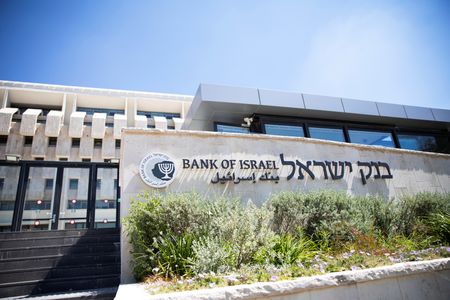
JERUSALEM (Reuters) -The Bank of Israel left short-term interest rates unchanged on Monday and was noncommittal on when it would resume rate cuts despite an easing of inflation and the country’s risk premium following its war with Iran.
The central bank left its benchmark rate at 4.50% for the 12th meeting in a row, as expected.
Some analysts had believed rate cuts could come as soon as August, but Bank of Israel Governor Amir Yaron said policymakers would remain cautious.
“The price of a mistake is high,” Yaron told a news conference after the decision, adding that he hoped the inflation environment would permit three quarter-point cuts to 3.75% in the coming year as the bank’s economists have forecast.
The annual inflation rate eased to 3.1% in May from 3.6% in April, holding just above the government’s 1-3% annual target.
Yaron said there was a danger supply constraints that have helped fuel price pressures may linger.
“We want to see clear signs of inflation converging downwards. Only then we will be able to begin lowering interest rates,” he said.
“When that will be – whether sooner or later – depends on when we see those developments.”
Monetary policy will continue to be “data dependent,” Yaron said.
Israel’s 5-year credit default swap – the cost of insuring government debt against default – has fallen to 85 basis points, 37 bps lower than it was before the Iran war and the lowest since March, according to S&P Global Market Intelligence.
Yaron has long said the risk premium and inflation needed to ease before rate cuts could begin.
In addition to inflation nearing the target, the shekel has appreciated more than 7% in the past few weeks and would likely help to lower inflation.
The risk premium is still relatively high despite the recent decline, Yaron noted.
The bank’s last move was to reduce the key rate by 25 basis points in January 2024 after inflation eased and economic growth slowed in the early days of the Gaza war.
It has said it is in no rush to ease again while inflation remains above target, and 10 of 11 analysts polled by Reuters had expected no move on Monday.
The bank said it forecast inflation would be around the midpoint of its target range in a year’s time.
The economy grew an annualised 3.7% in the first quarter after a 1% expansion for all of 2024.
Economic uncertainty has lingered due to the 21-month-old conflict between Israel and Palestinian Islamist group Hamas in Gaza.
The bank’s staff trimmed its 2025 growth estimate to 3.3% from 3.5% but raised its 2026 projection to 4.6% from 4%.
Prime Minister Benjamin Netanyahu is due to meet U.S. President Donald Trump at the White House on Monday, while Israeli officials hold indirect talks with Hamas aimed at a U.S.-brokered hostage-release and ceasefire deal.
(Reporting by Steven Scheer, Charlotte Greenfield and Emily Rose; Editing by Hugh Lawson, Aidan Lewis)