(Reuters) -The Bank of Japan kept interest rates steady on Thursday and raised its inflation forecast for the current fiscal year, signalling cautious optimism that Japan’s trade deal with the U.S.
would help the economy avert a steep downturn.
As widely expected, the central bank maintained short-term interest rates at 0.5% by a unanimous vote at the two-day policy meeting that ended on Thursday.
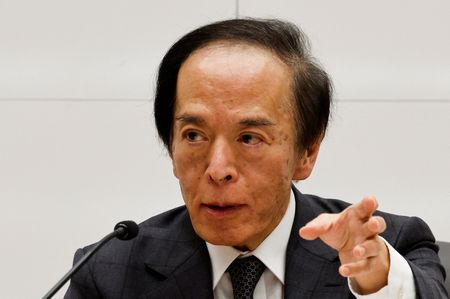
Following are excerpts from BOJ Governor Kazuo Ueda’s comments at his post-meeting news conference, which was conducted in Japanese, as translated by Reuters:
INTEREST RATE TRAJECTORY
“If the economy and prices move in line with our forecast, we expect to continue raising interest rates and adjust the degree of monetary support in accordance to improvements in economic and price developments.”
INFLATION OUTLOOK
“Uncertainty surrounding Japan’s economy has receded due to Japan’s trade agreement with the U.S.
But there’s no change to our baseline projection that underlying inflation will stagnate for some time due to slowdown in growth. Uncertainty surrounding each country’s trade policy remains high.”
“As for underlying inflation, we will look at various data including people’s perception on prices, long-term inflation expectations … and take a comprehensive assessment on the economy and prices.”
“Underlying inflation still remains short of our 2% target, but expected to rise moderately … The cycle of rising wages and inflation is still maintained.”
“It’s not as if we will wait until underlying inflation is firmly at 2%.
Our decision (on whether to raise rates) is dependent on how likely underlying inflation will reach that level.”
IMPACT OF FOOD INFLATION ON BROADER PRICE MOVES
“Rising food prices could hurt consumer sentiment and worsen household spending, or could prolong inflation.
I’d like to always keep a close eye out on whether rising food costs could affect inflation expectations and underlying inflation.”
IMPACT OF TARIFFS
“Uncertainty on the rate of tariffs may have receded.
But the impact of significantly high U.S. tariffs on the economy is still unclear. I don’t think the fog will clear immediately.”
“I don’t think we’re behind the curve, or that the risk of us being behind the curve is large.”
WAGE CYCLE
“We see rising wages pushing up service prices, and rising prices pushing up wages.
That cycle continues. But we don’t think it’s sharply accelerating. That’s why we think we’re not behind the curve. Still, we need to be mindful that headline inflation could affect underlying inflation, and inflation expectations, more than before because underlying inflation is now closer to 2%.”
(Reporting by Leika Kihara; Editing by Janane Venkatraman)