By Maria Martinez and Liz Lee
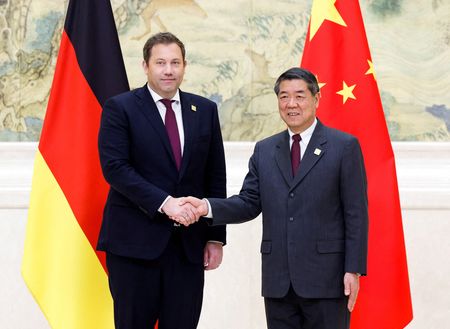
BEIJING (Reuters) -China’s Vice Premier He Lifeng and German Finance Minister Lars Klingbeil agreed on Monday that the two countries should strengthen commercial ties and bring an end to months of trade tensions between the world’s second- and third-largest economies.
Klingbeil met He in Beijing on the first visit to China by a minister from Chancellor Friedrich Merz’s government.
Ties between the two industrial powerhouses have been strained in particular over Chinese export curbs on chips and rare earths that have caused major disruptions for German firms.
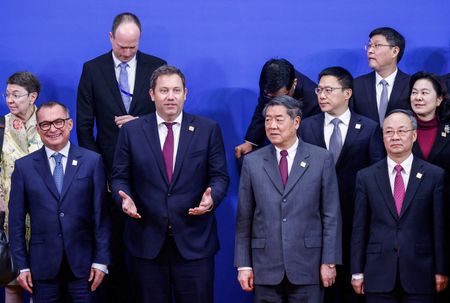
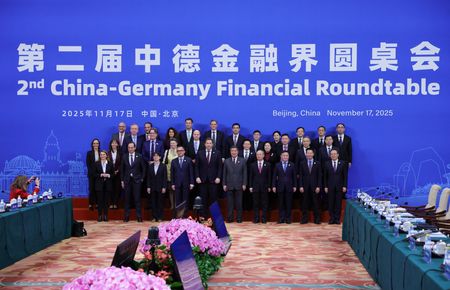
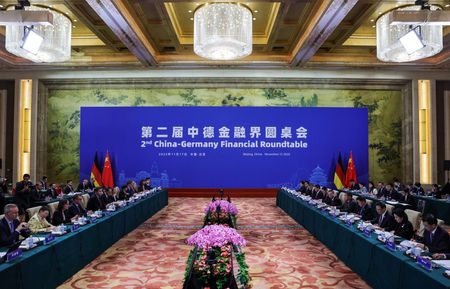
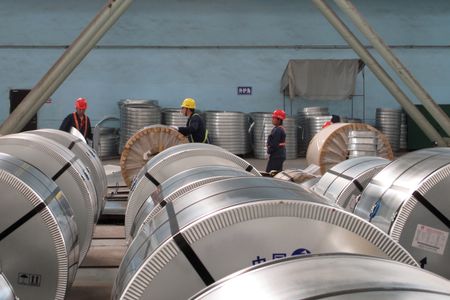
Klingbeil said Germany addressed the topic of Chinese overcapacity in key sectors such as steel, solar and electric mobility during talks at the China-Germany Financial Dialogue, an event held every two years for officials and corporate executives from the two countries to exchange views.
“From the German perspective, we see fair competition at risk and also see industrial jobs under threat,” Klingbeil said.
Both countries agreed it should be a shared task to address reducing such overcapacities and ensuring stable competitive conditions, he said.
European concerns about export restrictions on rare earths and critical raw materials were also addressed and “must be taken seriously”, Klingbeil said.
“We want to find joint solutions to ensure reliable access and dependable supply chains,” he said in closing remarks at the event.
‘FAIR, EQUITABLE’ BUSINESS ENVIRONMENT
Talking to the press, Klingbeil said he was satisfied because China’s vice premier made “very clear” that he wants to find solutions on rare earths and critical raw materials.
His Chinese counterpart also told him that he wants to discuss issues directly whenever tensions arise.
Chinese Vice Premier He said Beijing was committed to working with Germany to expand joint cooperation and “foster a fair, equitable and non-discriminatory business environment.”
“We should take practical and pragmatic actions and not be influenced by various factors that interfere with the security and stability of the global industrial chain and supply chain,” He said, without referring to any specific company.
Another topic for Germany was Chinese support for Russia in its war against Ukraine.
Klingbeil said China could play a decisive role when it comes to ending the war.
However, there were no advances on this issue.
“Today, it remained at the commitment that they want to work with Germany to promote peace.
It didn’t go any further than that,” Klingbeil said.
MUTUAL MARKET ACCESS
Klingbeil arrived in Beijing less than a week after Germany’s parliament appointed an expert commission to rethink trade policy toward China.
Beijing’s support for Russia has been a source of friction, as have Berlin’s criticism of China’s human rights record and state-subsidised industrial policy, but the two countries remain bound by an advantageous commercial relationship.
Their economic ties have become even more crucial as U.S.
President Donald Trump’s tariffs squeeze global markets.
Chinese companies are now serious competitors for German firms in many sectors.
“Our companies have long embraced this competition, but I want to emphasize that it must take place under fair conditions,” Klingbeil said.
“That is why, in our conversation, it is important to work toward mutual market access — including financial markets — and reliable framework conditions.”
China bought $95 billion worth of German goods last year, around 12% of which were cars, Chinese data shows.
Germany purchased $107 billion of Chinese goods, mostly chips and other electronic components.
China is responsible for almost a third of German automakers’ sales and German chemicals and pharmaceuticals firms also have a large presence in the country, although they are facing increasing pressure from domestic competitors.
BERLIN’S TOUGH STANCE ON CHINA
Klingbeil’s trip to China follows a cancelled trip by German Foreign Minister Johann Wadephul last month after China rejected all but one of his requested meetings.
Wadephul has struck an increasingly tough stance on China since he took office in May, going even further than his predecessor Annalena Baerbock, who labelled Chinese President Xi Jinping “a dictator.”
“It’s a good sign that Klingbeil’s trip is now going ahead as planned without similar requests or tensions,” said Bernhard Bartsch of the Berlin-based Mercator Institute for China Studies, in reference to Wadephul’s cancelled trip.
Contrasting with Klingbeil’s conciliatory tone, Chancellor Friedrich Merz described both China and the U.S.
on Monday as major challenges for Germany and the EU.
Developments in China are “increasingly repressive internally and increasingly aggressive externally”, the chancellor said at an economic congress in Berlin.
Merz is expected to visit China in the coming months.
(Reporting by Maria Martinez and Liz LeeAdditional reporting by Christian Kraemer and Andreas Rinke; Writing by Joe CashEditing by Saad Sayeed, Susan Fenton and Frances Kerry)