(Bloomberg) — India pledged to spend more to fire up the key engines of growth in Asia’s third-largest economy, as it stages a world-beating recovery from the pandemic.
Finance Minister Nirmala Sitharaman proposed increasing the size of the economy’s annual spending to 39.5 trillion rupees ($529 billion) to support growth plans for the year beginning April.
Capital expenditure is budgeted to rise significantly once again — by 35% — to 7.5 trillion rupees, she said.
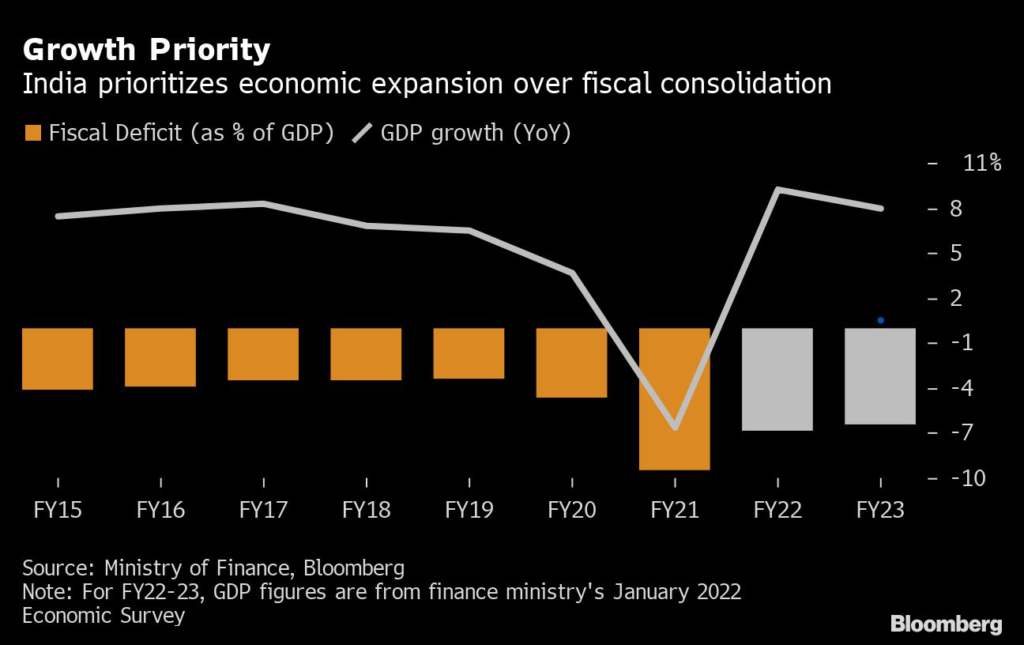
That will leave her with a budget shortfall equivalent to 6.4% of gross domestic product, wider than the median 6.1% seen in a Bloomberg survey.
The government will end the current financial year with a deficit of 6.9% of GDP against a targeted 6.8%, she said.
“This budget continues to provide impetus for growth,” she said in Parliament in New Delhi on Tuesday.
Indian bonds fell, with the yield on benchmark 10-year notes rising by as much as nine basis points after she targeted a higher budget deficit for next fiscal year. Benchmark stocks were trading up 1.6%.
The budget is one of the most keenly watched economic events with businesses, investors and India’s 1.4 billion people looking to it for direction on policy and spending priorities.
Boosting government expenditure on infrastructure, creating jobs and increasing productivity are key to the country’s sustained recovery from the pandemic-induced contraction last fiscal year.
Gross domestic product is seen growing by 9.2% — the quickest rate among major economies — in the current year ending March, with her ministry expecting the performance to be repeated in the next year with an estimated 8%-8.5% expansion.
Sitharaman, who has increasingly turned to income from state-asset sales to fund her budget, said the proposals will directly benefit the country’s youth, women, farmers, as well as public and private investment.
She expects to shortly complete the listing of Life Insurance Corp.
of India, which could replenish the state’s coffers by as much as $10 billion if the government sells a 5% stake. That will provide the administration with funds needed to boost capital spending.
The budget’s “approach is driven by seven engines,” Sitharaman said, listing roads, railways, airports, ports, mass transport, waterways and logistics infrastructure as the key areas.
“All seven engines will pull forward the economy in unison” complemented by energy transmission, IT communication, water and sewerage sector and social infrastructure, she said.
(Updates with details throughout)
More stories like this are available on bloomberg.com
©2022 Bloomberg L.P.