(Bloomberg) — An idea and a dream. Time was in markets, that’s all you’d need. But now the easy money has stopped flowing, and good luck if it’s all you’ve got.
And while the travails of profitless companies are well known to anyone who’s watched the Nasdaq plunge this year, the extent to which such firms have come to clog the equity landscape is only beginning to be understood.
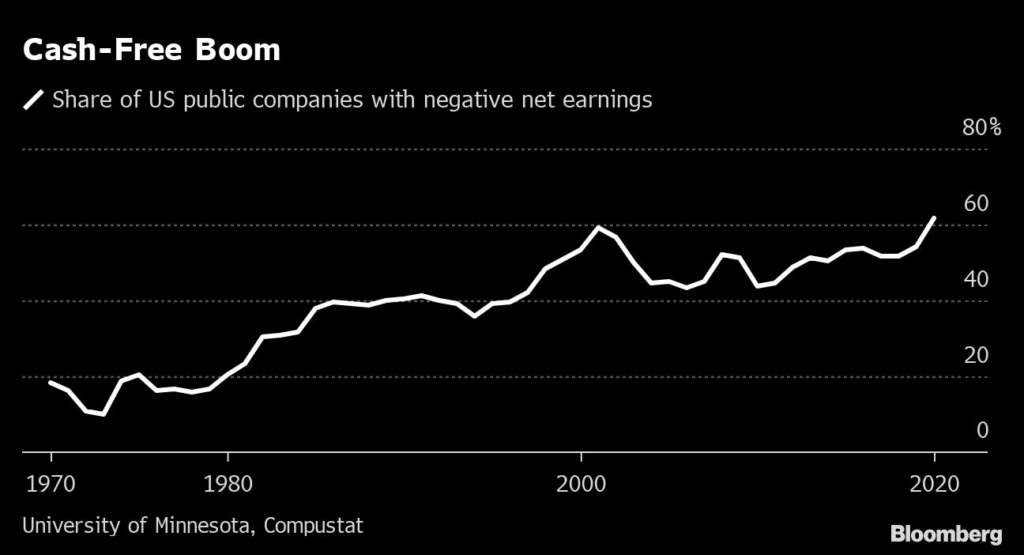
New research shows that over the last five decades, the percentage of US firms trading publicly with zero earnings has more than tripled to more than half of the total market.
Until very recently, they were the belle of the stock-market ball, intangible-asset-laden businesses like Uber and Airbnb — built not on factories or resources, but ideas — unleashed in the hope something will catch on and make them the next Facebook or Google.
All of which is fine when times are good. When optimism dries up and the market appetites switch from hot intellectual property to cold hard cash, intangible-laden companies have started to become a luxury no one can afford.
US public firms with negative net earnings reached a record at the end of 2020, accounting for 62% of the group, compared with 18% in 1970, according to a new paper by University of Minnesota academic.
Unsurprisingly, the trend is strongest among newly minted companies, with 77% of initial public offerings not making money when they came to market in 2019. That’s up from 24% in 1980.
It’s not just in tech.
Unprofitable companies have flourished everywhere, from farms to electric cars. Their numbers are multiplying fast in the heart of the real economy: manufacturing. Around 63% of US publicly listed manufacturers didn’t turn a profit in 2020, compared with 19% in 1970.
Their numbers include household names like Casper Sleep and Peloton.
The proliferation of money-losing public firms is being driven not just by tolerance among investors, but an overt preference for a certain kind of loss-making firm: one built on intangible assets, the author suggests.
Businesses are being encouraged to sell stock years before they’re profitable because of a belief that some formula or idea will gradually attract a network of users that will one day prove exceedingly valuable.
To see the connection, the study measures characteristics tied to intangible assets — elevated customer-spending and research and development expenses — and plots them against loss-making firms.
It finds a very high correlation between the two, suggesting most of these companies went public on the assumption their intangible assets will one day pay off in earnings.
“This is a long-term trend due to some economic fundamental changes,” said Dan Su, a PhD graduate from the University of Minnesota and author of the paper.
“But if we focus on the business-cycle perspective, monetary policy is important for these companies’ market valuation as they cannot make positive profits until many years later.”
Investors were quick to follow and quick to exit.
In the US, the biggest 100 unprofitable companies as of 2019 gained more than 130% in the three years prior to their February 2021 peak, according to data compiled by Su and Bloomberg. Since that high, those firms have plunged 65% while the Russell 1000 gained 1.8% in the same 16-month period.
From the peak in the gauge, the returns are minus 38% and minus 15%, respectively.
The rapid growth came at a time when private equity flush with cash was willing to bankroll loss-making companies like Uber and WeWork — businesses years away from being profitable, but that promised the scale to one day rewire and dominate existing industries.
That was the bet, and the cash to fund them was dirt cheap.
“You basically win more by growing faster and if you grow faster you are not required to be profitable, because then that’s a drag on growth,” said Peter Garnry, head of equity strategy at Saxo Bank A/S.
A lot has changed since — even among the biggest believers.
From Uber chief Dara Khosrowshahi saying that “the market is experiencing a seismic shift” and announcing cost cuts in a letter obtained by CNBC to Bill Gurley of venture capital firm Benchmark warning that the process of shifting perceptions on valuations formed during the bull market could be “painful, surprising, and unsettling to many.”
That pain is already on display as the tide goes out on easy-money liquidity that kept profitless companies aloft and inflated their valuations.
These days, investors want cash-rich companies, not cash burners built on hopes.
As low interest rates fostered the boom in unprofitable companies, the reverse — higher rates — suggests their demise.
Loss-making tech firms have erased pandemic gains as the Federal Reserve steps up its fight against inflation.
The avenues to take profitless companies public are also shrinking. Worldwide, proceeds in the market for IPOs sank 75% in the first quarter compared with a year earlier.
So far in the second quarter, fund-raising is less than any other on record both globally and in the US.
It’s not all bad news though. Business models and ways of exploiting digital technologies have improved dramatically since the dotcom bubble, and there will be survivors, according to Garnry at Saxo Bank.
“Inside these massive casualties, there will be companies — that are now down 90% — that long-term will have a very interesting business model,” he said.
Su argues that conditions are different from two decades ago because of lasting changes in how society and companies function.
The intangible economy’s tentacles reach beyond tech, growing more pronounced in nine of 10 industries, Su analyzed. That means it may be more than just an easy-money phenomenon.
“We are likely to see more highly valued firms with negative net earnings now and also in the future,” he said.
“We will see more Amazon-like or Tesla-like firms with massive profits come much later. This shouldn’t be interpreted as bubbles.”
More stories like this are available on bloomberg.com
©2022 Bloomberg L.P.