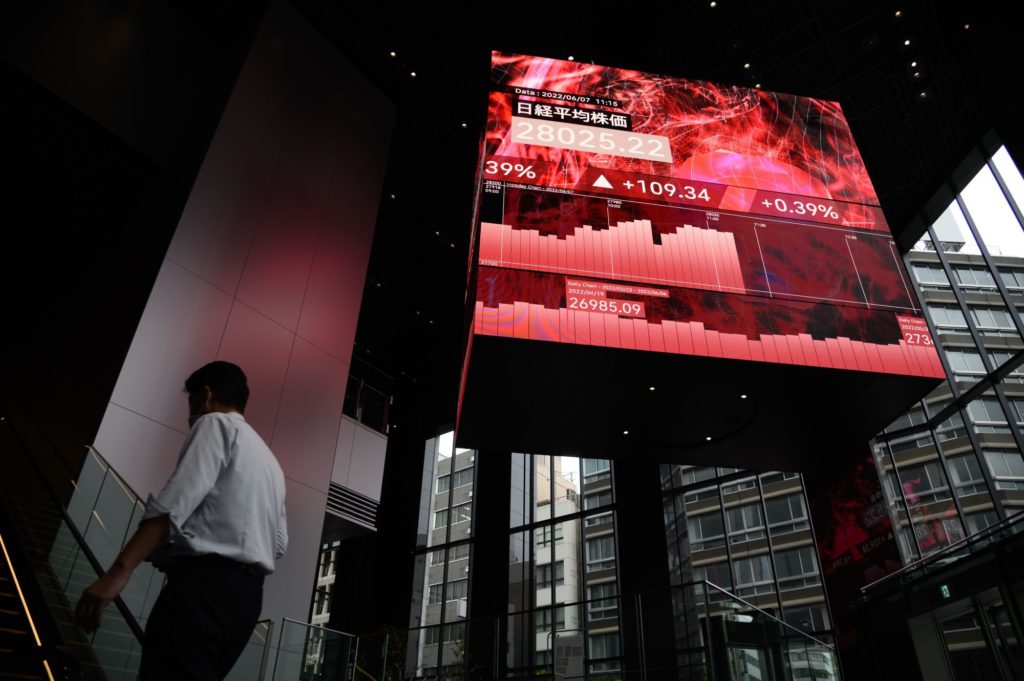
(Bloomberg) — Asian stocks dropped and bond yields surged on Monday following a fresh high in American inflation that heaped pressure on the Federal Reserve to intensify monetary tightening. The yen reached a 24-year low.
Equities shed more than 2% across Asian markets.
Tech shares in Hong Kong declined further by 3.7%, weighing on the broader Hang Seng index.
US futures slid, with Nasdaq 100 contracts falling 1.8% and those for the S&P 500 dropping 1.2%, putting the later on the cusp of a 20% decline from January’s high.
The moves come in the wake of steep losses on Wall Street that contributed to the worst drop in global shares last week since October 2020.
The yen weakened to 135.19 per dollar, the lowest level since 1998, as Japan’s easy monetary policy increasingly stands at odds with that of developed-market peers hiking rates.
Treasury yields rose across the curve, led by shorter maturities, with the two-year rising 10 basis points to the highest level since late 2007.
Yields on 30-year Treasuries are below those on five-year notes, pointing to fears that sharp Fed interest-rate hikes will spark a hard economic landing. New Zealand’s 10-year bond yield topped 4% for the first time since 2014 in the slipstream of the moves in Treasuries.
The dollar was stronger on haven demand amid the toxic mix of rising costs and slower growth.
Risk sensitive currencies like the Australian dollar weakened. Oil, one of the commodities stoking price gains, retreated to about $119 a barrel.
Markets are also contending with Covid outbreaks in China, where Beijing and Shanghai resumed mass virus testing.
The fear is China’s Covid-zero strategy will lead to repeated lockdowns that damage both its economy and global supply chains. The latter are also being affected by the war in Ukraine.
“At some point financial conditions will tighten enough and/or growth will weaken enough such that the Fed can pause from hiking,” Goldman Sachs Group Inc.
strategists including Zach Pandl wrote in a note. “But we still seem far from that point, which suggests upside risks to bond yields, ongoing pressure on risky assets, and likely broad US dollar strength for now.”
The US consumer price index rose 8.6% in May from a year earlier — a fresh 40-year high — in a broad-based advance, adding to a slate of troubling inflation data globally.
Many investors expect half-point Fed rate hikes this week and again in July and September. Barclays Plc and Jefferies LLC said an even bigger 75-basis-point move is possible at the June meeting.
No Smooth Ride
The volatility in Treasuries “can’t be anything that any central bank would welcome,” Sonal Desai, Franklin Templeton’s fixed income chief investment officer, said on Bloomberg Television.
“We’re going to see more of the same. It’s not going to be a nice, smooth grind upwards. The Fed is going to need to do more.”
The yen’s slide against the greenback reflects the stark policy contrast between a hawkish Fed and a still dovish Bank of Japan.
Chief Cabinet Secretary Hirokazu Matsuno reiterated “concern” over the recent rapid weakening of the yen and said foreign exchange rates should move stably and in line with economic fundamentals.
Still, the Japanese currency will “come under renewed selling pressure” if the Bank of Japan doesn’t change its easy policy, Rob Carnell, chief economist and head of Asia-Pacific research at ING Groep NV in Singapore, said on Bloomberg Television on Monday.
“I think it’s a question of when rather than if with them, exactly what kind of nuance they put into play with the yield curve control.”
Poor sentiment was evident over the weekend in a cryptocurrency slide that took Bitcoin below $25,000 to the lowest in 18 months.
In Australia, financial markets are closed for a holiday.
What to watch this week:
- First WTO ministerial meeting in nearly five years.
Through June 15.
- ECB’s Luis De Guindos due to speak, Monday.
- US PPI, Tuesday.
- China key economic activity data, liquidity operations, medium-term lending facility, Wednesday.
- FOMC rate decision, Chair Jerome Powell briefing, US business inventories, empire manufacturing, retail sales, Wednesday.
- ECB President Christine Lagarde due to speak, Wednesday.
- Bank of England rate decision, Thursday.
- US housing starts, initial jobless claims, Thursday.
- Bank of Japan policy decision, Friday.
- Eurozone CPI, Friday.
- US Conference Board leading index, industrial production, Friday
Some of the main moves in markets:
Stocks
- S&P 500 futures fell 1.2% as of 1:19 p.m.
in Tokyo. The S&P 500 fell 2.9%
- Nasdaq 100 futures fell 1.8%. The Nasdaq 100 dropped 3.6%
- Japan’s Topix index down 2%
- South Korea’s Kospi index shed 3%
- Hong Kong’s Hang Seng index fell 2.8%
- Hong Kong’s Hang Seng tech index declined 3.7%
- China’s Shanghai Composite index dropped 1.1%
Currencies
- The Bloomberg Dollar Spot Index rose 0.4%
- The euro was at $1.0488, down 0.3%
- The Japanese yen tumbled to 135.19
- The offshore yuan was at 6.7573 per dollar, down 0.4%
Bonds
- The yield on 10-year Treasuries rose three basis points 3.18%
Commodities
- West Texas Intermediate crude fell 1.4% to $119.04 per barrel
- Gold fell 0.5% to $1,862.76 an ounce
More stories like this are available on bloomberg.com
©2022 Bloomberg L.P.