By Bernadette Christina
JAKARTA (Reuters) – Indonesia on Tuesday issued new regulations on palm oil export taxes, detailing the recently announced levy rate cut to accelerate shipments that have been slow to rebound after the ending of an export ban.
But the levy rate will be raised in August, according to the finance ministry regulations, sparking concerns from an industry group.
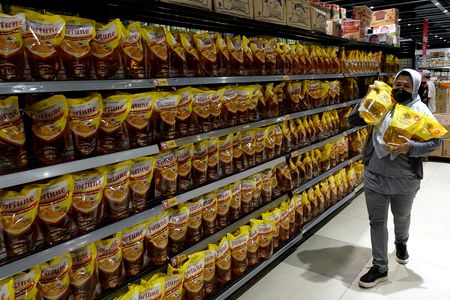
The world’s biggest palm oil exporter allowed palm shipments to resume from May 23 following a three-week ban designed to boost cooking oil stocks and keep runaway local prices in check.
Authorities have since launched an export acceleration programme and tweaked tax rules after shipments were slow to restart amid confusion over procedural issues.
Details of Tuesday’s regulations were in line with previous announcements, including lowering the maximum levy rate for crude palm oil to $200 a tonne from $375, effective until July 31.
Indonesian exporters pay a levy and an export tax on shipments and the government last week announced a hike in the maximum export tax to $288 per tonne.
Overall, the combined ceiling for both levy and tax would be reduced to $488 per tonne from $575 per tonne.
The new rates apply to sales that are tied to the domestic distribution of cooking oil.
The trade ministry recently bumped up the allocation for such exports to 2.25 million tonnes, from about 1 million previously.
As of Tuesday, the ministry has issued export permits for 566,614 tonnes of crude palm oil and its derivatives under this scheme.
Separately, companies are currently allowed to sell stocks built up during the export ban without having to join a domestic cooking oil programme. But they will have to pay a higher export tax of a maximum $488 per tonne for crude palm oil, bringing the combined levy and tax to $688 a tonne.
Indonesia had approved export permits as of Monday for 1.16 million tonnes of palm oil products under the programme, which expires on July 31.
The export acceleration programme has helped companies to empty their storage tanks, Eddy Martono, secretary general of industry group GAPKI told Reuters.
But he said to avoid hurting farmers, the government should assess the international palm oil price and domestic FFB prices before imposing a hike in export levy rates beginning Aug.
1 “so we can avoid a case when the price goes down and the levy is raised.”
The Indonesian Oil Palm Farmers Union appreciated the levy cut, but complained that palm fresh fruit bunches (FFB) prices remain weak and refiners were still limiting purchases due to near-full storage tanks, said Sabarudin, a union official.
Details of the levy rates:
CPO reference Previous Levies from June Levies from
price levies 14 – July 31 Aug.
1
<750 55 55 55
>750-800 75 75 75
>800-850 95 95 95
>850-900 115 115 115
>900-950 135 135 135
>950-1,000 155 145 150
>1,000-1,050 175 150 165
>1,050-1,100 195 155 180
>1,100-1,150 215 160 190
>1,150-1,200 235 165 200
>1,200-1,250 255 170 210
>1,250-1,300 275 175 215
>1,300-1,350 295 180 220
>1,350-1,400 315 185 225
>1,400-1,450 335 190 230
>1,450-1,500 355 195 235
>1,500 375 200 240
($1 = 14,695.0000 rupiah)
(Reporting by Bernadette Christina Munthe; Writing by Gayatri Suroyo; Editing by Tom Hogue and Ed Davies, Martin Petty)