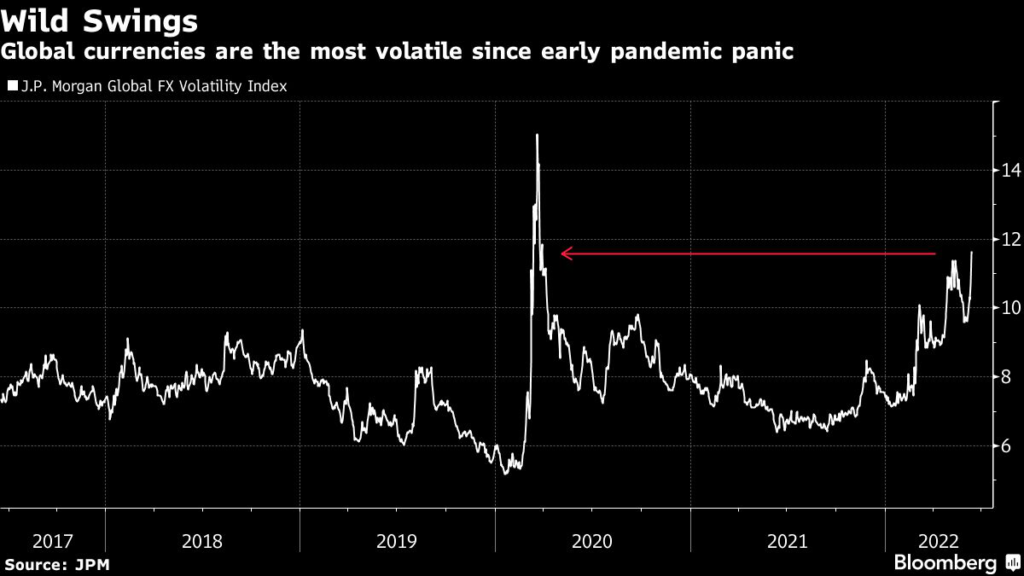
(Bloomberg) — Goldman Sachs Group Inc. is preparing to offer foreign-exchange prices that last for days to help fintechs, airlines and e-commerce firms avoid turbulence in the $6.6 trillion-per-day global currency market.
The Wall Street giant has begun quoting FX rates that last for minutes and plans to extend this in the coming weeks, according to Abbas Khamisa, executive director in FX solutions and structuring at the bank.
The aim is to help firms hedge risk and protect them from having to do hundreds of transactions at different rates.
Several other banks have offered similar services, but clients have reported challenges in accessing quotes efficiently and transparently, according to Goldman executives.
For most corporate treasurers right now, FX needs are typically managed through a combination of the spot market and forwards: instruments in which they pay a bank an agreed sum to conduct a trade in, say, several weeks or months at a pre-determined price.
Under Goldman’s offering, clients can expect to pay a premium, in the form of an added spread, to reflect the risk that exchange rates move against the bank’s position. The bank will vary its prices based on the volumes, currency pairs and amount of time the customer needs.
“Firms can request a quote ranging from minutes to hours, to days, to the weekend and eventually to months, with clients knowing exactly how much they are being charged,” Khamisa said in an interview.
“We’ve had a lot of interest.”
Companies from software giant Microsoft Corp. to dating conglomerate Match Group Inc. have warned investors and analysts of the perils of a strong dollar.
Tinder owner Match said in its first quarter earnings call in May that it was estimating a $40 million increase in full year foreign-exchange charges compared with the prior year, due to a rapidly weakening Japanese yen and euro.
Sarah Boyce, an associate director at the London-based Association of Corporate Treasurers, expressed caution about Goldman Sachs’s offering.
“Why is this better than me just doing a series of forward rates?” she said in an interview. “The thing to always remember is the treasury and finance team will need to explain it to the board, and they are not accountants or traders.”
Goldman’s guaranteed prices are different to forward rates because they give clients the flexibility to trade at a set rate rather than requiring them to do so, Khamisa said.
“When the client has certainty on the timings and notional of their exposure, then they can execute a trade,” he said. “This allows clients to price their goods and services in multiple currencies, without the challenges of forecasting and risk managing potential exposures in advance.”
Tom Auld, a Cambridge University academic and former high frequency trader, said the plans would likely suit both sides — provided clients are meeting corporate needs and aren’t betting on market moves.
“It makes a lot of sense if you’ve got an unsophisticated client who is not going to try and arbitrage the price, and may not be able to make a quick decision,” he said.
“Goldman Sachs will have to be very careful about who they field it to. They won’t give it to a hedge fund but they might give it to an SME or some other client that isn’t interested in arbitraging.”
Monex Europe Ltd., a client of Goldman’s, is preparing to offer the new service to its foreign exchange customers, according to Michael Quinn, a senior trader.
“Depending on how accurately Goldman’s solution is modeled — my understanding is that it remains a nascent product — this is potentially seismic for currency markets in applicable industries,” Quinn said in an email.
“The closest analogy of a similar new product introduction in the currency markets would be in the mid 2000s when held rates, which were directly linked to specific underlying deals, subsequently helped fuel an M&A boom.”
(Adds context in sixth paragraph.)
More stories like this are available on bloomberg.com
©2022 Bloomberg L.P.