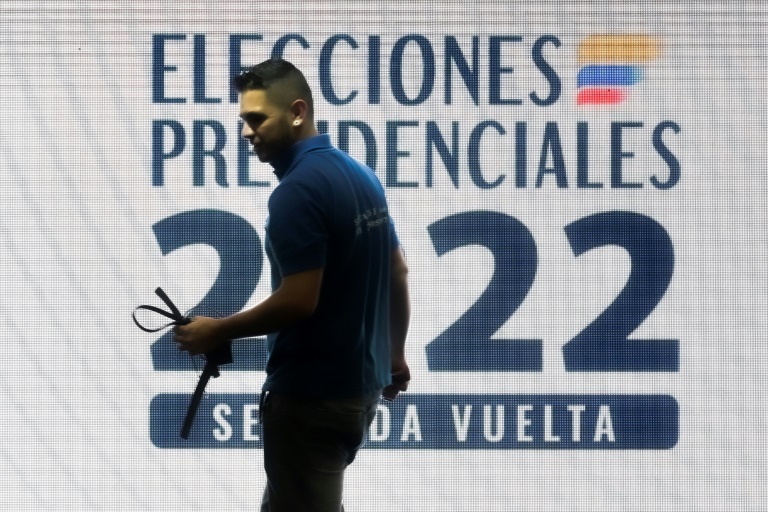
Colombians headed to the polls Sunday in a presidential election filled with uncertainty, as ex-guerrilla Gustavo Petro and millionaire businessman Rodolfo Hernandez vie for power in a country saddled with widespread poverty, violence and other woes.
Abstention is expected to be high as voters face a stark choice between electing their first ever left-wing president or plumping for a maverick outsider dubbed the Colombian Donald Trump.
“These are the tightest elections in the country’s recent history,” said the Sunday edition of the El Tiempo daily.
Amid fears a tight result could spark post-election violence, some 320,000 police and military have been deployed to ensure security.
Colombia is no stranger to political violence with five presidential candidates having been murdered over the course of the 20th century.
Several candidates received death threats before the first round.
Petro, 62, has repeatedly evoked the potential of fraud during the campaign and again raised his concerns Sunday.
“The projections put us well above the other candidate….
The only thing we still have to overcome is fraud,” he wrote on Twitter.
In response, the national registrar, Alexander Vega, denounced “disinformation.”
Although Petro comfortably topped last month’s first round with 40 percent, 12 points ahead of Hernandez, opinion polls have the two candidates neck and neck.
In Bogota, outgoing President Ivan Duque opened voting for Colombia’s 39 million voters at 8:00 am (1300 GMT).
Polls close at 4:00 pm, with early results expected a couple of hours after that.
Hernandez, 77, was amongst the early voters in the northern city of Bucaramanga, where he was mayor from 2016 to 2019.
– ‘Whoever wins, it won’t be good’ –
With the traditional political powers suffering a chastening first round defeat, a lot of early voters seemed undecided, not just about who to vote for but what the candidates represent.
Although Colombia has never had a left wing government before, Petro has been in politics for 30 years, while Hernandez is an unconventional outsider with little experience.
“Whoever wins today won’t be good but at least it will be a change,” said Valentina Rios, 19, who voted in Bogota.
“For me, neither of them represents change,” countered Alejandro Bueno, 20, an economics student in the capital, who hopes for “a peaceful transition to the next government.”
The successor to unpopular conservative Duque will have to deal with a country in crisis, reeling from the coronavirus pandemic, recession, a spike in drug-trafficking related violence and deep-rooted anger at the political establishment that spilled over into mass anti-government protests in April 2021.
Almost 40 percent of the country lives in poverty while 11 percent are unemployed.
Left-wing ideology is intrinsically linked in many Colombians’ minds to the country’s six-decade long multi-faceted conflict.
“Neither of the two is good … but the least bad is Rodolfo.
The other one was a guerrilla,” said Ruth Sepulveda, 56, a homemaker in Bucaramanga.
Petro was a radical leftist urban guerrilla in the 1980s and spent almost two years in jail.
But his M-19 group made peace with the state in 1990 and formed a political party.
“The worry comes from the experience of leftist governments in the region,” Patricia Munoz, an expert at Pontifical Javerian University, told AFP.
Michael Shifter, from the Inter-American Dialogue think tank, says fears Colombia could turn into another authoritarian populist socialist state like neighboring Venezuela “borders on hysteria.”
However, he said it’s understandable since Colombia has been effected more than any other Latin American country by “the Venezuela tragedy and nightmare.”
– ‘I’ll end corruption’ –
Until a few months ago, Hernandez was a virtual unknown outside of Bucaramanga.
He made the fight against corruption his main campaign pledge, although he himself is under investigation for graft.
He has vowed to “reduce the size of the state, end corruption and replace inept officials.”
But his other policies are unconventional and he lacks a clear program.
“As a businessman he’s used to resolving conflicts in a direct and quick way, but the exercise of governance requires dialogue, agreements, long meetings to find common ground,” said Munoz.
That will be Hernandez’s challenge if he is elected, given he has almost no representation in congress.
Whoever wins, for the first time Colombia will have a black woman vice president, either Petro’s running mate and environmentalist feminist Francia Marquez or conservative academic Mirelen Castillo.