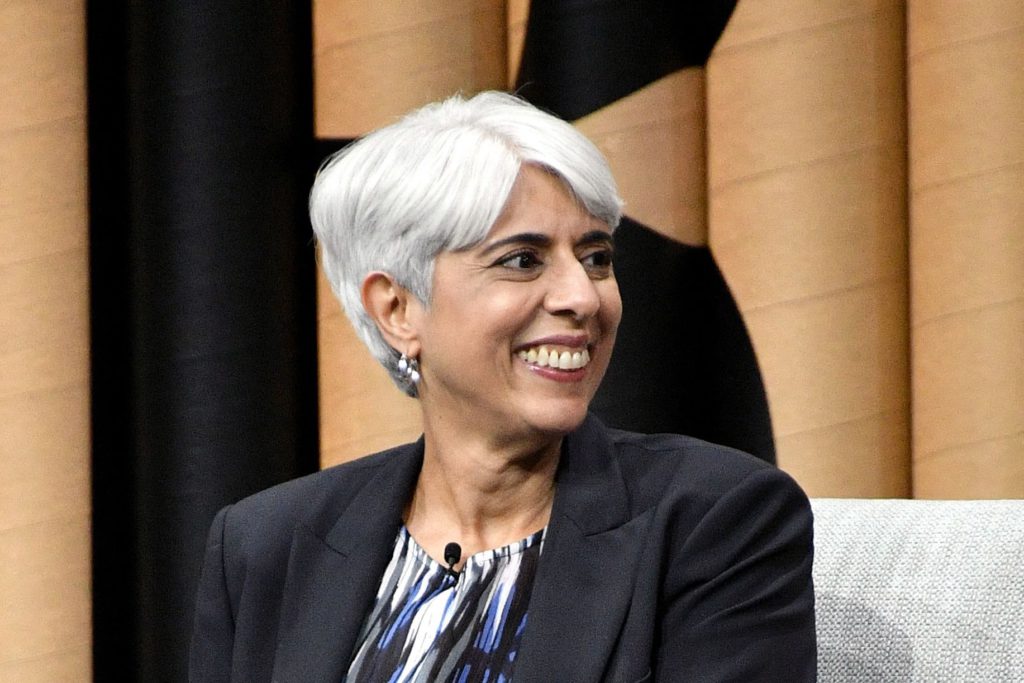
(Bloomberg) — President Joe Biden selected a former Defense Department innovation official, Arati Prabhakar, to serve as the next White House science adviser as his administration undertakes an effort to accelerate biomedical research.
She will replace Eric Lander, who resigned in February following reports he mistreated his staff.
As head of the Office of Science and Technology Policy, Prabhakar will work to “expand our possibilities, solve our toughest challenges, and make the impossible possible,” Biden said in a statement.
Prabhakar would be the first woman, person of color and immigrant confirmed by the Senate to lead the White House agency, if lawmakers approve her nomination.
Her portfolio will include issues ranging from climate change to the physical sciences.
Prabhakar, 63, also will play an essential role in Cancer Moonshot 2.0 — an initiative personally important to Biden that aims to cut the cancer death rate in half over the next 25 years.
Prabhakar will draw on her experience leading the Defense Advanced Research Projects Agency — a Pentagon entity that develops cutting-edge national security technologies, including precision-guided weapons and stealth technology — particularly as the administration stands up a new biomedical research accelerator.
She led DARPA from 2012 to 2017.
The new biomedical research program — the Advanced Research Projects Agency for Health, or ARPA-H — aims to shepherd medical breakthroughs the same way DARPA paved the way for the internet and GPS.
Prabhakar’s experience “will be invaluable as ARPA-H applies the DARPA model to drive biomedical and health breakthroughs that will address diseases affecting a significant number of Americans,” Sudip Parikh, chief executive officer of the American Association for the Advancement of Science, said in a a statement.
Prabhakar, who served as a DARPA program manager from 1986 to 1993, said during a STAT summit last year that ARPA-H should be separate from the National Institutes of Health, which aligns with a bill (H.R.
5585) the House is expected to consider Wednesday. That position differs from plans the administration already has undertaken to house ARPA-H within the NIH.
Prabhakar clocked nearly 15 years of experience in Silicon Valley between running DARPA during President Barack Obama‘s administration and leading the National Institute of Standards and Technology from 1993 to 1997.
She’s currently chief executive of Actuate, a nonprofit that aims to apply a DARPA-like approach to issues including climate change, chronic disease and the use of machine learning without compromising privacy.
Three other women have led the OSTP on an acting basis, including its current temporary director, Alondra Nelson.
Nelson is expected to return to her position as deputy director for science and society.
Lander resigned in February after a White House investigation found credible evidence he had bullied and spoken harshly to members of his staff.
(Adds comment in eighth paragraph)
More stories like this are available on bloomberg.com
©2022 Bloomberg L.P.