(Bloomberg) — US equity futures fell, stocks in Europe wavered and the dollar resumed its advance Thursday after high US inflation hardened expectations for more aggressive Federal Reserve monetary tightening that could trigger a recession.
The Stoxx Europe 600 index edged lower, led by telecom and real-estate shares.
S&P 500 and Nasdaq 100 contracts retreated ahead of the second-quarter earnings season, kicked off on Thursday by JPMorgan Chase & Co. and Morgan Stanley. An Asian share index dropped for the third time in four days.
Traders have shifted toward expectations of an historic one percentage-point Fed interest-rate hike later this month after the US consumer-price gauge clocked a 9.1% annual climb.
Fed Bank of Atlanta President Raphael Bostic said “everything is in play” to combat price pressures.
“It is clear that central banks around the world are laser-focused on fighting the entrenched inflation they helped to create, growth-be-damned,” said Jeffrey Halley, a senior market analyst at Oanda Asia Pacific Ltd.
“US markets are pricing in faster Fed tightening, and a recession is on the way imminently.”
The dollar pushed higher, hovering around the highest level in more than two years. Treasury two-year yields, sensitive to imminent Fed moves, climbed while longer-maturity rates were more stable.
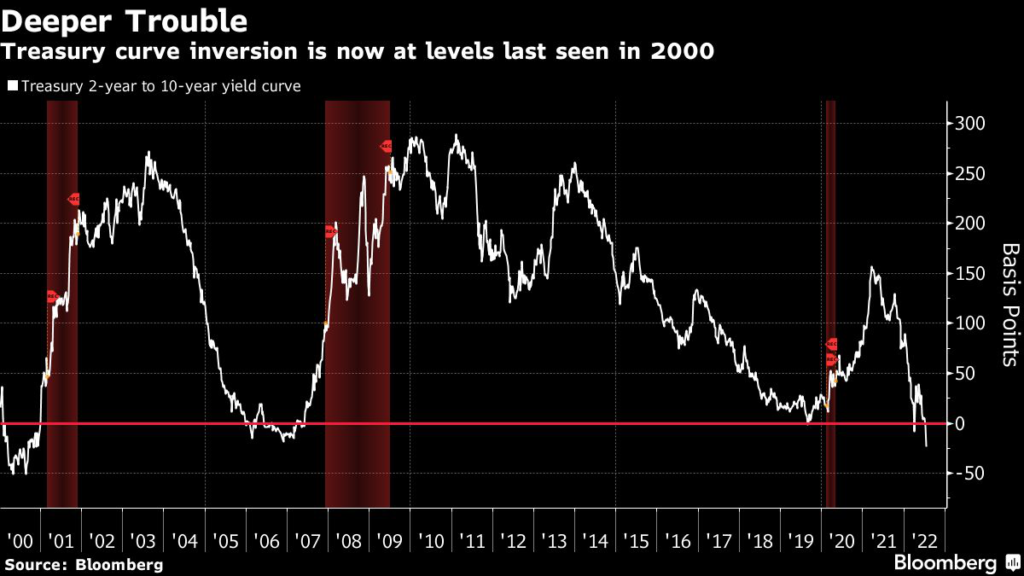
The inversion between two-year and 10-year yields — a potential recession indicator — is the deepest since 2000.
The euro fell back toward $1, after briefly dipping below it Wednesday, after Bloomberg reported that the European Commission had cut its growth forecast for the common-currency area.
Italy’s 10-year yield climbed more than 10 basis points as the country’s governing coalition appeared to be heading for a break-up.
The yen sank. Brent crude oil held below $100 a barrel. Bitcoin rallied past $20,000, weathering the bankruptcy filing of crypto lender Celsius Network.
The big question for markets is whether the latest US inflation print marks the peak.
Commodity prices, pushed up this year in part by supply disruptions related to Russia’s war in Ukraine, have moderated somewhat of late.
But if higher costs prove to be persistent and come alongside a global economy buckling under rate hikes, that could be toxic for a range of assets already nursing heavy losses in 2022.
At this point, markets may be getting ahead of the Fed, according to Danielle DiMartino Booth, Quill Intelligence chief strategist.
“We need to move the discussion onto how long is the recession going to be, how deep it’s going to be,” she added.
Fed Bank of Cleveland President Loretta Mester said in a Bloomberg Television interview the consumer-price report was uniformly bad and that the central bank will need to go well beyond the neutral level of rates.
The figures don’t suggest a smaller hike than in June, she added.
Swaps referencing Fed meetings are priced for the policy rate to peak at about 3.7% this December, up from the current target range of 1.50%-1.75%.
Traders then expect the Fed to start cutting rates to counter an economic slowdown.
What to watch this week:
- Earnings due from JPMorgan, Morgan Stanley, Citigroup, Wells Fargo
- US PPI, jobless claims, Thursday
- China GDP, Friday
- US business inventories, industrial production, University of Michigan consumer sentiment, Empire manufacturing, retail sales, Friday
- G-20 finance ministers, central bankers meet in Bali, from Friday
- Atlanta Fed President Raphael Bostic speaks, Friday
Will the eurozone avoid a recession or a debt crisis?
How will the euro and stocks perform in the next six months? Share your views and participate in the latest MLIV Pulse survey. It only takes a minute, so please click here anonymously.
Some of the main moves in markets:
Stocks
- The Stoxx Europe 600 fell 0.1% as of 8:22 a.m.
London time
- Futures on the S&P 500 fell 0.4%
- Futures on the Nasdaq 100 fell 0.4%
- Futures on the Dow Jones Industrial Average fell 0.3%
- The MSCI Asia Pacific Index fell 0.5%
- The MSCI Emerging Markets Index fell 0.2%
Currencies
- The Bloomberg Dollar Spot Index rose 0.5%
- The euro fell 0.4% to $1.0016
- The Japanese yen fell 1% to 138.82 per dollar
- The offshore yuan fell 0.4% to 6.7508 per dollar
- The British pound fell 0.4% to $1.1845
Bonds
- The yield on 10-year Treasuries advanced two basis points to 2.95%
- Germany’s 10-year yield advanced four basis points to 1.19%
- Britain’s 10-year yield advanced two basis points to 2.08%
Commodities
- Brent crude fell 0.6% to $98.95 a barrel
- Spot gold fell 0.9% to $1,720.43 an ounce
More stories like this are available on bloomberg.com
©2022 Bloomberg L.P.